
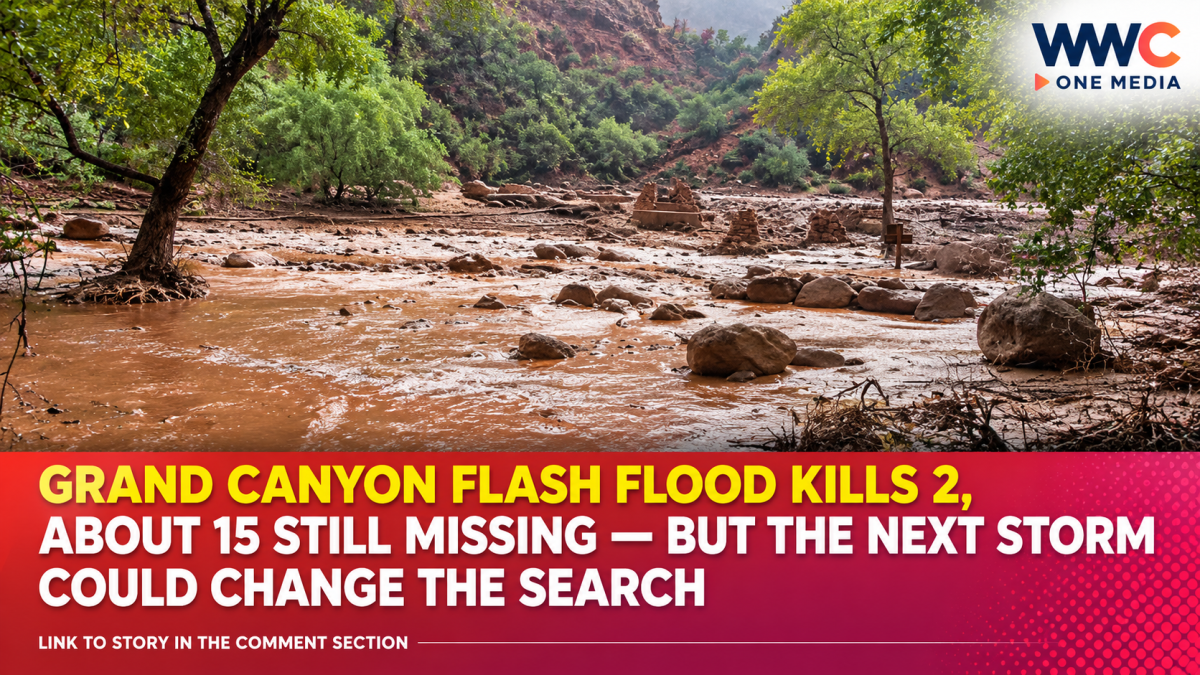
GRAND CANYON NATIONAL PARK, Arizona — Search crews were racing against dangerous weather at the Grand Canyon after a violent flash flood killed at least two people, left approximately 15 others missing or unaccounted for and tore apart critical infrastructure deep inside one of America’s most visited national parks.
The disaster unfolded at about 2:30 p.m. on Saturday, August 29, when intense rainfall sent floodwater surging through Bright Angel Canyon and the Phantom Ranch area. The torrent ripped through trails and footbridges and carried mud, rocks, logs and other debris toward the Colorado River.
By Monday, the National Park Service had confirmed the recovery of two bodies. One was a 46-year-old man found near Crystal Rapids along the Colorado River on Sunday. Details about the second victim were initially withheld by authorities.
Associated Press later reported that the family of Texas chiropractor John Giusti identified him as one of those who died. Two friends traveling with him, Brent Rosenkranz and Timothy Smith, were among people reported missing at the time of AP’s latest report.
But even as rescuers searched the canyon floor, another danger was developing overhead.
More storms put search crews under pressure
The National Weather Service placed the Grand Canyon area under a Flood Watch through midnight Monday local time, forecasting showers and thunderstorms and warning of renewed flash-flood potential.
That matters enormously in the Grand Canyon. Its steep walls and narrow drainages can funnel rainfall into fast-moving torrents even when storms occur miles away.
The danger may be particularly severe in areas affected by the 2025 Dragon Bravo wildfire. The National Park Service says the fire burned watersheds that drain toward Bright Angel Creek, leaving some areas more vulnerable to rapid runoff, flash flooding and debris flows during heavy rain.
AP also reported that scientists believe this year’s particularly wet Southwest monsoon has been influenced by a strong El Niño, which has helped increase atmospheric moisture. Researchers cited by AP say short-duration, intense summer downpours across the western United States have also strengthened in recent decades.
How many people are actually missing?
The number has shifted as authorities have tried to determine who was inside the canyon and who successfully escaped.
The National Park Service initially sought information about more than 20 people who might have been missing or unaccounted for. Its subsequently updated public-assistance notice put that figure at approximately 15.
That distinction is important: “unaccounted for” does not necessarily mean every person is trapped or presumed dead. Some hikers may simply have left the area without officials immediately being able to verify their safety.
As of Sunday morning, 62 people had been evacuated from Phantom Ranch and the lower North Kaibab Trail, with additional evacuations planned. The American Red Cross was assisting evacuees after they reached the South Rim.
Reuters reported accounts from survivors describing how quickly conditions deteriorated. One visitor said his group moved to higher ground shortly before a footbridge was swept away, while another group heard the approaching flood before escaping the area.
The flood didn’t just devastate trails — it hit the park’s lifeline
One of the biggest consequences may last far beyond the search operation.
Flooding badly damaged the 12.5-mile Transcanyon Waterline, the system carrying water from the inner canyon toward facilities on the South Rim. GMA, citing the National Park Service, reported that roughly 40% of the pipeline was damaged or destroyed.
The pipeline was already undergoing a massive modernization project. AP reports the rehabilitation and related water-system upgrades have a price tag of about $208 million and had been expected to be completed in 2027.
With the waterline knocked out, the National Park Service imposed Stage 4 water restrictions on the South Rim.
Overnight accommodations inside the park were halted beginning August 31, including El Tovar, Bright Angel Lodge, Maswik Lodge, Yavapai Lodge, Trailer Village and Phantom Ranch. Dry camping is being permitted, while wood and charcoal fires have been prohibited. The park remains open for daytime visitors, although services may operate on reduced schedules.
Major trails and crossings remain closed
The flood also severed important connections through the inner canyon.
The entire North Kaibab Trail, Phantom Ranch and Bright Angel Campground are closed, along with the Black and Silver bridges spanning the Colorado River. Other portions of the trail system remain accessible, but park officials are warning visitors to check conditions before entering the canyon.
For rescuers, however, the immediate question is not when tourists can return.
It is whether everyone who entered Bright Angel Canyon before Saturday’s wall of water can still be accounted for — and whether the weather will give search teams enough time to find them.
With two people already dead, families still waiting for news and thunderstorms capable of sending another surge through the canyon, the next storm may determine how difficult — and how dangerous — that search becomes.




Leave a Reply