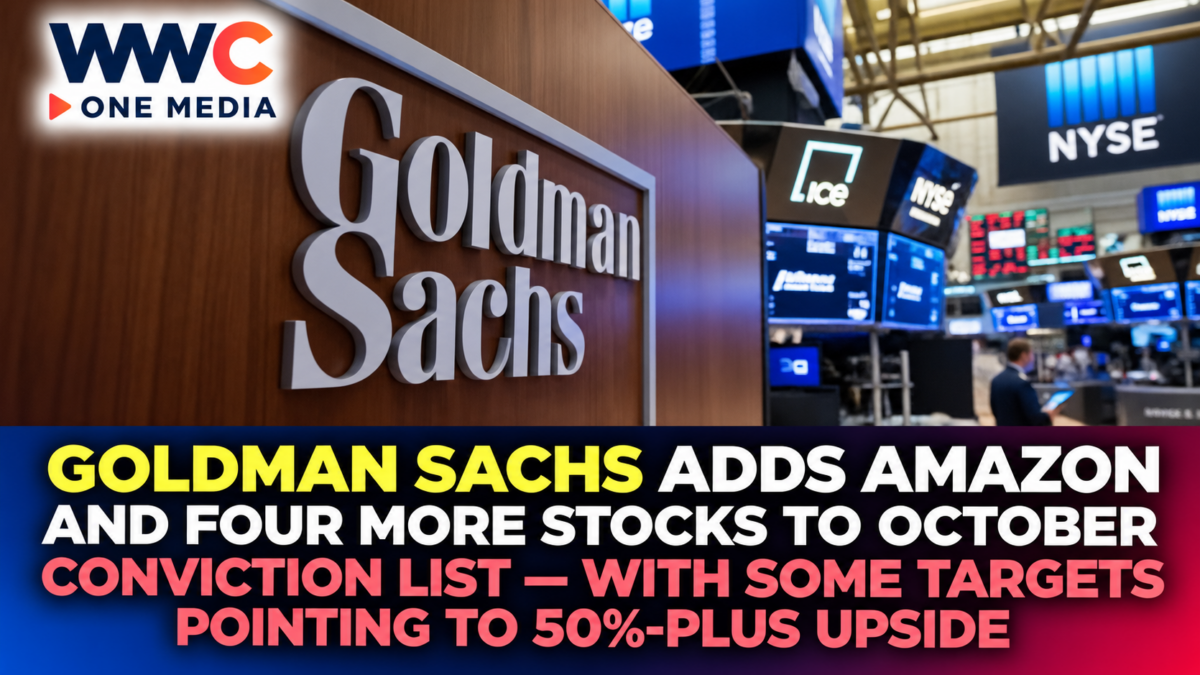
NEW YORK — Goldman Sachs has reshuffled one of Wall Street’s most closely watched stock-picking lists, adding Amazon, Burlington Stores, Huntington Ingalls, Johnson Controls and Occidental Petroleum as the investment bank searches for opportunities across artificial intelligence, defense, retail, data centers and energy.
Goldman’s October update to its:
U.S. Conviction List — Director’s Cut
does not concentrate on a single market theme.
Instead, the bank is spreading its highest-conviction calls across five very different businesses:
Amazon — AI, cloud computing, e-commerce and advertising
Burlington Stores — off-price retail
Huntington Ingalls — U.S. Navy shipbuilding
Johnson Controls — building systems and data-center cooling
Occidental Petroleum — oil production and enhanced recovery
Some of Goldman’s price targets imply unusually large potential gains.
Its published targets include:
Amazon — $375
Burlington Stores — $382
Huntington Ingalls — $439
Johnson Controls — $191
Occidental Petroleum — $69
Depending on the share price used when the list was published, those targets represented potential upside ranging from roughly:
25% to more than 60%.
But Goldman is not simply betting that these stocks rebound.
Each company has a separate fundamental catalyst the bank believes could drive earnings over the next several years.
AMAZON MAY BE THE BIGGEST NAME — BUT HUNTINGTON INGALLS HAS THE BIGGEST IMPLIED UPSIDE
Amazon immediately attracted attention because it is already one of the world’s largest companies.
Goldman set a:
$375 12-month price target
for the stock.
That represented more than:
50% upside
from levels around the time of the recommendation.
But the most aggressive target among the new additions belongs to defense contractor:
Huntington Ingalls Industries.
Goldman analyst Noah Poponak set a:
$439 price target
which represented potential upside of more than:
60%.
That means Goldman’s most bullish October conviction is not an AI stock.
It is America’s largest military shipbuilder.
AMAZON’S THREE-PART BULL CASE: AWS, RETAIL MARGINS AND ADVERTISING
Goldman analyst Eric Sheridan sees several growth engines working simultaneously at Amazon.
The first is:
Amazon Web Services.
AWS remains one of the largest cloud-computing platforms in the world.
Artificial intelligence is creating another enormous cycle of demand for:
Computing capacity
Data storage
AI accelerators
Networking
and
Cloud services.
Companies developing AI applications frequently do not want to build their own physical infrastructure.
They rent it from hyperscalers such as:
Amazon
Microsoft
and
Google.
Goldman believes the AI infrastructure boom can support continued AWS growth.
AMAZON IS SPENDING ENORMOUSLY ON AI
Amazon is investing heavily to capture that demand.
The company is building:
Data centers
AI chips
Power infrastructure
and
Cloud capacity.
AWS also offers Amazon-designed chips including:
Trainium
and
Inferentia
designed to reduce dependence on outside semiconductor suppliers and lower AI-compute costs.
Those investments are expensive.
But if AI demand remains strong, Goldman believes they could create years of cloud growth.
AMAZON’S RETAIL BUSINESS IS ALSO BECOMING MORE PROFITABLE
AWS is only part of Goldman’s thesis.
Amazon’s massive e-commerce operation has historically generated far lower margins than its cloud business.
But the company has spent years restructuring its fulfillment network.
Amazon divided its U.S. logistics system into more regionalized networks.
The objective was to place products closer to customers and reduce:
Shipping distances
Delivery times
and
Fulfillment expenses.
That strategy has helped improve retail profitability.
Goldman expects continued margin expansion to provide another earnings driver.
AMAZON’S AD BUSINESS IS QUIETLY BECOMING A GIANT
The third pillar is advertising.
Amazon owns one of the world’s most valuable sources of consumer purchase data.
Brands advertise directly on:
Amazon search results
Product pages
Prime Video
and other parts of its ecosystem.
Advertising is particularly attractive because it can carry much higher margins than physical retail.
That means faster growth in ads can raise Amazon’s overall profitability even if merchandise sales grow more slowly.
For Goldman, the combination of:
AWS
Retail efficiency
and
Advertising
creates several independent paths to earnings growth.
GOLDMAN IS BETTING ON BURLINGTON AFTER A PULLBACK
The second new conviction pick is:
Burlington Stores.
The off-price retailer has faced investor concerns over:
Consumer weakness
Weather
Inflation
and
Higher energy costs.
Its shares recently pulled back sharply.
Goldman analyst Brooke Roach sees that weakness as an opportunity rather than a sign that Burlington’s long-term growth story has broken.
Her target is:
$382.
At the time of the call, that implied substantial upside.
BURLINGTON IS BETTING ON VALUE-CONSCIOUS CONSUMERS
Burlington competes with businesses such as:
TJX Companies
and
Ross Stores.
Off-price retailers purchase branded merchandise at discounts and resell it below conventional department-store pricing.
This business model can perform well when consumers become more price sensitive.
Shoppers may still want:
Branded clothing
Home goods
and
Accessories
but become less willing to pay full price.
That environment can send more traffic toward off-price chains.
GOLDMAN EXPECTS BURLINGTON SALES TO GROW ABOVE 10%
Goldman expects Burlington’s revenue to grow:
more than 10% annually through 2028.
The thesis includes:
New store openings
Comparable-store sales growth above 3%
and
Improved merchandising.
Burlington has spent years trying to move closer to the operating model used by TJX and Ross.
That includes faster inventory turnover and more localized merchandise decisions.
If execution improves, Goldman believes margins can expand significantly.
BURLINGTON IS ALSO TARGETING AROUND 10% MARGINS
The retailer’s longer-term operating margin target is roughly:
10%.
That would represent an important improvement from historical levels.
Higher margins would allow profits to grow faster than revenue.
That operating leverage is central to Goldman’s thesis.
But the risks are straightforward.
If low- and middle-income consumers weaken substantially, even discount retailers can suffer.
A recession could reduce overall spending.
And competition in the off-price category remains intense.
HUNTINGTON INGALLS IS THE PUREST NAVY SHIPBUILDING BET
Goldman’s third addition is:
Huntington Ingalls Industries.
The company is one of the most strategically important defense contractors in the United States.
It builds major U.S. Navy vessels including:
Aircraft carriers
Nuclear-powered submarines
Amphibious assault ships
and other military ships.
Goldman calls it a relatively pure way to gain exposure to expanding U.S. naval shipbuilding.
That is increasingly important as Washington focuses on rebuilding maritime capacity.
U.S. SHIPBUILDING HAS BECOME A NATIONAL-SECURITY PRIORITY
The United States faces growing concern about the size and industrial capacity of its shipbuilding sector.
China operates the world’s largest navy by number of vessels and has an enormous commercial shipbuilding industry.
The U.S., by comparison, has fewer active shipyards capable of building sophisticated naval vessels.
Washington is therefore trying to increase:
Shipyard productivity
Submarine production
Maintenance capacity
and
Workforce development.
Huntington Ingalls sits at the center of that effort.
GOLDMAN SAYS SHIPBUILDING REVENUE IS ALREADY ACCELERATING
Goldman highlighted that Huntington Ingalls’ shipbuilding revenue has grown approximately:
15% to 20%
for four consecutive quarters.
That suggests the defense-spending cycle is already appearing in financial results.
The company also benefits from unusually long program durations.
An aircraft-carrier or submarine contract can generate work for years.
That gives defense shipbuilders significantly better revenue visibility than many industrial companies.
BUT SHIPBUILDING HAS ITS OWN EXECUTION PROBLEMS
The bullish case is not without risk.
U.S. naval shipbuilding has struggled with:
Labor shortages
Supply-chain bottlenecks
Cost overruns
and
Schedule delays.
Nuclear-submarine construction is especially complex.
A higher defense budget does not automatically translate into higher profits.
Huntington Ingalls still needs enough:
Welders
Engineers
Electricians
and
Suppliers
to deliver ships efficiently.
That execution risk partly explains why the shares underperformed earlier in 2026.
GOLDMAN SEES THAT WEAKNESS AS AN OPPORTUNITY
Huntington Ingalls shares were down roughly:
20% in 2026
before Goldman’s new recommendation.
Goldman believes the decline does not fully reflect the company’s long-term position.
Its:
$439 target
suggests one of the largest upside opportunities on the entire conviction list.
The bet is that stronger Navy budgets and improved shipyard execution can eventually restore investor confidence.
JOHNSON CONTROLS IS GOLDMAN’S DATA-CENTER INFRASTRUCTURE PLAY
The fourth addition is:
Johnson Controls International.
At first glance, the company may not look like an artificial-intelligence investment.
It makes systems for buildings, including:
Heating
Ventilation
Air conditioning
Controls
Security
and
Fire protection.
But AI data centers need enormous amounts of cooling.
That is turning Johnson Controls into an indirect beneficiary of the AI infrastructure boom.
AI SERVERS PRODUCE ENORMOUS HEAT
High-end GPUs and AI accelerators consume enormous amounts of electricity.
Much of that energy becomes:
Heat.
Data centers therefore require increasingly sophisticated cooling technology.
Traditional air conditioning is often insufficient for high-density AI racks.
Operators increasingly use technologies involving:
Liquid cooling
Chillers
Advanced HVAC systems
and
Building-management controls.
Johnson Controls sells many of these systems.
DATA-CENTER COOLING ORDERS HAVE RISEN MORE THAN 30%
Goldman analyst Joe Ritchie highlighted Johnson Controls’ data-center cooling business.
Orders have reportedly grown more than:
30%
for:
three consecutive quarters.
That helped push the company’s backlog to a record:
$21 billion.
Backlog gives investors visibility into future revenue.
And unlike AI software companies, Johnson Controls provides physical infrastructure that must actually be installed before data centers can operate.
GOLDMAN THINKS JOHNSON CONTROLS COULD MORE THAN DOUBLE EPS
Goldman’s thesis goes beyond data centers.
The bank believes Johnson Controls is in the early stages of a wider operational transformation.
Management has been simplifying the company and improving:
Margins
Execution
Portfolio focus
and
Cash generation.
Goldman believes earnings per share could:
more than double through 2028.
Its price target is:
$191.
That leaves meaningful upside even after Johnson Controls’ strong 2026 share-price performance.
DATA CENTERS MAY BE A MULTIYEAR INDUSTRIAL BOOM
This is one of the most important themes connecting Johnson Controls to Amazon.
Amazon and other hyperscalers are spending enormous amounts building AI infrastructure.
But those data centers need far more than chips.
They require:
Electricity
Transformers
Cooling systems
Generators
Construction
and
Grid connections.
That means the AI boom increasingly benefits old-economy industrial companies.
Johnson Controls is one example.
OCCIDENTAL PETROLEUM IS GOLDMAN’S ENERGY ADDITION
The fifth stock is:
Occidental Petroleum.
Goldman analyst Neil Mehta upgraded the stock from:
Neutral
to
Buy
and raised his price target from:
$63
to
$69.
At the time of the call, that implied approximately:
25% upside.
Occidental shares had already risen strongly during 2026, supported partly by higher crude-oil prices.
But Goldman believes more value remains.
OCCIDENTAL’S ADVANCED OIL RECOVERY IS CENTRAL TO THE THESIS
One reason Goldman likes Occidental is its expertise in:
Enhanced oil recovery.
Oil fields do not stop containing petroleum when conventional production begins declining.
A large amount can remain trapped underground.
Enhanced recovery techniques can potentially extract more.
Occidental has extensive experience using:
Carbon dioxide injection
and other methods to increase production from mature fields.
Goldman believes these techniques could add up to approximately:
2 billion barrels of oil equivalent
to the company’s recoverable resource base.
That could extend asset lives and improve returns.
GOLDMAN ALSO SEES $4 BILLION OF ADDITIONAL CASH FLOW
Cost reductions and operational improvements are another pillar.
Goldman believes Occidental could generate as much as:
$4 billion in additional cash flow by 2030.
That money could be used to:
Reduce debt
Return capital to shareholders
or
Fund future projects.
Debt reduction is particularly important because Occidental has carried substantial leverage from previous acquisitions.
HIGHER OIL PRICES ARE HELPING
The energy backdrop has also become more favorable.
Brent crude has recently traded above:
$100 per barrel
amid geopolitical disruption and tight global fuel markets.
Higher oil prices generally increase cash flow for producers such as Occidental.
But they also introduce risk.
Oil can be extremely volatile.
A geopolitical de-escalation or global recession could push crude prices sharply lower.
That would weaken part of Goldman’s investment thesis.
WARREN BUFFETT’S BERKSHIRE REMAINS A MAJOR OCCIDENTAL SHAREHOLDER
Occidental has also attracted attention because:
Berkshire Hathaway
owns a large stake in the company.
Warren Buffett’s investment has helped reinforce Occidental’s profile among long-term investors.
But Berkshire’s ownership is not a guarantee of future share-price performance.
Goldman’s recommendation is based primarily on:
Operations
Resource potential
Cash flow
and
Valuation.
GOLDMAN REMOVED FIVE STOCKS AT THE SAME TIME
The additions were only half of the October reshuffle.
Goldman removed:
Air Products and Chemicals
ConocoPhillips
Golar LNG
Loar Holdings
and
Tyson Foods.
A removal does not automatically mean Goldman believes a stock should be sold.
The Conviction List is designed to represent the firm’s most differentiated high-conviction Buy ideas.
A stock can remain Buy-rated even after leaving the list.
That distinction matters.
CONOCOPHILLIPS IS THE MOST INTERESTING REMOVAL
ConocoPhillips had gained approximately:
36.6% year to date
when Goldman removed it.
That demonstrates how the list works.
A company may leave not because its fundamentals deteriorated, but because:
valuation changed
or
another stock now offers a more compelling risk-reward profile.
Occidental replacing ConocoPhillips suggests Goldman currently sees greater incremental upside in OXY.
GOLDMAN’S LIST IS NOT A SHORT-TERM TRADING SCREEN
The U.S. Conviction List — Director’s Cut was launched in:
2023.
Goldman’s Investment Review Committee selects approximately:
20 to 25 Buy-rated U.S. stocks
from across the firm’s research coverage.
The selections focus on:
Fundamentals
Differentiated analyst views
Risk-adjusted return potential
and
Upcoming catalysts.
The list is refreshed monthly.
That means additions and removals can happen relatively quickly as analyst assumptions or valuations change.
PRICE TARGETS ARE NOT GUARANTEES
This is perhaps the most important point for readers.
A:
$375 Amazon target
does not mean Amazon will trade at $375.
A:
$439 Huntington Ingalls target
does not mean the shipbuilder will rise 60%.
These are analysts’ estimates based on assumptions about:
Revenue
Margins
Cash flow
Valuation multiples
and
Industry conditions.
If those assumptions change, price targets can change rapidly too.
Goldman’s own conviction list is updated every month for exactly that reason.
AMAZON COULD FACE AI-SPENDING RISK
Goldman’s Amazon thesis depends partly on strong AI infrastructure demand.
But AI capital spending is reaching unprecedented levels.
Hyperscalers may spend hundreds of billions of dollars annually building capacity.
If customer demand fails to generate sufficient returns, companies could eventually slow that investment.
That would affect:
AWS
and
Amazon’s semiconductor infrastructure.
The market is already debating whether AI investment is becoming excessive.
BURLINGTON DEPENDS ON THE CONSUMER
Burlington’s main vulnerability is much more traditional.
Consumers.
If unemployment rises significantly or household finances deteriorate, spending on apparel and home goods could weaken.
Off-price retail sometimes gains share in difficult economic environments.
But it is not recession-proof.
Burlington still needs shoppers entering stores and buying discretionary products.
HUNTINGTON INGALLS DEPENDS ON GOVERNMENT EXECUTION
For Huntington Ingalls, congressional defense spending is only part of the equation.
The company also needs:
Stable contracts
Skilled labor
Shipyard productivity
and
Supply-chain performance.
The Pentagon can authorize more ships.
But building nuclear-powered warships efficiently remains one of the most complicated industrial tasks in the world.
JOHNSON CONTROLS DEPENDS ON THE AI BUILDOUT CONTINUING
Johnson Controls could benefit significantly from data-center expansion.
But the AI infrastructure boom is capital-intensive.
If cloud companies reduce data-center spending, cooling-equipment demand could eventually weaken.
At the moment, however, order growth and backlog suggest the cycle remains strong.
OCCIDENTAL DEPENDS HEAVILY ON COMMODITY PRICES
Occidental’s cash generation remains sensitive to:
Oil
and
Natural gas prices.
Advanced recovery technology can improve production economics.
Cost cuts can help.
But neither eliminates commodity risk.
If crude prices drop sharply, cash-flow estimates can fall quickly.
That makes OXY fundamentally different from Goldman’s other new additions.
THE FIVE PICKS SHOW HOW BROAD THE CURRENT BULL MARKET HAS BECOME
Perhaps the most interesting part of the October list is its diversity.
Only one of the five picks is a giant technology platform:
Amazon.
The others represent:
Retail
Defense manufacturing
Building infrastructure
and
Oil production.
That suggests Goldman sees opportunities beyond the small group of mega-cap technology companies that dominated much of the earlier stock-market rally.
AI STILL CONNECTS MORE OF THE LIST THAN IT FIRST APPEARS
Artificial intelligence nevertheless runs through several picks.
Amazon provides:
AI computing.
Johnson Controls cools:
AI data centers.
Huntington Ingalls may benefit indirectly from increased use of:
Autonomy
AI-enabled defense systems
and broader military modernization.
Even energy companies could benefit from higher electricity and infrastructure demand associated with AI.
So while Goldman is diversifying sectors, AI remains one of the economic forces underneath the portfolio.
DEFENSE IS ANOTHER STRUCTURAL THEME
Huntington Ingalls reflects another major investment trend:
Higher global defense spending.
Countries across:
North America
Europe
and
Asia
are increasing military budgets.
The United States is also focused on expanding naval and industrial capacity.
That creates long-term demand for companies that can manufacture complex defense platforms.
Unlike consumer trends, military procurement cycles can last decades.
ENERGY REMAINS IMPOSSIBLE TO IGNORE
Occidental’s inclusion shows energy remains relevant even in an AI-driven market.
Modern economies still depend heavily on:
Oil
Natural gas
and
Refined fuels.
Geopolitical conflict has pushed oil above $100 per barrel in recent periods.
Meanwhile, AI data centers themselves require enormous amounts of electricity.
The energy system therefore remains central to both the old economy and the new one.
GOLDMAN EXPECTS MARKET CONDITIONS TO BECOME MORE CONSTRUCTIVE
Goldman’s October update also reflects its broader market outlook.
Strategists believe several major risks are increasingly being reflected in prices.
These include:
Interest rates
Oil
and
Geopolitical uncertainty.
That does not mean volatility is over.
But Goldman appears more willing to take targeted stock risk where analysts see strong company-specific catalysts.
HIGH TREASURY YIELDS STILL CREATE A CHALLENGE
The 10-year U.S. Treasury yield recently climbed above:
5%.
That creates stiff competition for equities.
Investors can earn substantial income from government bonds without assuming company-specific risk.
Stocks therefore need to offer:
Strong earnings growth
or
Compelling valuation upside
to remain attractive.
Goldman’s five October additions are essentially companies where its analysts believe the expected growth justifies taking that extra risk.
THE BIGGER STORY: GOLDMAN IS NOT BETTING ON ONE MARKET — IT IS BETTING ON FIVE DIFFERENT ECONOMIC ENGINES
The October Conviction List is more interesting than a simple collection of five stock symbols.
Each pick represents a different economic bet.
Amazon is a bet that AI computing, e-commerce efficiency and digital advertising keep expanding.
Burlington is a bet that value-conscious consumers continue migrating toward off-price retail.
Huntington Ingalls is a bet that Washington finally spends enough money rebuilding U.S. naval capacity.
Johnson Controls is a bet that the AI data-center boom creates a multiyear infrastructure cycle far beyond semiconductor companies.
And Occidental Petroleum is a bet that higher-value oil recovery, stronger cash flow and disciplined capital allocation can unlock more value from existing energy assets.
That breadth is important.
Wall Street’s rally is no longer just about buying the largest AI chipmaker or the biggest technology platform.
Goldman is looking for companies that benefit from the second-order effects of the new economic environment:
More computing
means more cloud demand.
More data centers mean more cooling.
More geopolitical tension means more warships.
Higher living costs mean more demand for discount retail.
And tight energy markets keep oil economics relevant.
But Goldman’s conviction does not eliminate risk.
These companies still have to execute.
And the most aggressive call—Huntington Ingalls at $439—requires a potential gain exceeding 60% from the level around the time of Goldman’s recommendation.
That is why the October list is attracting attention.
Goldman Sachs is not simply saying these five companies can outperform — it is betting that several of Wall Street’s biggest themes are only beginning to show up in their earnings.