
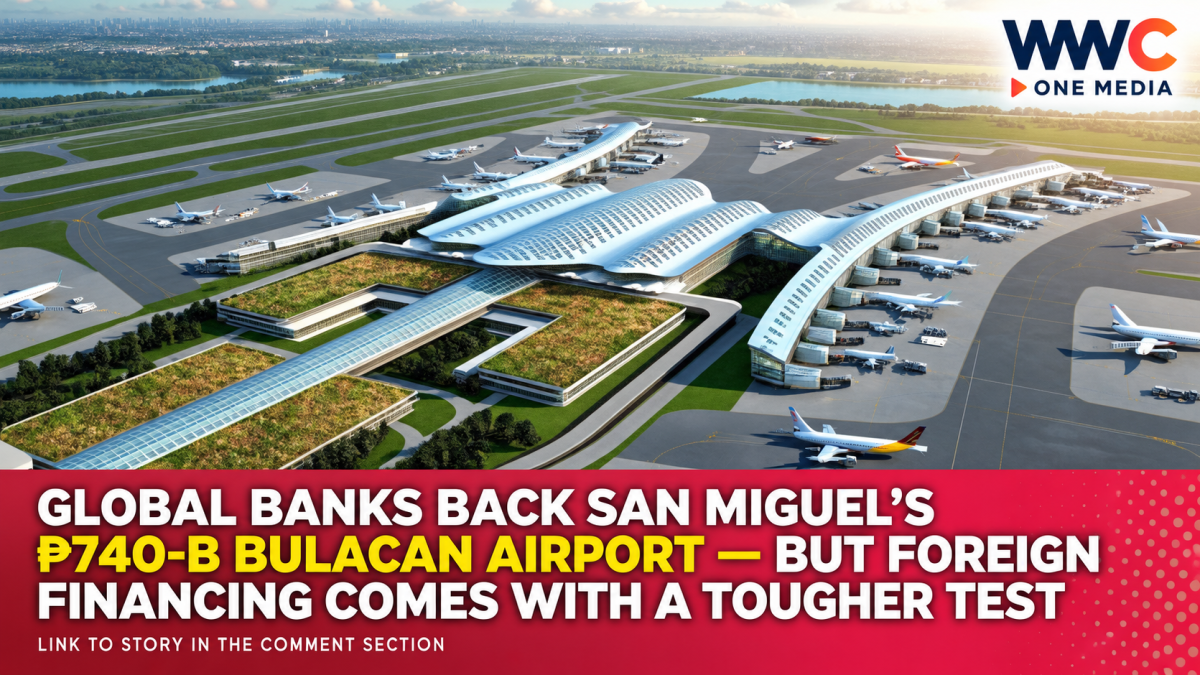
MANILA, Philippines — San Miguel Corp.’s massive New Manila International Airport in Bulacan is drawing financial and technical support from some of the world’s biggest banking and engineering groups, giving one of the Philippines’ most ambitious infrastructure projects a significant international vote of confidence.
But the foreign money comes with something else: intense scrutiny over whether the airport can meet global environmental, social and climate-resilience standards while rising from a flood-prone coastal area of Bulacan.
San Miguel Chairman and CEO Ramon S. Ang said the financing behind the airport development is coming from foreign lenders rather than Philippine banks.
“Those financing this airport development are all foreign banks from Europe. We did not borrow the money here,” Ang told reporters, according to InsiderPH. He said the international financing requires the project to comply with stringent global standards.
The statement puts a fresh spotlight on how heavily the ₱740-billion New Manila International Airport, or NMIA, has tapped international capital and engineering expertise as San Miguel races toward its planned first runway opening by the end of 2028.
The financial firepower behind Bulacan airport
Publicly available records show that the airport has already attracted a heavyweight roster of global financial institutions.
Project-finance publication IJGlobal previously reported that lenders involved in the airport’s roughly $2.17-billion Phase 1 debt package included Standard Chartered, SMBC, KfW, HSBC, MUFG, ANZ and ING, with Atradius providing insurance support. The financing was tied primarily to land-development works.
A Dutch government disclosure separately identifies SMBC Bank International in London as a financier for an Atradius-covered facility linked to land development at the airport. The insurance carried a maximum liability of about $1.73 billion.
That history adds context to Ang’s latest statement. While he characterized the airport’s current financing as coming from European foreign banks, earlier publicly disclosed financing involved a broader international group that included European, Japanese and Australian institutions.
That distinction matters: San Miguel has not publicly named every lender covered by Ang’s latest remarks, so claims about the present financing syndicate should remain attributed to the SMC chief rather than treated as a complete published lender list.
Dutch government support helped unlock the project
One of the most important pieces of international backing came from the Netherlands.
In 2022, the Dutch government, through Atradius Dutch State Business, approved export credit insurance connected to Dutch engineering and dredging giant Royal Boskalis Westminster’s €1.5-billion land-development contract for the airport.
GMA News reported at the time that San Miguel described the support as a major milestone for the project. The Boskalis contract was also described as the largest project in the Dutch company’s century-plus history, while the Atradius coverage was then its largest export credit insurance policy.
The Philippine Daily Inquirer similarly reported that the insurance protects against certain nonpayment risks—a mechanism that can make large and complicated infrastructure projects more bankable to international lenders.
Boskalis has remained involved in technical supervision even after the bulk of the land-development work, according to Ang.
Why international lenders care about flooding
Foreign financing is particularly significant because NMIA is being developed in a low-lying coastal area where flooding, subsidence, storm surges and future sea-level rise have become major points of public debate.
San Miguel says those risks were incorporated into the airport’s engineering from the beginning.
Danish engineering specialist DHI modeled rivers, coastal waters, extreme storms, sea-level rise and land subsidence around the airport site. UK engineering consultancy Mott MacDonald later reviewed and integrated the hydrological data as the development sought compliance with international lender requirements.
The airport platform is designed to sit roughly 3.85 to 5.50 meters above mean sea level, according to San Miguel Aerocity. The company maintains that the project’s drainage and river-management system was designed not only to protect the airport but also to prevent the development from worsening flooding in surrounding communities.
The Philippine Star reported this week that San Miguel Aerocity continues to reject allegations that the airport itself has aggravated flooding in Bulacan, pointing to hydrological studies dating back to 2018.
The issue remains contested. Environmental organization Global Witness has previously raised concerns about climate exposure, community impacts and the long-term viability of the coastal airport site, while noting that international banks including ING, HSBC and Standard Chartered have been involved in financing.
San Miguel disputes claims that the development caused Bulacan’s recent flooding, arguing that low elevation, constrained waterways and long-standing drainage problems predate the airport. The Philippine Daily Inquirer reported Ang making that case after residents and environmental groups again raised concerns following severe flooding.
Airport passed through an international lender review
NMIA’s international financing story goes beyond commercial loans.
Earlier this year, San Miguel Aerocity presented the project at the 12th OECD Workshop for Financial Institutions in Paris, attended by export credit agencies, development institutions, commercial lenders and environmental specialists from OECD member countries.
The airport was discussed as a case study in applying the International Finance Corporation Performance Standards and Equator Principles, two widely used frameworks for assessing environmental and social risks in major infrastructure financing.
Atradius Dutch State Business representative Marije Hensen said the project demonstrated how lenders, consultants and developers could work together toward compliance with international standards after assessing the project before deciding to support it.
For San Miguel, meeting those standards is more than a reputational exercise. Compliance can affect whether global banks continue lending, whether export-credit protection remains available and how easily the company can raise the billions of dollars still required for later phases.
The next deadline: 2028
The financing push is unfolding as construction enters a decisive phase.
Ang said this week that San Miguel is targeting the first runway for completion toward the end of 2028, followed by a second runway in 2029. Additional runways could be added annually until the planned four-runway system is completed around 2032, depending on passenger demand.
One runway could accommodate roughly 35 million passengers a year, according to Ang, with capacity rising to around 70 million with two runways and eventually more than 100 million as the airport expands.
The project has experienced delays, including shortages of suitable backfill material. San Miguel previously said restrictions affecting sand sources after the government’s Manila Bay reclamation review slowed construction and added substantial costs.
Still, the scale of international financing and technical participation suggests the project is far beyond being merely a domestic corporate bet.
It has become a test of whether the Philippines can deliver a privately led infrastructure project of global scale while satisfying the banks, insurers and engineering specialists whose money and reputations are tied to its success.
And that may be the bigger story behind the foreign lenders lining up behind Bulacan: their support gives the airport financial credibility—but it also ensures that every environmental, engineering and construction decision will face international scrutiny all the way to opening day.
WWC ONE MEDIA M.J.E

Leave a Reply