
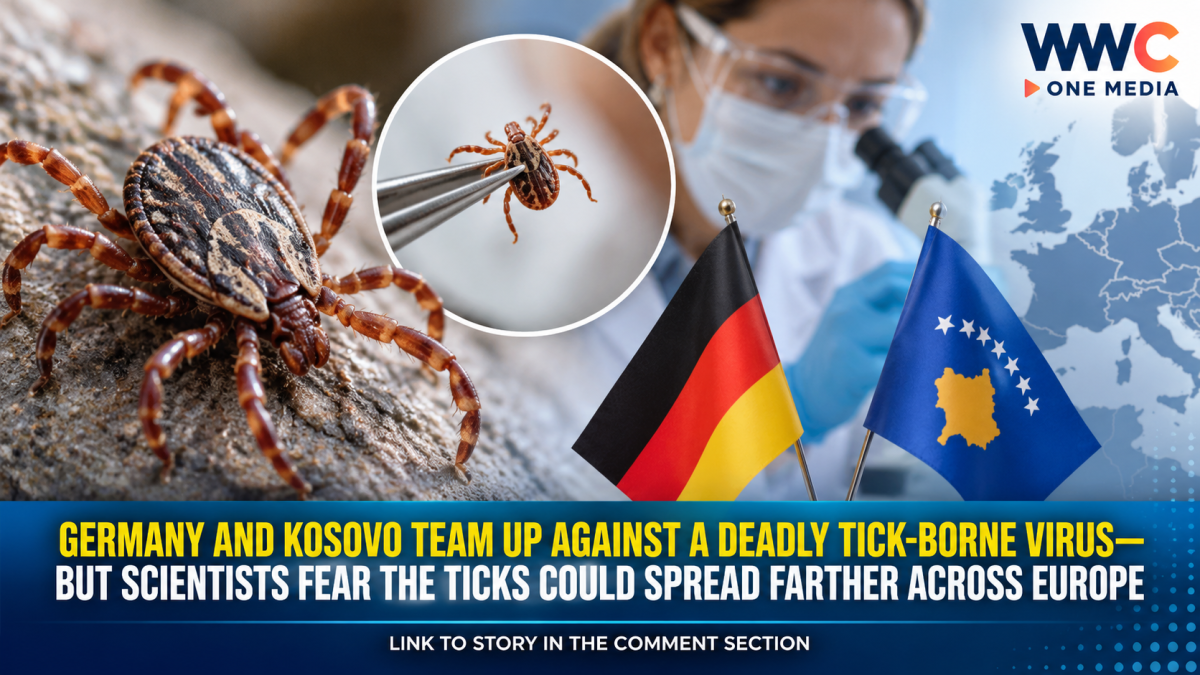
BERLIN/PRISTINA — German and Kosovar scientists are strengthening cooperation to monitor Hyalomma ticks and the potentially deadly Crimean-Congo hemorrhagic fever (CCHF), as changing environmental conditions raise concerns that disease-carrying ticks could establish themselves farther north in Europe.
The unusually large Hyalomma tick, sometimes described as a “hunting tick,” differs from many common ticks because it can actively pursue its hosts rather than simply wait in vegetation. Deutsche Welle reported that the species, historically associated with Africa, Asia and southern Europe, has increasingly been detected farther north, including in Germany and parts of Eastern Europe.
The concern goes beyond the tick itself.
Some Hyalomma ticks can transmit CCHF virus, which causes Crimean-Congo hemorrhagic fever — a serious viral disease that can result in severe bleeding, organ failure and death. The World Health Organization says CCHF has a case-fatality rate of roughly 10% to 40%, although outcomes vary depending on several factors.
Why Kosovo is important
Kosovo has longstanding experience dealing with CCHF and Hyalomma ticks, while Germany has high-security laboratories and specialized expertise in studying dangerous pathogens.
The German-Kosovar scientific partnership grew from concerns over the disease in Kosovo and has included surveillance, laboratory cooperation, research and public education. According to Deutsche Welle, the collaboration has received support through Germany’s Biosecurity Program.
Researchers say the partnership benefits both sides: Kosovo provides important field experience and access to patients and affected areas, while German institutions contribute laboratory capabilities and diagnostic expertise.
The cooperation has also focused on educating farmers and communities about how CCHF can spread.
That is particularly important because infection does not require a tick to bite a person.
People can also be infected through animals
The WHO says people can contract CCHF after being bitten by an infected tick or through contact with infected animal blood or tissues, particularly during or immediately after slaughter.
Farmers, livestock workers, veterinarians, hunters and slaughterhouse workers are therefore among those at greater risk. Healthcare workers can also face exposure when caring for infected patients without appropriate infection-control precautions.
In Kosovo, researchers have emphasized the danger faced by farmers who remove ticks from livestock with their bare hands. If infected animal blood comes into contact with an open wound, transmission can occur.
Is the virus already spreading across Germany?
There is an important distinction.
Hyalomma ticks have been found in Germany, but Germany has not been established as a country with locally acquired CCHF transmission in the latest European surveillance data.
The ECDC’s latest weekly surveillance report, based on data through September 2, 2026, recorded four locally acquired CCHF cases in Europe during 2026 — all in Spain. Three were associated with tick bites in Salamanca and one with a tick bite in Ciudad Real. One of the four patients died.
Germany’s Robert Koch Institute likewise identifies Hyalomma ticks as an important vector and reservoir associated with CCHF, while German health authorities continue to monitor the risk.
Germany’s official health information service has previously noted that CCHF virus had not been detected in Hyalomma ticks found in Germany, even though the ticks themselves have been observed there.
Climate change adds another layer of concern
Scientists are watching the geographic expansion of Hyalomma ticks closely because warmer conditions can make parts of Europe increasingly suitable for species that were previously concentrated farther south.
ECDC data released in June 2026 show that the known European distribution of Hyalomma marginatum has expanded, with new administrative areas reporting the species. ECDC also maintains updated maps tracking Hyalomma populations across Europe.
The WHO has similarly warned that the potential for CCHF to occur farther north in Europe is increasing because of factors including climate change and the movement of ticks and their animal hosts.
No widely available vaccine
One of the biggest challenges is that there is currently no approved vaccine for CCHF, and there is no specific treatment that has been universally established as a definitive cure.
Treatment is primarily supportive, with doctors managing complications and providing intensive medical care when necessary. WHO notes that ribavirin has shown potential benefits in some circumstances, but more research is needed to establish its effectiveness.
Symptoms can initially resemble other infections, including fever, headache, muscle aches, dizziness, abdominal pain, nausea and vomiting. Severe illness can progress to bleeding, organ failure and other life-threatening complications.
What travelers and outdoor workers should know
Health authorities stress that people should not panic over the presence of Hyalomma ticks.
Most tick encounters do not result in CCHF infection. However, people visiting areas where CCHF occurs should take precautions against tick bites.
WHO recommends wearing protective clothing, checking the body for ticks after outdoor activities and removing attached ticks promptly using fine-tipped tweezers. People who develop concerning symptoms after a tick bite or contact with potentially infected animals should seek medical attention and tell healthcare professionals about their possible exposure.
For Germany and Kosovo, the cooperation represents a broader strategy: detect the tick, track the virus and strengthen preparedness before the threat becomes harder to contain.
For European health authorities, the message is increasingly clear — the biggest danger may not be where the virus is today, but where its vectors could establish themselves tomorrow.
WWC ONE MEDIA J.M.S




Leave a Reply