
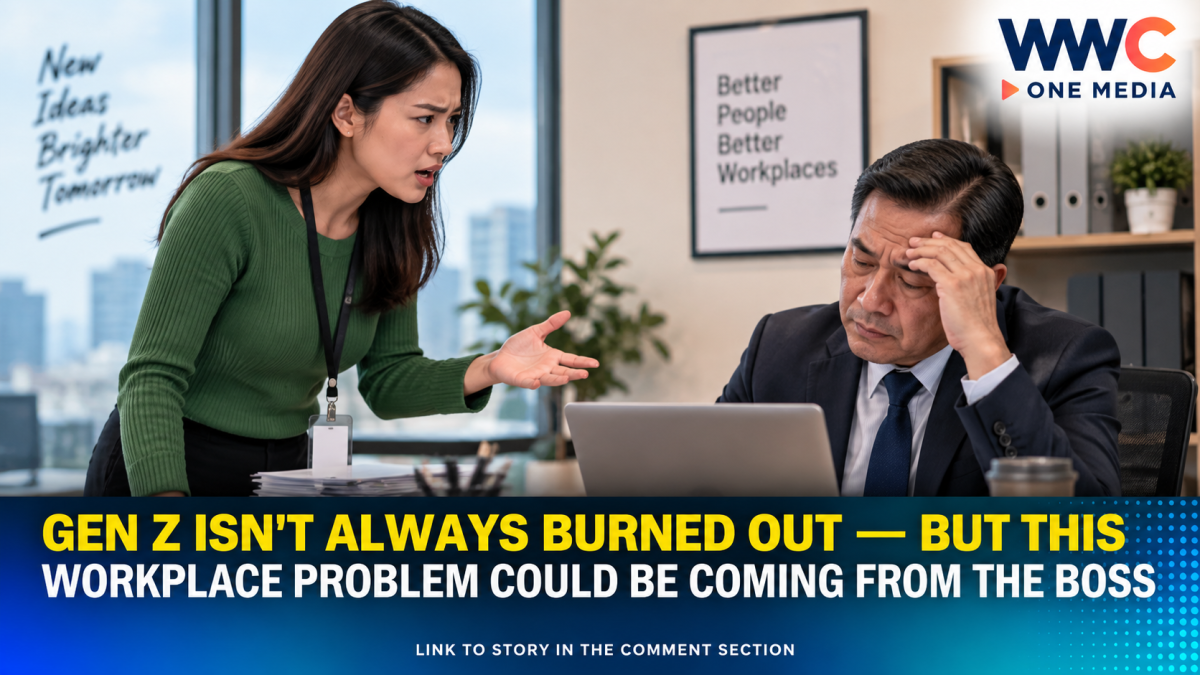
What if an employee who says, “I’m overwhelmed,” isn’t necessarily burned out?
That question is at the center of a new CNA commentary by business founder Joanne Chia, who reflects on her own experiences as a manager and employer — and how her understanding of workplace burnout changed dramatically over time.
Chia, founder of hair-care brand Rehues, says she once believed she was suffering from burnout when she was actually struggling with the steep learning curve that came with becoming a manager. Years later, she experienced what she describes as genuine burnout — and the difference was much harder to ignore.
The burnout warning signs may not look dramatic
Chia’s first experience involved stress, exhaustion and the emotional pressure of managing other people. She found herself replaying difficult conversations with employees and worrying for days about whether she had handled them correctly.
At one point, she even blamed her exhaustion on dealing with younger, particularly Gen Z, employees who questioned decisions and wanted to understand the reasoning behind instructions. But she later realised that she was also learning how to become a manager — and that she had not yet developed the skills to handle those responsibilities confidently.
Her later experience was different.
As a business founder, she began carrying work mentally even when she was physically away from it. Sleep stopped feeling restorative, small problems became disproportionately irritating, routine tasks felt exhausting and even professional achievements quickly lost their satisfaction.
That distinction is important because the World Health Organization defines burnout as a consequence of chronic workplace stress that has not been successfully managed. It describes three major dimensions: exhaustion, growing mental distance or cynicism toward one’s job, and reduced professional effectiveness. WHO classifies burnout as an occupational phenomenon rather than a medical condition.
Gen Z may be changing what employees expect from bosses
The debate over younger workers is becoming increasingly important across Asian workplaces.
A recent CNA Money Mind survey of 3,628 people aged 21 to 29 across Singapore, Malaysia, Indonesia, Thailand, the Philippines, China and India found that Gen Z workers are using AI to become faster and more productive — but many also say the productivity gains have resulted in higher expectations from employers.
In China, 85% of employed respondents who use AI agreed that the technology had increased expectations to produce more work in the same amount of time. The figure was 82% in India and 69% in both Singapore and Indonesia.
That creates a difficult workplace equation: technology can save time, but employers may quickly turn that saved time into additional output.
For younger workers, meanwhile, expectations are shifting toward clearer boundaries, meaningful feedback and managers who explain the purpose behind their work.
The “Gen Z problem” may actually be a management problem
This is where the story gets more complicated.
A 2026 Singapore Workplace Report from Gallup and the Singapore Institute of Directors highlights a growing generational divide, but warns against reducing the issue to stereotypes about younger workers being fragile or unwilling to work.
The report says younger employees often want a more “productive and protective” relationship with managers — one that combines efficiency and direct communication with guidance and protection from avoidable workplace friction.
At the same time, some business leaders interviewed for the report expressed concerns about reduced willingness among younger employees to work long hours or weekends, particularly in industries where such availability has traditionally been expected.
That tension is real.
But it doesn’t necessarily mean one generation is right and the other is wrong.
It could signal that the old definition of workplace commitment is colliding with a new understanding of productivity, boundaries and employee wellbeing.
Managers have more influence than many companies realise
The issue isn’t simply about Gen Z.
Gallup’s workplace research has consistently found that managers have an enormous influence on employee engagement. Its research estimates that managers account for about 70% of the variance in team-level engagement.
That means an employee’s experience can be shaped dramatically by the person immediately supervising them.
A talented employee placed under an unclear, overwhelmed or unsupportive manager may struggle. Conversely, a strong manager can help an employee navigate difficult assignments without allowing temporary stress to become chronic workplace strain.
This is why Chia argues that employers need to distinguish between a capacity problem and a capability problem.
Is the employee carrying too much?
Or are they learning something difficult for the first time?
Sometimes, the answer can be both.
The danger is getting the response wrong
Chia argues that employers should resist two extremes: immediately telling struggling employees to “toughen up,” or automatically removing every difficult responsibility from them.
Both responses can fail.
An inexperienced employee may genuinely need time, training and guidance to develop.
But if priorities constantly change, everything is treated as urgent and employees don’t know what good performance actually looks like, the problem may lie with the organisation rather than the worker.
That distinction could become increasingly important as workplaces become more demanding and AI accelerates the pace of work.
The goal isn’t to eliminate every uncomfortable assignment.
It is to make sure employees aren’t being pushed beyond sustainable limits without the training, clarity and support needed to succeed.
The bigger workplace lesson
The most revealing part of Chia’s experience may be that she initially blamed her exhaustion on her employees.
Later, she realised she was also struggling with the responsibilities of leadership.
That is a lesson many organisations could overlook.
Not every exhausted employee is burned out. But not every exhausted employee simply needs to become more resilient.
Sometimes the real problem is the system surrounding them.
And as Gen Z continues to challenge traditional ideas about hierarchy, availability and workplace loyalty, companies may have to answer a much bigger question:
Are they managing a supposedly difficult generation — or are they finally being forced to become better managers?
WWC ONE MEDIA M.J.E

Leave a Reply