
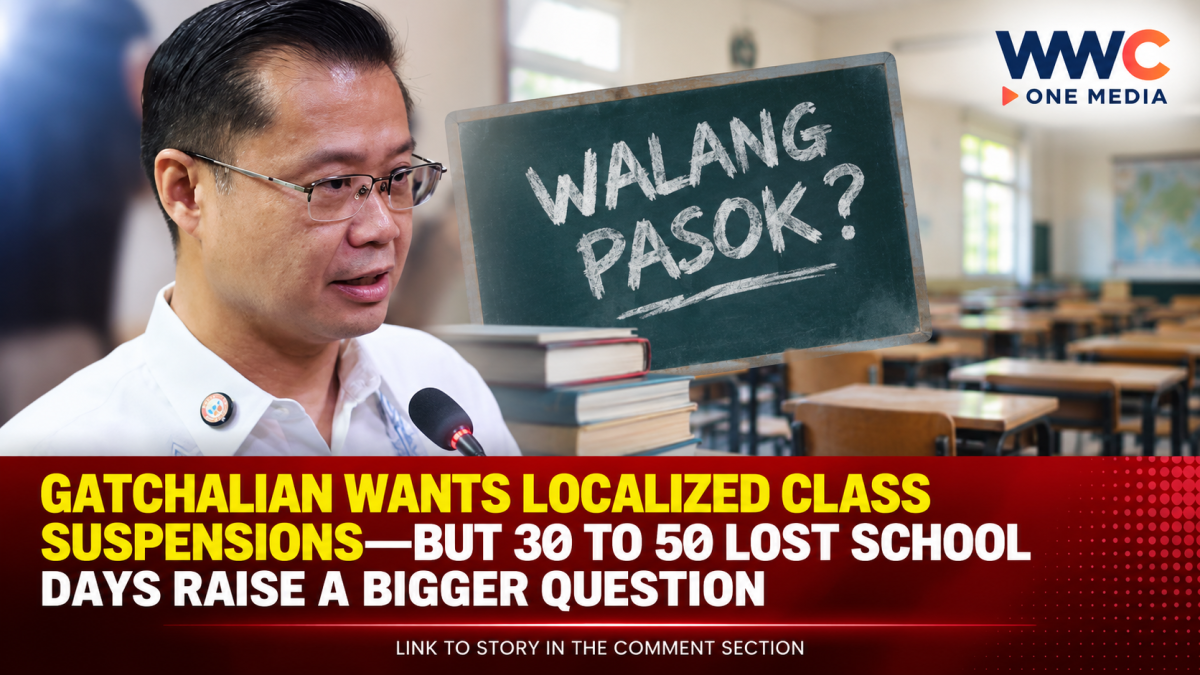
MANILA, Philippines — Senate President Sherwin Gatchalian is calling for a more localized and targeted approach to class suspensions, warning that blanket cancellations during bad weather may be worsening the country’s learning-loss problem.
Gatchalian said schools in communities that are not directly affected by floods, severe weather or other hazards should be allowed to continue holding face-to-face classes, rather than automatically shutting down schools across an entire city, municipality or province.
The proposal comes as repeated weather-related disruptions continue to affect in-person learning nationwide.
According to data cited by Gatchalian from the Second Congressional Commission on Education (EDCOM II), students have lost an average of 30 to 50 class days out of a 180-day school calendar because of class suspensions over the past two years.
His office also reported that face-to-face classes had been disrupted in various parts of the country on at least 20 weekdays during the past 30 days.
“While we know that class suspensions seek to ensure the safety of learners and teachers, widespread disruption to classes can aggravate learning loss,” Gatchalian said.
The senator stressed that protecting students and teachers must remain the priority, but argued that the response should reflect actual conditions on the ground.
If a particular school or community remains safe, he said, students should not necessarily have to miss classes simply because bad weather is affecting another area.
From blanket suspensions to school-by-school decisions?
The proposal comes amid a broader push within government to make decisions on class resumption more responsive to local conditions.
In August, the Department of Education said it was working on a framework that would give school heads a greater role in determining whether classes can safely resume, in coordination with local governments. DepEd Secretary Sonny Angara said blanket suspensions could unnecessarily keep schools closed even when individual campuses are already safe and ready to conduct classes.
Malacañang likewise said DepEd was studying a more flexible, school- and community-based approach instead of automatically applying the same suspension across an entire province, city or municipality.
The idea is particularly relevant during prolonged periods of heavy rain, when conditions can vary dramatically between neighboring communities.
Local governments already have a role
Localized class suspensions are not an entirely new concept.
Existing DepEd rules already provide mechanisms for localized cancellation or suspension of classes during disasters and emergencies. Local chief executives, acting through their local disaster risk-reduction mechanisms, may implement localized suspensions when conditions warrant. School heads may also take action when an immediate threat to the safety of learners and personnel exists, subject to the applicable rules.
Recent government actions demonstrate how the system can operate.
On Aug. 13, 2026, Malacañang suspended classes and government work across Metro Manila and several provinces because of continuous heavy rainfall associated with the southwest monsoon, while also reiterating that local chief executives could implement localized suspensions in other areas.
Then, on Sept. 4, the government ordered alternative learning modes and learning-continuity measures in NCR and several provinces affected by enhanced habagat and poor air quality caused by haze from fires in Indonesia. Local chief executives were still allowed to order localized class cancellations or suspensions where necessary.
Gatchalian’s proposed solution
Gatchalian is also backing Senate Bill No. 53, or the proposed 21st Century School Boards Act, which seeks to strengthen the role of local school boards.
Under the proposal, local school boards would have greater responsibility for implementing timely, coordinated and localized measures to keep basic education running during disasters, calamities and emergencies.
The push reflects Gatchalian’s broader argument that education policy should account for the differences between communities rather than relying on a one-size-fits-all response.
He has previously called for more location-specific information to guide decisions on class cancellations, including more granular weather and heat-index data for schools and local governments.
The bigger challenge: keeping students safe without stopping learning
The debate highlights a difficult balancing act for the education sector.
Suspending classes can be critical when students and teachers face dangerous flooding, landslides, extreme heat, storms or other hazards. But repeated cancellations can also mean students fall further behind—particularly in a country already dealing with significant learning gaps.
Recent monsoon disruptions illustrate the scale of the problem. DepEd reported that 9,009 public schools suspended in-person classes during one day of severe weather linked to the enhanced southwest monsoon and Tropical Depression Neneng.
For Gatchalian, the answer is therefore not simply to suspend fewer classes. It is to make suspension decisions more precise.
The emerging policy direction is clear: if one community is under threat while another remains safe, the entire area should not necessarily have to stop learning.
That could mean more decisions being made at the school, community and local-government level, while still keeping safety as the overriding consideration.
The question now is whether the proposed shift toward localized decisions can reduce learning loss without putting students and teachers at greater risk.




Leave a Reply