
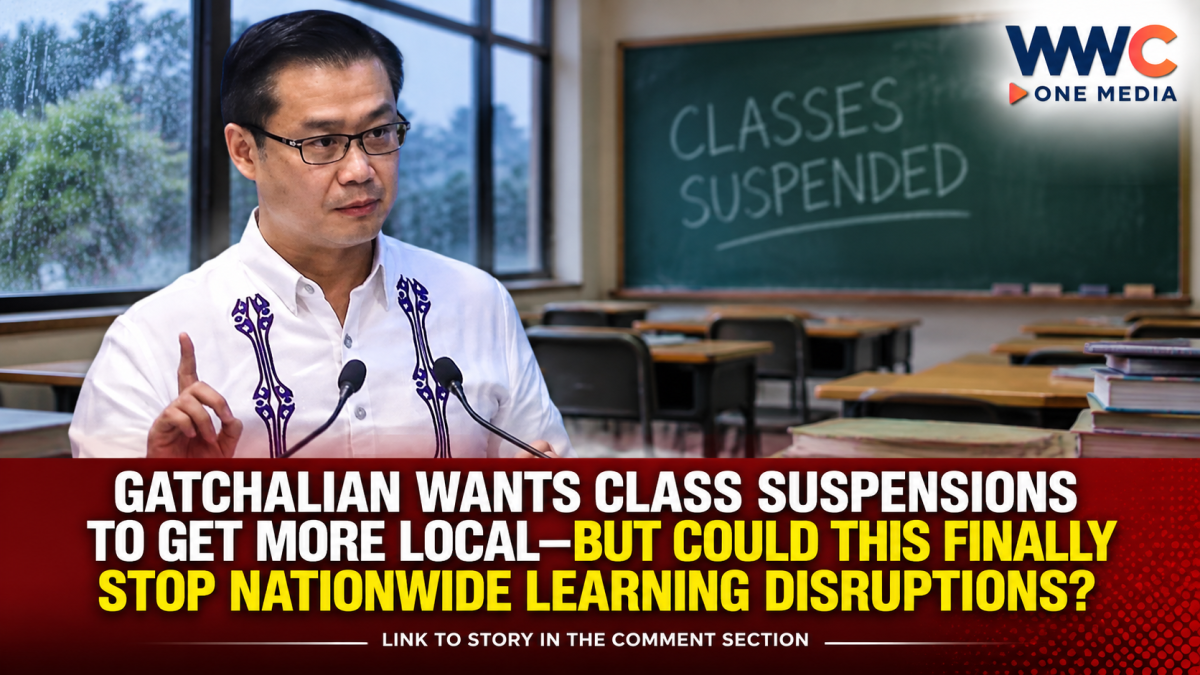
MANILA, Philippines — With repeated weather disturbances disrupting classes across the country, Senate President Sherwin Gatchalian is calling for a more localized approach to class suspensions—one that considers the actual conditions of individual communities and schools instead of relying too heavily on broad, area-wide cancellations.
The proposal comes as prolonged southwest monsoon rains and flooding have repeatedly forced schools to suspend face-to-face classes, raising concerns not only about student safety but also about mounting learning losses.
Gatchalian’s position comes amid a growing push from education groups and policymakers for “granular” or location-specific class suspension decisions, particularly when weather conditions vary significantly from one locality to another.
One city, different conditions
The argument behind localized suspensions is straightforward: a severe weather situation affecting one barangay or school does not necessarily mean every school in an entire city or province faces the same level of danger.
The Catholic Educational Association of the Philippines recently backed a granular approach, saying decisions should take into account factors such as the location of the school, flooding risk, accessibility, school conditions, time of day, and the ability of students and teachers to safely travel.
The EDSA-Ortigas Consortium of schools likewise warned that repeated, broad suspensions can fragment instruction and contribute to cumulative learning loss, especially when alternative learning arrangements cannot fully replace face-to-face instruction.
The groups stressed, however, that student and personnel safety must remain the primary consideration.
EDCOM 2: Learning days are already being lost
The call for more precise suspension policies is also gaining traction from the Second Congressional Commission on Education, or EDCOM 2.
According to EDCOM 2’s latest analysis of DepEd data, schools lost an average of 15 days per school year to calamity-related class suspensions during School Years 2024–2025 and 2025–2026.
Some areas experienced substantially greater disruption. Negros Occidental lost 71 school days in one division because of the prolonged Kanlaon Volcano eruption, while Canlaon City lost 61 days. In Metro Manila, 16 schools divisions lost an average of 15 days, with monsoon rains and typhoons accounting for much of the disruption.
EDCOM 2 has proposed a three-level system:
- Automatic suspensions when nationally established hazard thresholds are reached;
- Localized suspensions determined by local officials using risk assessments and scientific information; and
- School-level suspensions based on the actual conditions surrounding an individual campus.
The commission also wants schools to prepare annual learning-continuity plans so instruction can continue through printed materials, modules, home-based learning and other appropriate methods when disasters interrupt face-to-face classes.
DepEd is already preparing a major policy change
The proposal is not happening in isolation.
The Department of Education has been working on an updated Executive Order that would modernize the country’s rules governing class suspensions and resumptions.
DepEd said the proposed policy would institutionalize a more granular approach to both suspending and resuming classes, giving local executives and school heads greater flexibility to respond to conditions on the ground.
The proposed framework would cover not only typhoons but also hazards such as heavy rainfall, flooding, earthquakes, storm surges, poor air quality, volcanic hazards and extreme heat.
DepEd Secretary Sonny Angara said the objective is to protect students while preventing unnecessary loss of instructional time.
The department reported that from June 8 to August 31, weather disturbances and disaster-related suspensions had already resulted in roughly 20 to 40 days of instructional loss in some areas, underscoring the scale of the problem.
The problem became impossible to ignore during Habagat
The issue intensified during the recent enhanced southwest monsoon.
In August, DepEd reported that more than 8.4 million learners across eight regions had been affected by in-person class suspensions. More than 12,000 public schools were affected, while thousands of classrooms sustained varying degrees of damage.
The disruption has continued into September, with local governments still announcing suspensions or alternative learning arrangements in areas affected by persistent rains and flooding.
Recent suspension announcements have demonstrated why advocates want decisions to be more localized. In some municipalities, classes were suspended across an entire locality, while particular schools in the same area were allowed to continue face-to-face classes because conditions were considered manageable.
Palace already allows localized decisions
The national government has also recently reinforced the role of local authorities.
Under Memorandum Circular No. 134 issued September 4, alternative learning modes were ordered in Metro Manila and several provinces affected by the enhanced southwest monsoon and poor air quality.
At the same time, local chief executives in other areas were allowed to implement localized cancellation or suspension of classes under existing rules.
A subsequent Memorandum Circular No. 135 also maintained alternative learning arrangements in affected areas amid continued heavy rainfall and its cumulative effects.
The bigger question: How much learning can students afford to lose?
For education advocates, the debate is no longer simply about whether classes should be suspended.
It is about how precisely authorities can determine when a suspension is actually necessary—and how quickly schools can safely reopen afterward.
EDCOM 2 has warned that lost learning cannot simply be recovered by adding more classroom hours or Saturday classes. It also pointed to a major digital-access problem: only a portion of teachers and students have the devices needed to rely on online learning as a default replacement for face-to-face instruction.
That means a suspension can have very different consequences depending on a student’s circumstances.
For one student, shifting to online learning may be relatively easy. For another, a suspension could mean several days with little or no access to instruction.
The emerging consensus among education officials and groups is therefore moving toward a more targeted model: suspend classes where conditions are genuinely unsafe, but allow schools in unaffected or safe areas to continue learning whenever possible.
The challenge will be making sure that greater flexibility does not compromise safety—and that local decision-making is backed by clear scientific standards, fast communication and accountability.
For Gatchalian and other education advocates, the goal is ultimately the same: keep Filipino learners safe without allowing preventable disruptions to permanently widen the country’s learning gap.



Leave a Reply