
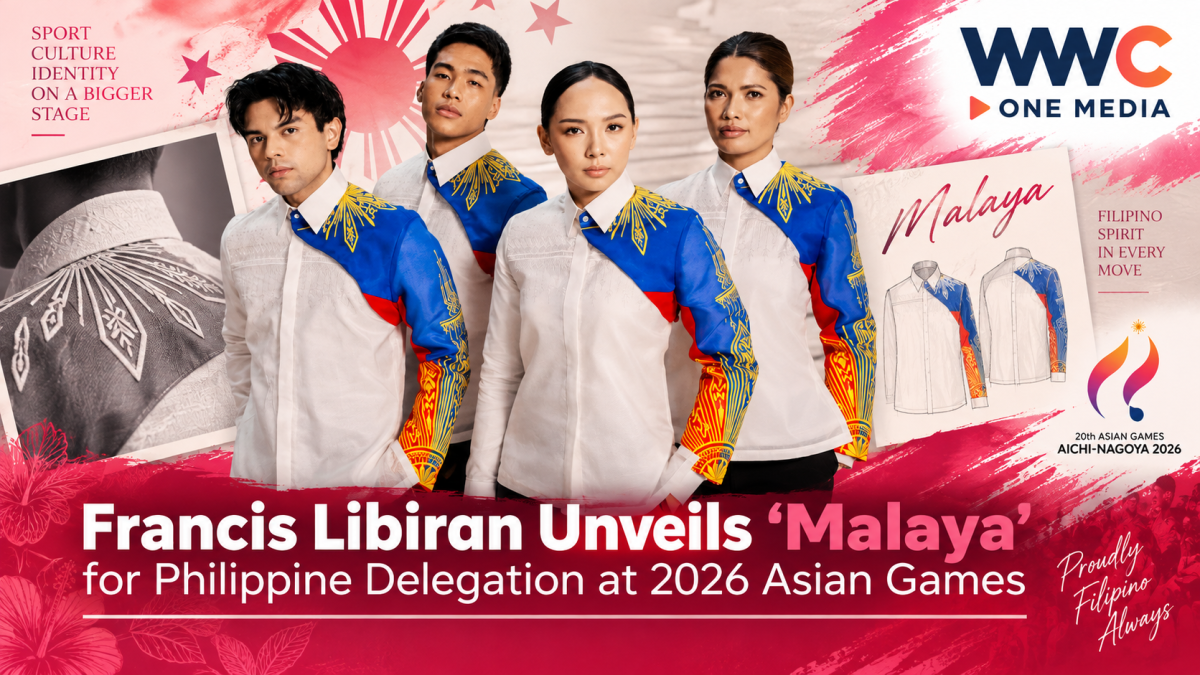
MANILA, Philippines — Acclaimed Filipino designer Francis Libiran has unveiled “Malaya,” a striking new national ensemble for the Philippine delegation heading to the 20th Asian Games in Aichi-Nagoya, Japan.
The design transforms the traditional barong into a bold contemporary statement, combining piña-jusi fabric, Kalinga-inspired motifs, Baybayin script and the colours of the Philippine flag.
A Barong Designed to Stand Out
At the heart of Malaya is a sheer cream piña-jusi body paired with an eye-catching asymmetrical sleeve in vibrant blue and red.
Yellow embroidery runs along the cuff and shoulder, while a matching embroidered cap completes the ensemble.
The dramatic colour combination was designed to ensure the Philippine delegation stands out during the opening ceremony.
As athletes walk, wave and appear before international cameras, the movement of the red and blue sleeve is intended to make the country’s colours instantly recognisable.
‘Malaya’ Celebrates Freedom and Filipino Identity
The name Malaya means “free” in Filipino and serves as the central message behind the design.
Libiran incorporated the word into the embroidery using Baybayin, the Philippines’ pre-colonial writing system.
The ensemble also features motifs inspired by traditional Kalinga tattoo designs from the Cordillera region.
Among the symbols incorporated into the embroidery are representations associated with:
- Protection
- Good fortune
- Health
- Guidance
- Unity
- Faith
The combination creates a design that brings together different layers of Philippine culture in a modern national uniform.
Traditional Craft Meets Modern Fashion
Malaya continues the long tradition of the barong while giving it a more contemporary visual identity.
The ensemble retains traditional piña-jusi weaving and hand embroidery, but introduces modern elements through:
- Asymmetrical colour blocking
- A geometric Baybayin layout
- A relaxed straight-cut silhouette
- A structured point collar
- Contemporary tailoring
The result is a national garment that looks to the past while clearly facing the future.
Designed for Athletes of Different Builds
Creating a single national look for dozens of athletes presented another challenge.
A weightlifter, runner and tennis player can have dramatically different body types, meaning the traditional rigid structure of a barong would not necessarily work for everyone.
Libiran’s solution was a relaxed and contemporary straight fit designed to provide more flexibility while maintaining a polished appearance.
The same principle was applied to the women’s delegation, with fluid fabric and tailored-but-relaxed cuts designed for different body shapes.
Lightweight Fabric for Comfort
The designer selected piña-jusi for more than its cultural significance.
The material is lightweight, breathable and fluid, making it suitable for athletes while maintaining the elegant sheen associated with traditional Filipino formalwear.
An inner shirt will also provide additional warmth for the cooler climate in Japan.
The combination aims to balance three important requirements:
National identity. Comfort. Style.
Handcrafted for Each Athlete
Each uniform is being individually handcrafted for members of the Philippine delegation.
That process has created major logistical challenges for Libiran’s atelier, particularly because athletes have demanding training and travel schedules.
Some athletes are also based overseas and could not be measured personally.
Tennis star Alex Eala, for example, provided her measurements remotely for the creation of her ensemble.
Despite the tight schedules and different body measurements, the team continues to handcraft the detailed embroidery and patterns for each piece.
The Design Has a Second Life
Malaya was also created with versatility in mind.
The striking sleeves are detachable, allowing the ensemble to be transformed into a simpler and more traditional-looking barong.
That means athletes may be able to wear the garment again for future special occasions.
Instead of becoming a one-time ceremonial uniform, Malaya was designed to remain part of the athletes’ personal memories and wardrobes.
More Than Just a Uniform
For Libiran, the project represents more than fashion.
The designer said wearing a national uniform can affect how athletes feel before stepping onto an international stage.
The barong becomes a physical symbol of the country they represent, carrying elements of Philippine history, craftsmanship and culture.
And for viewers watching from home, particularly young Filipinos, the design is intended to inspire pride in the country’s indigenous art, ancient writing systems and cultural traditions.
The Bottom Line
Francis Libiran’s Malaya brings Filipino heritage onto one of Asia’s biggest sporting stages through a bold reinterpretation of the traditional barong.
With its piña-jusi fabric, Kalinga-inspired motifs, Baybayin script and dramatic Philippine flag colours, the ensemble was designed to be impossible to miss.
When the Philippine delegation marches into the 2026 Asian Games, they will not simply be wearing a uniform — they will be carrying a modern expression of Filipino identity, freedom and national pride onto the world stage.



Leave a Reply