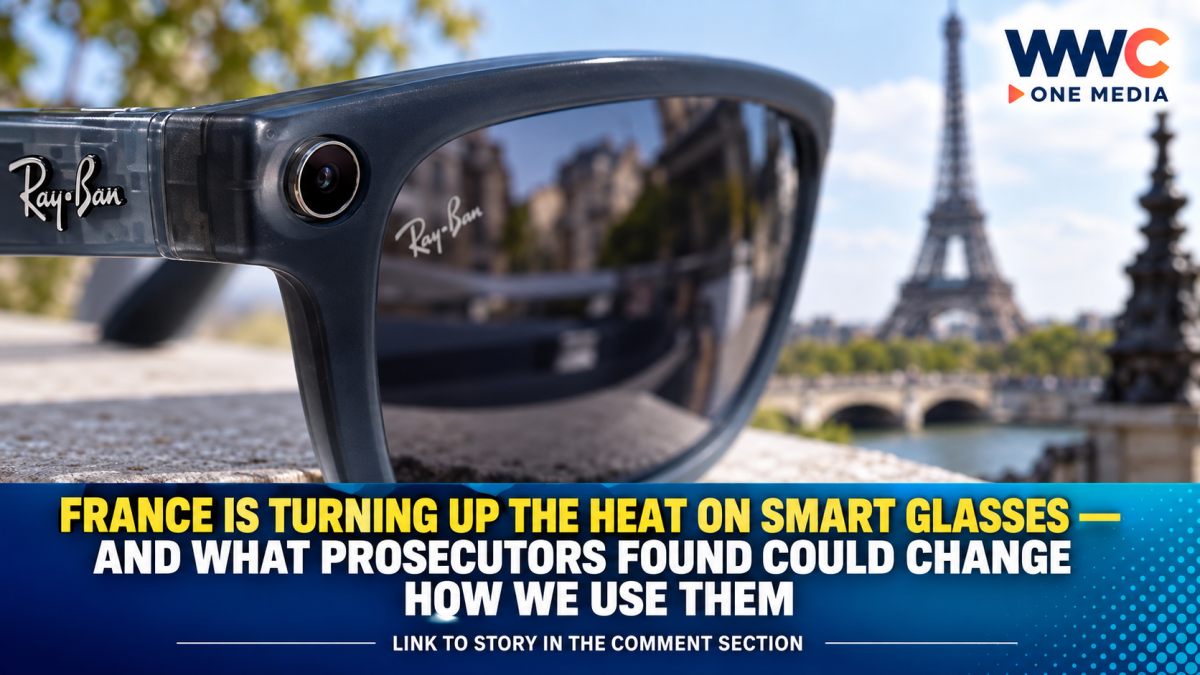
PARIS — France is taking a closer look at the rapidly expanding smart-glasses market after Paris prosecutors opened a criminal investigation into alleged sexual harassment involving camera-equipped eyewear, while the country’s data-protection regulator says it has received complaints about the devices being used in workplaces.
The investigations add to growing international concern over smart glasses that combine ordinary-looking eyewear with cameras, microphones and artificial-intelligence features capable of recording or analysing the world around the wearer.
The issue has become particularly sensitive because the devices can be considerably less conspicuous than a smartphone when recording people nearby. Reuters reported on Sept. 18 that the Paris prosecutor’s office recently opened at least one criminal investigation following complaints linked to a social-media trend in which women were allegedly filmed on the street without their consent and the footage subsequently posted online. Authorities did not identify the brand involved.
The prosecutor’s cybercrime unit also tested smart glasses in recent weeks to better understand how the technology could potentially be used in criminal activity, according to Reuters.
Why Meta’s smart glasses are under the spotlight
Several companies now sell connected eyewear, but Meta’s products, developed with EssilorLuxottica under brands including Ray-Ban, have become the dominant player in the market.
Reuters reported that Meta’s smart glasses accounted for roughly 76% of the global market, with about 7 million units sold in 2025. EssilorLuxottica has subsequently described growth in 2026 as exponential.
The glasses can capture photographs and video through a small built-in camera and incorporate AI-enabled features. A small indicator light is designed to show when recording is taking place.
Meta says privacy protections were incorporated into its AI glasses from the beginning and that the company intends to strengthen those safeguards as the technology becomes more capable.
EssilorLuxottica did not comment to Reuters on the French investigation.
France’s privacy regulator is also watching
France’s data-protection authority, CNIL, has separately raised concerns about smart glasses and launched an action plan examining their privacy implications.
CNIL says smart glasses can capture images and sounds of people nearby, sometimes without those people fully realising that recording is taking place. Because the devices can resemble conventional glasses, people around the wearer may have difficulty determining whether they are being recorded.
The regulator said it had received fewer than 10 complaints involving smart glasses in workplaces and has increasingly been contacted by companies asking whether they can prohibit their use at work.
CNIL’s concerns extend beyond one particular manufacturer. Its June 2026 action plan covers smart glasses generally and examines their compatibility with data-protection rules, including Europe’s General Data Protection Regulation.
The regulator has advised users to inform people nearby when appropriate, disable the glasses when they are no longer needed, avoid using them in places where people would not expect recording and obtain consent before sharing images or videos of identifiable people.
The tiny recording light has become a major point of debate
Manufacturers have argued that the recording indicator provides people with a warning that a photograph or video is being captured.
Privacy and children’s online-safety advocates, however, question whether a small light is sufficient protection.
Le Monde reported this month that French organisation e-Enfance had received more than 20 reports since the beginning of 2026 concerning women allegedly filmed without their knowledge using this type of eyewear. The publication also reported that the majority of the cases involved Meta models, while noting that the overall French market remains relatively small.
The debate is not simply about whether a camera is technically visible.
The larger question is whether people in public spaces can realistically understand when they are being recorded, what is being captured, where the footage goes and whether it might later be distributed online.
France is not alone
The French investigation comes as governments, businesses and institutions in other countries reassess how camera-equipped wearables should be used.
In Australia, the federal government is considering whether recording-capable smart glasses should be prohibited in Commonwealth workplaces. Public Service Minister Katy Gallagher has asked Australia’s public service for advice on potential restrictions, citing privacy and security concerns.
Australia has not announced a nationwide import ban. Earlier this month, Attorney-General Michelle Rowland said the government was not currently considering such a measure, while indicating that privacy rules could be strengthened and that individual councils and organisations could impose restrictions.
At the local level, Canterbury-Bankstown Council in Sydney has now voted to ban smart glasses from its leisure centres and pools, according to ABC News.
Other restrictions have also emerged internationally. Reuters reported that some UK cinemas have banned smart glasses, while Meta’s smart glasses are prohibited in courts in England and Wales. Oslo has also restricted their use in schools.
France’s legal framework already covers privacy — but enforcement is complicated
Smart glasses do not exist outside existing privacy law.
CNIL says their use generally falls under the GDPR and France’s data-protection legislation because the devices can process significant amounts of personal data.
French law also contains protections concerning the recording of a person’s image in a private place without consent. Reuters reported that violations can carry penalties of up to one year in prison and a €45,000 fine in applicable circumstances.
But authorities face a practical challenge: once footage is captured and uploaded to social-media platforms or messaging services, it can spread rapidly and become difficult to control.
That makes smart glasses different from many traditional recording devices. The camera is attached to the wearer, recording can be initiated discreetly, and the resulting content can potentially be processed or shared almost immediately.
The technology also has legitimate uses
The controversy does not mean smart glasses are inherently unlawful or that every use presents the same risk.
The technology can provide hands-free calls, audio, photography and AI-assisted functions. In Australia, accessibility advocates have highlighted potential benefits for people with disabilities, including features that can assist users with low vision or provide speech-to-text functions.
The regulatory challenge is therefore increasingly focused on how recording-enabled wearable technology should be used, particularly in workplaces, public facilities and situations where people reasonably expect privacy.
Meta’s next move could be significant
The scrutiny comes just days after Reuters reported that Meta is planning a new camera-free smart-glasses model, internally code-named “Luna,” for launch this autumn, according to The Information. The reported development comes amid growing attention to privacy concerns surrounding camera-equipped wearables.
Whether camera-free models become a meaningful alternative remains to be seen.
For now, France’s actions highlight a broader shift: smart glasses are moving from being treated primarily as consumer electronics to becoming a subject of criminal investigations, privacy regulation and workplace policy.
The technology may still be in an early stage of mass adoption, but regulators are increasingly being forced to confront a difficult question: when a camera is built into something that looks like an ordinary pair of glasses, how can everyone around the wearer know when they are being recorded — and what happens to that footage afterward?