
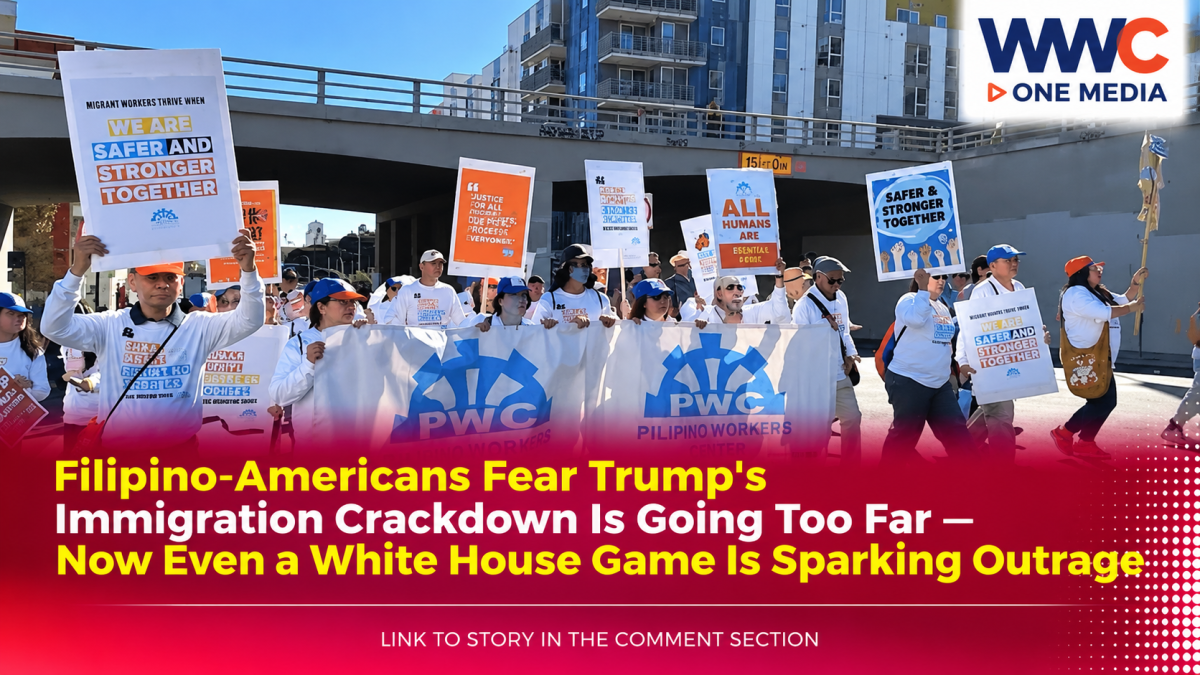
WASHINGTON — For many Filipino-Americans, the fear surrounding Donald Trump’s widening immigration crackdown is no longer limited to border raids, detention centres and deportation orders.
Now, even video games are part of the controversy.
A series of arcade-style games released through the White House website — including one that allows players to chase migrants and another centred on building a border wall — has sparked anger among immigrant advocates and renewed fears within Filipino-American and other Asian American communities.
Critics have described the games as deeply troubling, arguing that they trivialise the human consequences of deportation while turning one of America’s most divisive political issues into entertainment.
For immigrant communities already rattled by stepped-up enforcement, the reaction has been swift.
The concern is no longer simply about who might be detained. It is also about whether hostility toward migrants is becoming normalised.
According to a South China Morning Post report published on September 6, Filipino-Americans and immigration advocates described the White House games as “frightening” and “xenophobic,” warning that such messaging could deepen fear among communities with large immigrant populations.
The games that triggered a new backlash
The controversy erupted after the White House promoted a collection of arcade-style games connected to President Trump’s immigration agenda.
One game, called Rio Run, allows users to pursue migrants near the Rio Grande, which runs along part of the US-Mexico border.
Another uses a block-stacking concept to encourage players to “build the wall” and defend the border.
SCMP reported that the games were promoted alongside messaging celebrating deportation and border enforcement.
But what supporters may see as political messaging or satire has been received very differently by immigrant communities.
Advocates argue that turning deportation into a game risks reducing real human experiences into entertainment.
Detention.
Family separation.
Deportation.
Uncertain legal status.
Fear of arrest.
For millions of immigrants and their relatives, these are not political abstractions.
They are daily concerns.
Filipino-Americans are watching closely
Filipino-Americans are one of the largest Asian American communities in the United States, with many families maintaining close connections to relatives who are immigrants, permanent residents, visa holders or people navigating complex citizenship processes.
That makes immigration policy particularly personal.
Even US citizens may have parents, grandparents, spouses, siblings or friends whose lives could be affected by changes in immigration enforcement.
Recent polling also suggests that the impact of the crackdown extends well beyond people directly facing deportation.
An AP-NORC and AAPI Data poll found that about half of Asian American and Pacific Islander adults said they or someone they knew had experienced some form of disruption connected to immigration enforcement or concerns over immigration status, including changing routines, carrying proof of status or citizenship, or dealing with detention or deportation.
The fear is spreading beyond undocumented migrants
One of the most significant concerns surrounding the current crackdown is that its effects are being felt beyond undocumented immigrants.
Recent AP reporting found that the Trump administration has expanded enforcement and immigration restrictions affecting people who entered the United States legally or are navigating legal immigration pathways.
That has intensified anxiety among immigrant communities.
The questions are becoming broader:
Will my visa status change?
Could a family member lose legal protection?
Will applying for citizenship expose someone to additional scrutiny?
Should I carry proof of citizenship?
Will I be questioned because of how I look or where my family comes from?
Those concerns help explain why critics say the psychological impact of the crackdown extends far beyond the people directly targeted by immigration enforcement.
ICE arrests hit nearly 50,000 in a single month
The political controversy comes as immigration enforcement has continued at an extraordinary pace.
Associated Press reporting found that US Immigration and Customs Enforcement arrested nearly 50,000 people in July 2026 — the highest monthly total of Trump’s second term at the time.
The total represented a major increase compared with earlier months.
The report also found that more than half of those detained did not have criminal convictions or pending criminal charges.
The administration has defended its enforcement policies as part of a broader effort to strengthen border security and enforce immigration laws.
But critics argue that the scale of the crackdown has expanded far beyond the image of targeting only the most dangerous offenders.
Why immigrant advocates are calling the games dangerous
The strongest criticism of the White House games is not simply that they are offensive.
Advocates argue they could shape public attitudes.
When migration is presented as a game involving chasing people or defending against an approaching “horde,” critics say the language can reinforce the idea that migrants are threats rather than human beings.
That concern is particularly significant for younger audiences.
Games can make serious issues feel less serious.
And repeated political messaging can gradually normalise language that might once have been considered extreme.
SCMP reported that immigrant advocates fear the games could make hostility toward migrants appear more acceptable while minimising the suffering associated with detention and deportation.
The Asian American community is already feeling the impact
The latest controversy does not exist in isolation.
Polling earlier in 2026 found significant concern among Asian American, Native Hawaiian and Pacific Islander communities about Trump’s immigration policies.
A separate AP-NORC and AAPI Data poll found that around two-thirds of AAPI adults believed Trump had gone too far with deportations of immigrants living in the United States illegally.
Most respondents also said his administration had done more harm than good on immigration and border security.
These numbers are significant because Asian Americans are often discussed as a broad political category.
But immigration policy can affect communities differently.
For Filipino-Americans, family migration and long-standing connections between the Philippines and the United States mean immigration issues often reach across generations.
A change in policy can affect more than one person.
It can affect an entire family network.
From fear to everyday disruption
Perhaps the most striking finding from the AP’s recent reporting is how ordinary routines are changing.
Some people have started carrying additional proof of citizenship or immigration status.
Others have changed travel plans.
Some have altered their routines.
And others have become more cautious about encounters with authorities.
These changes reveal something larger than a disagreement over immigration policy.
They suggest that immigration enforcement is reshaping how some Americans experience everyday life.
For people who have spent decades in the United States — including naturalised citizens and permanent residents — the current political environment can still create uncertainty.
That is particularly true when enforcement expands rapidly and new policies continue to emerge.
The crackdown is also facing legal challenges
Not every immigration policy has survived court scrutiny.
A US federal judge recently blocked a new Trump administration order aimed at restricting birthright citizenship, finding that the affected children were already protected by existing constitutional and legal precedent.
Another federal court also struck down a policy that had suspended immigrant visa processing for nationals from 75 countries, ruling that the policy exceeded legal authority and conflicted with federal immigration law.
These legal challenges highlight an important reality.
The immigration crackdown is not a single policy.
It is a rapidly evolving collection of enforcement actions, visa restrictions, citizenship proposals and administrative changes.
Some are being implemented.
Some are being challenged.
And some have already been blocked by courts.
For immigrant families, that can make an already complicated system even harder to understand.
A Filipino man’s detention has added to the anxiety
The broader debate has also been intensified by individual cases involving Filipino nationals and long-term US residents.
Recent reporting highlighted the case of Loreto Javar, a 76-year-old Filipino national and permanent US resident who was detained by ICE while dealing with advanced prostate cancer.
According to reporting on the case, immigration officials cited a decades-old conviction in the Philippines that authorities said had not been properly disclosed during his original immigration process.
His family and advocates have raised concerns about his medical care and the interruption of his treatment while in detention.
The case has attracted attention because Javar had lived in the United States for decades as a permanent resident.
It has also reinforced fears among immigrant communities that long-term residence or legal status does not necessarily eliminate uncertainty under an aggressive enforcement environment.
The White House games have become a symbol of a larger problem
For critics, the games are controversial because of what they represent.
They come at a time when:
- ICE arrests have increased sharply
- Deportation efforts have expanded
- Legal immigration pathways face additional scrutiny
- Citizenship policies are being challenged in court
- Immigrant communities report changing their daily routines
- Asian American communities are expressing growing concern
The games therefore became more than a social media controversy.
They became a symbol.
A symbol of how aggressively immigration has entered American political culture.
And how immigration enforcement is increasingly being used not only as government policy but also as political messaging.
Trump supporters see a different story
Supporters of Trump’s immigration policies argue that stronger enforcement is necessary to secure the border and restore control over the US immigration system.
The administration has consistently defended tougher immigration measures as necessary for national security and law enforcement.
Supporters also argue that political opponents often focus on individual cases while ignoring broader concerns about illegal immigration and border security.
That political divide remains one of the biggest challenges in the debate.
Both sides agree that immigration is a major national issue.
But they fundamentally disagree about what the solution should look like.
And how far the government should go.
Filipino-Americans caught between politics and family
For many Filipino-Americans, the debate is not theoretical.
It can be about family.
A relative waiting for a visa.
A parent seeking citizenship.
A grandparent with permanent residency.
A spouse navigating immigration paperwork.
A friend worried about detention.
That is why political messaging that portrays migrants as targets or threats can feel especially personal.
Filipino-Americans may be US citizens.
But many remain closely connected to immigrant experiences.
And critics argue that the current environment risks making people feel they must constantly prove where they belong.
The bigger question: What happens when deportation becomes entertainment?
This may be the most difficult question raised by the White House games.
Political campaigns have always used powerful imagery.
Governments have always used messaging to build support.
But immigration advocates warn that there is a line between promoting policy and turning human suffering into entertainment.
The concern is not only about one game.
It is about what comes next.
If chasing migrants becomes a game…
If deportation becomes a slogan…
If fear becomes political entertainment…
Then critics ask whether the public will gradually stop seeing the people affected as individuals with families, histories and lives.
That is the fear now being voiced by Filipino-American advocates and other immigrant groups.
A community watching what comes next
The Trump administration’s immigration agenda continues to evolve.
New policies are being proposed.
Courts are issuing rulings.
Enforcement numbers continue to change.
And immigrant communities are adjusting to a political environment that many say feels increasingly unpredictable.
For Filipino-Americans, the latest controversy over the White House games has added another layer to that uncertainty.
The games may eventually disappear from the headlines.
But the underlying question will remain.
How far will the immigration crackdown go?
And perhaps more importantly:
What happens to a country built by immigrants when immigrants increasingly feel they have to prove they belong?
For Filipino-Americans and other immigrant communities, the answer could shape far more than the next election.
It could shape how safe they feel calling America home.
WWC ONE MEDIA J.M.D



Leave a Reply