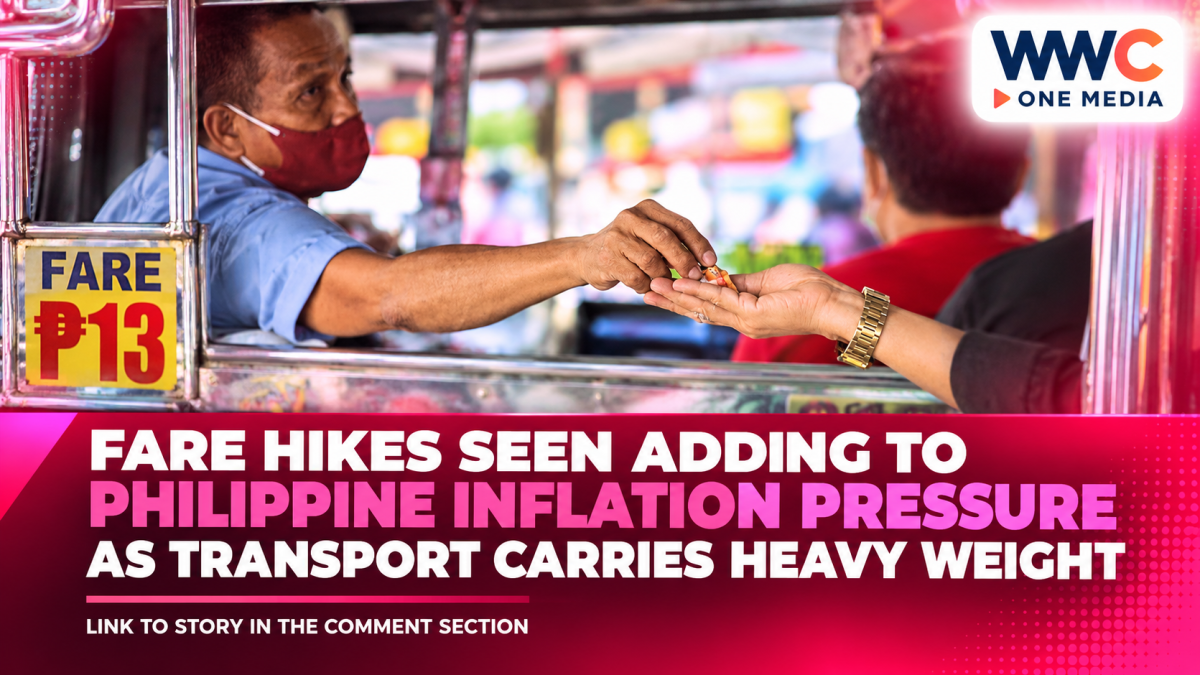
Higher public transport fares are expected to add upward pressure on Philippine inflation and increase delivery costs, with analysts warning that the impact could extend beyond commuters to the prices of food and other goods and services.
The Land Transportation Franchising and Regulatory Board has approved fare adjustments covering major public utility vehicle types, with the increases taking effect on Sept. 28. Analysts said the direct impact will be felt through higher transportation costs, while indirect effects could emerge as businesses pass increased logistics and delivery expenses on to consumers.
Traditional jeepney fares increased by P1, bringing the minimum fare to P14 for the first four kilometers, with an additional P2 for every succeeding kilometer. Modern jeepney fares rose to P17 from P15, while succeeding kilometers carry an additional P2.40.
Ordinary city bus fares increased to P15 from P13, with a P2.49 charge for every succeeding kilometer. Air-conditioned buses now have an P18 base fare, followed by P2.98 for every succeeding kilometer. Airport taxi flagdown rates also increased to P115 from P75, while transport network vehicle services saw sedan flagdown rates rise to P65 from P45.
The potential inflation impact comes as transportation already carries a substantial weight in the country’s consumer price index. The Philippine Statistics Authority reported that transport inflation accelerated to 13.5% in August from 11.9% in July, while transport accounted for 20.1% of the month’s headline inflation contribution.
Analysts said the ultimate effect of the fare increases will depend on their size and timing, as well as movements in other major price drivers such as fuel and food. A higher transport bill can immediately affect commuters, while businesses that rely on deliveries and logistics may face additional operating costs.
The latest fare adjustments also come as headline inflation has been easing. Inflation slowed to 6.1% in August from 6.2% in July, marking the fourth consecutive month of deceleration. However, transport prices continued to rise faster than the overall inflation rate.
For households, the more immediate concern may be reduced purchasing power as daily transportation expenses take up a larger share of monthly budgets. Analysts noted that even if the direct contribution of the fare increases to headline inflation remains limited, commuters could still feel a noticeable impact on their household finances.
The fare increases therefore introduce another potential source of price pressure at a time when policymakers are closely monitoring food, fuel, transportation and other major components of household spending.