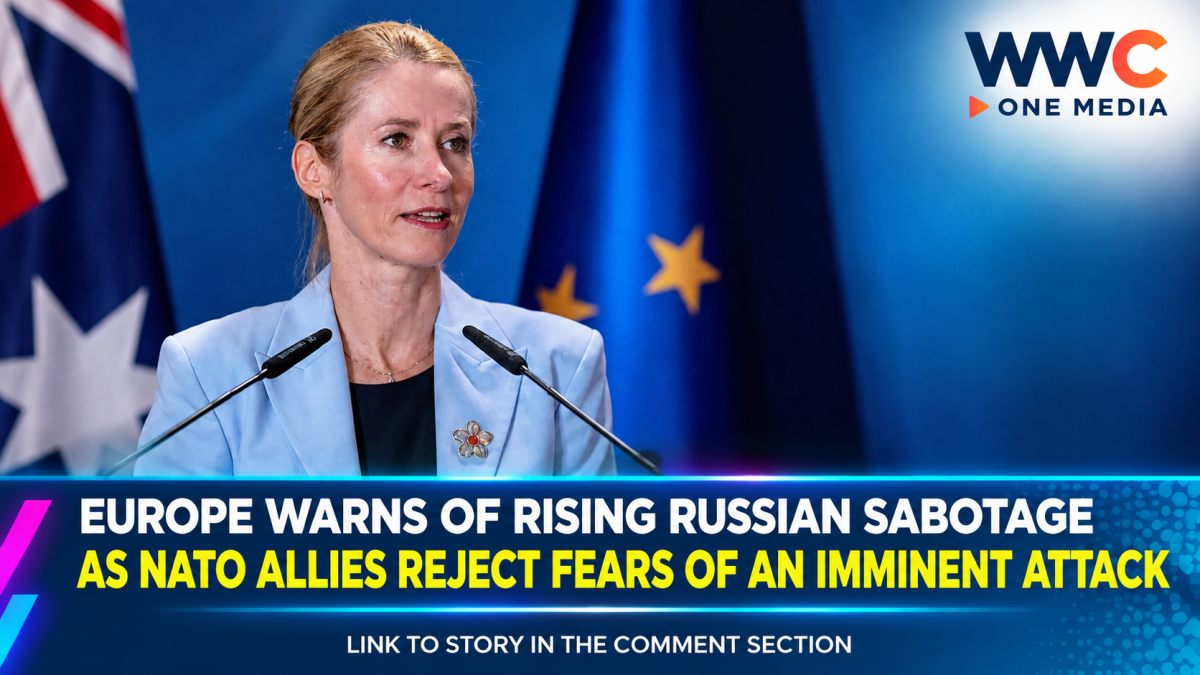
European governments are warning that Russia is intensifying sabotage, cyberattacks, drone incursions and other forms of hybrid activity across the continent, but officials from several NATO countries say there is no evidence that Moscow is preparing an imminent conventional attack on the alliance.
The warnings came as European officials gathered on the sidelines of the United Nations General Assembly, where Russia’s actions in Europe and its continuing war against Ukraine were major security concerns. EU foreign policy chief Kaja Kallas said Europe was facing a rapid increase in sabotage and airspace violations, which she said were intended to frighten European populations and weaken support for Ukraine.
Polish Foreign Minister Radoslaw Sikorski said the threat had moved beyond warnings, pointing to incidents involving arson, explosions, drone incursions and what Poland described as a Russian cruise missile violation of its territory. Poland also reported a brief incursion by a Russian military Mi-8 helicopter from the direction of Kaliningrad.
Romania has faced repeated drone-related incidents as Russia attacks Ukrainian infrastructure near the Danube and Black Sea. Foreign Minister Oana Toiu said Bucharest had recorded more than 100 incursions involving drones or drone fragments into Romanian territory, although she said there was no information indicating Romania itself was being directly targeted.
The concerns extend beyond airspace violations. NATO countries have been monitoring suspected Russian activity around critical infrastructure, including undersea communications cables. Earlier this month, reporting showed that Britain, Norway and the United States had tracked Russian undersea vessels near Norway’s Svalbard archipelago during an operation that Western officials said involved training with technology designed to disable critical subsea cables.
Germany has also investigated suspected Russian-linked activity. In August, authorities found a drone carrying explosives and a detonator at Leipzig/Halle Airport, an important civilian freight and NATO logistics facility. European officials subsequently increased pressure on Moscow, while Russia denied involvement.
At the same time, European officials are drawing a distinction between Russia’s alleged hybrid operations and the prospect of a full-scale military assault on NATO territory.
Estonian Foreign Minister Margus Tsahkna said there was no indication that Russia was currently capable of or preparing for direct military aggression against NATO or European countries. He argued that Moscow’s covert activities were instead aimed largely at creating fear and divisions among Western countries.
Lithuanian Foreign Minister Kestutis Budrys offered a different warning, saying allied intelligence pointed to a possibility that Russia could broaden pressure on NATO countries through attacks on critical infrastructure and other hybrid operations. His comments reflect a wider concern that Moscow could attempt to increase pressure without launching a conventional war against the alliance.
The assessments also differ among European intelligence agencies. Czech intelligence chief Michal Koudelka has warned that Russian operations against NATO could intensify within “months, not years,” while Latvia’s security chief Normunds Mežviets has said there are no signs of an imminent attack. Swedish military intelligence chief Thomas Nilsson has likewise warned that sabotage activity could increase.
Russia has consistently denied conducting sabotage operations in NATO countries or planning a confrontation with the alliance.
For NATO members, the challenge is therefore not limited to preparing for a conventional military attack. Governments are also strengthening defenses against cyberattacks, sabotage, drone incursions and threats to critical infrastructure while trying to maintain public support for Ukraine.
The contrasting assessments underscore the uncertainty facing Europe. Officials broadly agree that Russian hybrid activity is increasing, but they differ over how far Moscow intends to escalate and whether those operations represent preparation for a broader confrontation or an effort to intimidate and divide European societies.
As NATO countries reinforce their defenses and coordinate responses, the immediate focus remains on preventing individual acts of sabotage or airspace violations from developing into a larger security crisis — while maintaining deterrence without turning the current wave of hybrid incidents into a direct military confrontation.