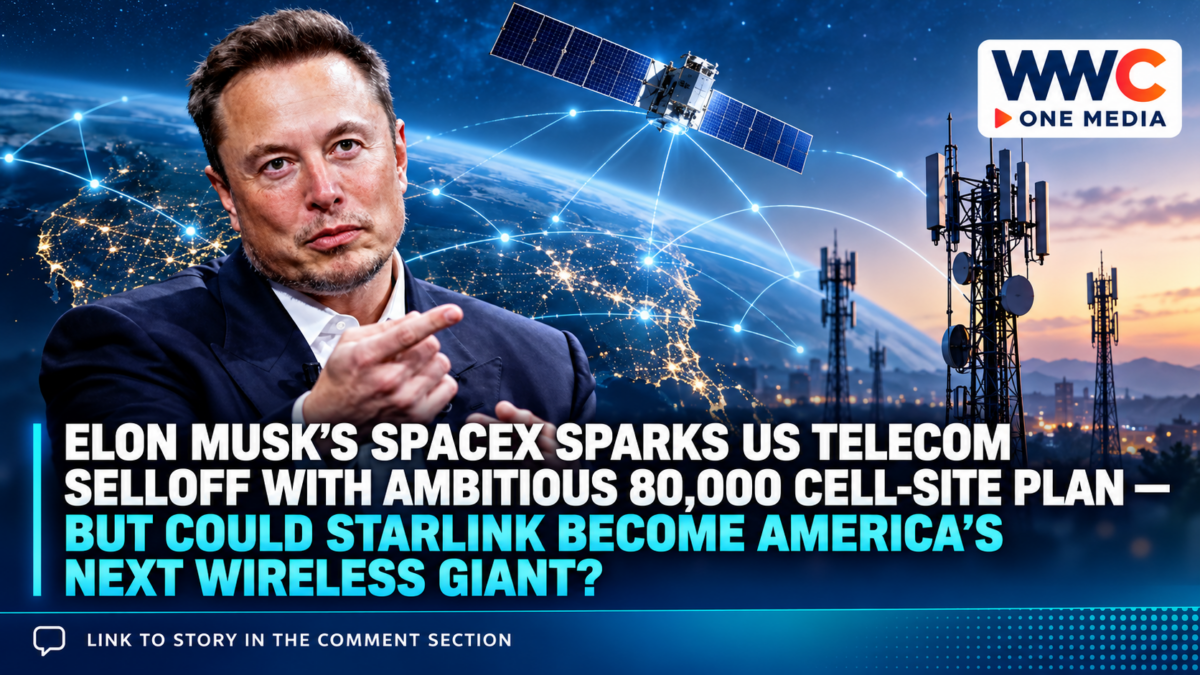
Elon Musk’s SpaceX is sending shockwaves through America’s telecommunications industry after reports revealed that the aerospace company is negotiating access to at least 80,000 cellular sites across the United States — a potentially groundbreaking move that could position its Starlink business as a fourth nationwide wireless competitor.
The development rattled Wall Street on Friday, October 23, as shares of major telecommunications companies declined amid fears that SpaceX could eventually challenge the dominance of AT&T, Verizon and T-Mobile.
The reported negotiations represent another major step in SpaceX’s expanding wireless ambitions, raising a critical question for investors and consumers: Could the company best known for rockets and satellite internet fundamentally reshape how Americans connect to mobile networks?
Wall Street reacts as telecom giants face a potential new rival
According to Reuters, citing an earlier Bloomberg News report, SpaceX has been holding discussions with cellular infrastructure providers over access to thousands of existing sites that could form the foundation of a new nationwide terrestrial wireless network.
The report triggered immediate concern among investors in established telecommunications companies.
During Friday’s trading session, AT&T shares fell 5.6%, reaching their lowest level in more than three months. T-Mobile dropped 5%, while Verizon declined 1.6%.
Germany’s Deutsche Telekom, which controls more than half of T-Mobile US, also lost 3.2%.
The declines reflected growing uncertainty over how a well-funded technology challenger could affect pricing, customer retention and long-term profitability across the US wireless market.
While no new SpaceX nationwide mobile network has officially launched, the prospect of future competition has already prompted investors to reassess the traditional telecom business model.
Why SpaceX wants access to 80,000 cell sites
Bloomberg reported on October 22 that SpaceX was seeking access to a minimum of 80,000 cell sites as part of its potential expansion into nationwide wireless services.
The scale of the proposed arrangement is significant.
According to figures from the Wireless Infrastructure Association cited by Reuters, approximately 158,500 purpose-built cellular towers were operating in the United States in the previous year.
That means SpaceX’s reported target is equivalent to roughly half the number of those towers, although individual cell sites and physical towers are not necessarily identical.
Among the infrastructure companies reportedly involved in discussions is Crown Castle, one of America’s largest telecommunications tower operators.
Crown Castle operates approximately 40,000 cellular towers nationwide, while American Tower has around 42,000 US sites. Privately held Vertical Bridge operates approximately 18,000.
By negotiating access to existing infrastructure, SpaceX could potentially accelerate network deployment compared with building every tower independently.
However, securing sites would be only one part of creating a competitive mobile network.
The company would still need substantial investments in radio equipment, network systems, coverage optimization, regulatory compliance and customer services.
The Starlink advantage: Satellites combined with ground networks
SpaceX already operates Starlink, a satellite internet system that provides broadband connectivity to customers, including those in rural and remote communities.
Its ambitions increasingly extend beyond fixed internet access.
A combination of satellite connectivity and conventional ground-based wireless infrastructure could eventually create a service capable of reaching areas where traditional mobile coverage remains unreliable.
Satellite connections could help address certain coverage gaps, while terrestrial cell sites could provide the capacity and performance required in populated communities, commercial districts and indoor environments.
SpaceX’s recent move to acquire nationwide low-band wireless spectrum has further strengthened expectations that the company is considering a much larger role in mobile communications.
Low-band spectrum is particularly valuable because its signals generally travel farther and penetrate buildings more effectively than higher-frequency signals.
For established operators, this is what makes SpaceX’s reported expansion plans particularly important.
Rather than positioning Starlink solely as a supplementary service for underserved locations, SpaceX could eventually develop a broader wireless offering capable of competing for mainstream mobile subscribers.
Such a transformation, however, remains a possibility rather than an announced commercial outcome.
Telecom tower companies emerge as potential winners
While major wireless carriers suffered stock market declines, telecommunications infrastructure companies moved in the opposite direction.
Crown Castle shares surged 11.6% following reports that it was among the companies discussing possible site-access arrangements with SpaceX.
American Tower climbed 4.9%, while SBA Communications advanced 4.6%.
Investors appeared to anticipate that a new nationwide wireless competitor could create substantial demand for existing infrastructure.
A company entering the wireless market would need access to thousands of sites, potentially generating additional leasing revenue for tower operators.
Crown Castle Chief Executive Officer Chris Hillabrant said during an earnings call that the company was speaking with various interested parties, but did not publicly confirm a specific SpaceX agreement.
The contrasting share-price movements illustrate how a new telecom entrant could produce very different outcomes across the industry.
For incumbent mobile providers, additional competition could create pressure on profit margins.
For tower owners, another large customer could offer a significant commercial opportunity.
Analysts warn that the real disruption could take years
Despite the market reaction, analysts cautioned that SpaceX would face considerable challenges before emerging as a fully competitive national wireless operator.
Research firm TD Cowen estimated that building a nationwide terrestrial network could cost more than $80 billion.
The figure highlights the enormous financial commitment needed to establish a credible alternative to existing operators.
Bernstein analysts also warned that the potential competitive impact may be several years away, even if investors continue reacting to SpaceX’s infrastructure and spectrum investments.
Establishing a nationwide wireless network involves far more than securing towers.
Operators must deliver consistent connectivity, sufficient network capacity, competitive pricing, customer support and reliable coverage across geographically diverse markets.
Meanwhile, established telecommunications companies already possess extensive networks, longstanding customer relationships and substantial operational experience.
SpaceX could also explore commercial partnerships, including mobile virtual network operator arrangements, although such agreements may be complicated by the fact that existing carriers could view the company as a future competitor.
Could SpaceX trigger a new American telecom price war?
One of the biggest unanswered questions is whether an eventual SpaceX mobile service could intensify pricing competition in the United States.
If Starlink were able to combine satellite coverage with competitive terrestrial mobile plans, established providers might face greater pressure to improve service packages and pricing.
Consumers could potentially benefit from more choice and better connectivity, particularly in underserved regions.
However, those advantages would depend on how SpaceX structures its eventual services, their pricing, network performance and availability.
There is currently no confirmed nationwide launch date, public pricing schedule or final infrastructure agreement supporting the reported 80,000-site ambition.
For now, the immediate impact is being felt more strongly in financial markets than in consumers’ mobile phone bills.
The bigger picture: SpaceX is becoming more than a space company
SpaceX’s expansion ambitions underscore the growing convergence of satellite communications, wireless telecommunications and advanced infrastructure.
The company’s existing satellite network gives it a different technological foundation from traditional mobile operators.
But turning that advantage into meaningful market share will require major capital spending, operational execution and regulatory progress.
Friday’s stock market reaction suggests investors are increasingly willing to price in the possibility of a major competitive shift, even before the new network becomes a reality.
For AT&T, Verizon and T-Mobile, the next major challenge may not come from another established telecom company.
It could come from an aerospace and satellite internet business seeking to transform itself into a nationwide wireless competitor.
The central question is no longer simply whether SpaceX wants to enter America’s mobile market. It is whether Elon Musk can turn an ambitious satellite-and-cell-tower strategy into a serious nationwide challenger — and how much the existing telecom giants may have to change before that happens.