
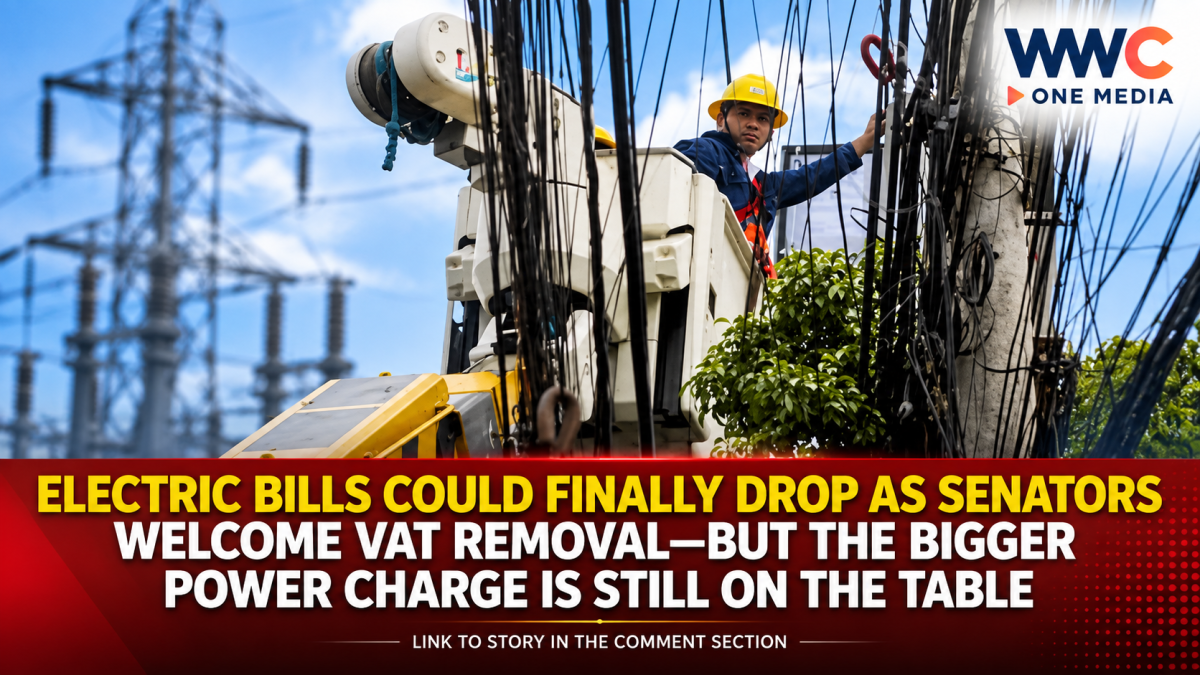
Filipino electricity consumers could soon see some relief on their monthly power bills after the government moved to remove the 12% value-added tax (VAT) imposed on allowable system-loss charges, a development welcomed by senators pushing for broader electricity-sector reforms.
The Energy Regulatory Commission (ERC) approved on Aug. 26 a resolution declaring the allowable system-loss charge an inherent government-mandated pass-through cost, meaning it should not be treated as part of the gross sales subject to VAT for power generators, the National Grid Corporation of the Philippines (NGCP) and distribution utilities.
The Bureau of Internal Revenue (BIR) is now preparing the corresponding Revenue Memorandum Circular that will formally implement the VAT removal.
Senators welcome the move
Senate President Sherwin Gatchalian welcomed the impending BIR issuance, saying consumers burdened by high electricity prices should benefit from every legitimate opportunity to reduce their bills.
Gatchalian said the Ease of Paying Taxes (EOPT) Act already provides a legal basis for excluding certain pass-through costs from the VAT base, meaning a separate law may not be necessary simply to remove VAT from allowable system-loss charges.
He is nevertheless continuing to push Senate Bill No. 2350, which seeks to go further by eliminating the system-loss charge itself from consumers’ electricity bills.
That distinction could become crucial in the months ahead.
VAT removal is not the same as eliminating system loss
System loss refers to electricity that is generated and paid for but does not ultimately reach consumers because of losses occurring during transmission and distribution.
These can be technical losses, such as electricity dissipated through power lines, transformers and other equipment, or nontechnical losses, including electricity theft, illegal connections and meter tampering.
Under the existing regulatory framework, a portion of allowable system losses can be recovered through electricity bills.
The government’s latest action therefore does not immediately erase the entire system-loss charge. Instead, it removes the 12% VAT that had been imposed on the allowable charge.
That means consumers could pay less—but they will still see a system-loss component on their bills unless Congress or regulators eventually approve broader reforms.
When will consumers actually feel the savings?
This is where the timeline becomes important.
The BIR said it would issue its circular after the required 15-day period following publication of ERC Resolution No. 26, which was officially published on Aug. 28.
ERC Chairperson Francis Saturnino Juan previously said distribution utilities would then be directed to revise their billing formats.
In a congressional budget hearing, Juan said implementation could occur around October or November, depending on the completion of the regulatory and billing-process requirements.
GMA News likewise reported that the ERC expected consumers could potentially see lower electricity bills before the Christmas season once the VAT removal is implemented.
Sen. Gatchalian, meanwhile, said implementation of the VAT removal was expected to begin around the middle of September, while emphasizing that distribution utilities and electric cooperatives should be monitored to ensure that the benefit is actually passed on to consumers.
But the savings may be smaller than many consumers expect
While the VAT removal is being welcomed as a step toward lower electricity costs, not all lawmakers believe it will provide enough relief on its own.
Sen. Bam Aquino has argued that removing VAT only from system-loss charges could translate into a relatively small reduction in consumers’ overall electricity bills—estimated at around 0.5% to 0.8%. He has instead called for removing the 12% VAT from electricity bills more broadly.
That means the immediate savings from the policy could be modest for many households, particularly because the system-loss charge represents only one component of an electricity bill.
Senators want to go after the system-loss charge itself
Several senators have already filed measures targeting the broader issue.
Gatchalian has pushed a bill seeking to abolish the system-loss charge passed on to consumers, while Sen. JV Ejercito filed measures seeking to abolish the charge and remove the 12% VAT on electricity. Sen. Erwin Tulfo, meanwhile, has backed an inquiry into the policy allowing system losses to be passed on to consumers and has also filed a measure specifically addressing VAT on system-loss charges.
The Senate Energy Committee has also examined how utilities are reducing losses and preventing electricity theft.
During one Senate hearing, lawmakers were told that utilities are investing in smart meters, upgraded transformers, substations and other technologies to reduce technical and nontechnical losses. Meralco, for example, reported substantial reductions in system losses over the years.
Why the issue matters to every electricity consumer
The debate goes beyond the 12% VAT.
Consumer advocates and lawmakers are questioning why households should continue paying for electricity that never reaches their homes, particularly when some losses are linked to preventable problems such as electricity theft and inefficient infrastructure.
At the same time, regulators and electric cooperatives have warned that not all system losses can simply be eliminated. Technical losses are an inherent part of transmitting and distributing electricity, while rural and geographically dispersed areas can face higher costs because of long distribution lines and other infrastructure limitations.
The challenge for policymakers is therefore to reduce unnecessary losses without destabilizing utilities or compromising the reliability of the country’s power supply.
The bigger question
The removal of VAT from allowable system-loss charges is an immediate step toward lowering electricity costs, but it may only be the beginning.
For consumers, the more important question is whether the government will eventually tackle the system-loss charge itself, along with other components that continue to push Philippine electricity prices upward.
For now, households can expect some relief once the BIR issuance and utility billing changes take effect—but the size of the savings on an actual electric bill could be much smaller than the headline 12% figure suggests.
The real test will come when the revised bills begin arriving.



Leave a Reply