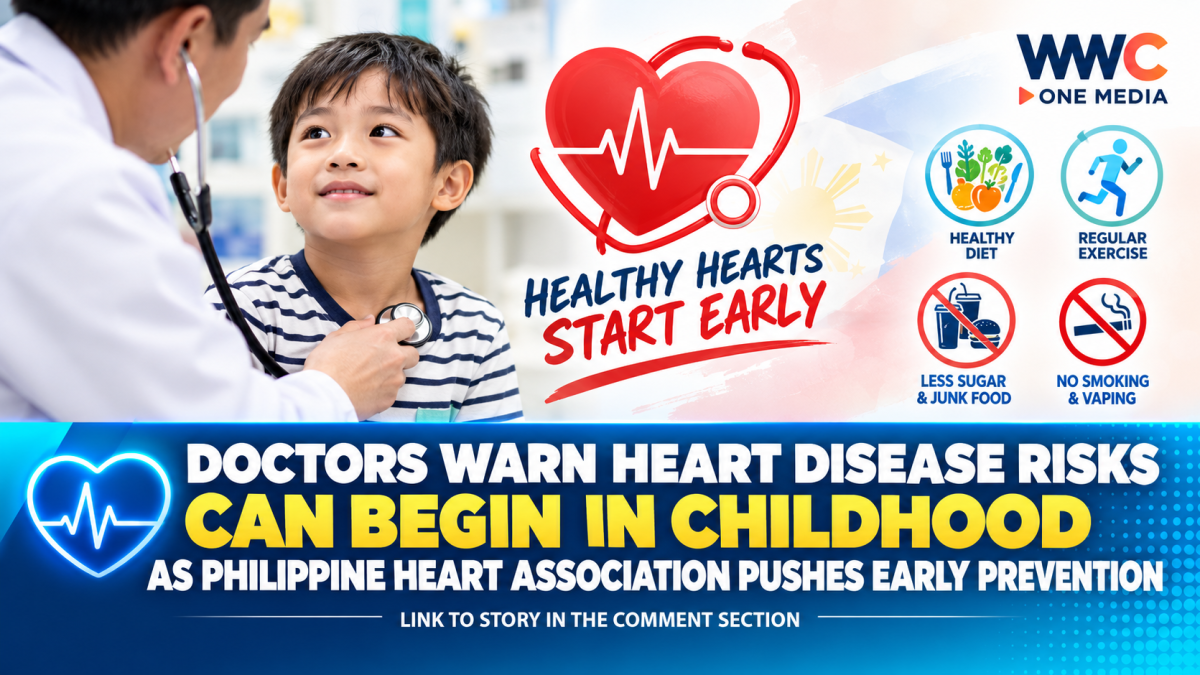
MANILA — Heart disease is often associated with adulthood, but Philippine cardiologists are warning that some of the risk factors behind cardiovascular disease can begin much earlier — even during childhood.
The Philippine Heart Association (PHA) issued the warning during the country’s World Heart Day 2026 observance, emphasizing that high blood pressure, elevated cholesterol and obesity can emerge at a young age and potentially persist into adulthood.
Dr. Maria Concepcion Sison, vice president of the Philippine Society of Pediatric Cardiology and a PHA member, pointed to the long-running Bogalusa Heart Study as evidence supporting the concept of “tracking,” in which certain health measurements and habits established during childhood can continue later in life.
Heart Disease Risk Can Start Earlier Than Expected
Doctors stressed that heart attacks among children remain rare. The concern is instead the gradual development of cardiovascular risk factors that can contribute to disease later in life.
Research associated with the Bogalusa study found links between childhood high blood pressure, high cholesterol and obesity and early development of atherosclerosis, or plaque buildup in the arteries.
That means cardiovascular prevention is not simply an issue for older adults.
For families, doctors say childhood is an important period for establishing habits involving nutrition, physical activity, sleep and avoidance of nicotine.
Doctors Urge Healthier Habits From a Young Age
The PHA is encouraging families to promote balanced nutrition based on “Pinggang Pinoy,” the food guide developed by the Department of Science and Technology’s Food and Nutrition Research Institute.
Children are also encouraged to get 30 to 60 minutes of physical activity at least four times a week, while reducing prolonged sedentary activities such as excessive screen time.
Doctors are also warning young people about exposure to nicotine from cigarettes, tobacco products and vaping, which can affect cardiovascular health.
Routine monitoring of blood pressure and weight beginning around age three was also among the recommendations discussed by the PHA, alongside adequate sleep and stress management.
Philippines Faces a Major Cardiovascular Disease Burden
The warning comes as cardiovascular disease continues to represent a major public-health challenge.
According to the Philippine Statistics Authority (PSA), ischemic heart diseases were the country’s leading cause of death in 2025, with 135,250 recorded deaths, equivalent to 19.7% of all deaths nationwide.
Neoplasms were the second-leading cause with 77,422 deaths, followed by cerebrovascular diseases with 66,988 deaths.
Globally, cardiovascular disease also remains the leading cause of death, according to figures cited by the PHA.
PHA Launches Community Heart-Health Program
The PHA is also taking its prevention campaign directly into communities.
Under “Project Puso: Adopt-a-Barangay,” the association has partnered with Barangay 657 in Intramuros, Manila, where quarterly cardiovascular-risk screenings will be conducted.
The program is intended to establish baseline information that can eventually contribute to a cardiovascular health registry for the community.
The initiative reflects the PHA’s broader World Heart Day message, “Don’t Miss a Beat: Collab sa Bawat Beat,” which emphasizes cooperation among communities, local governments, hospitals, health agencies, policymakers and other sectors.
The Warning Is About Prevention, Not Panic
The message from Philippine cardiologists is straightforward: cardiovascular health should not be treated as something that only becomes important in adulthood.
Healthy routines established early can help address modifiable risk factors before they become more difficult to manage.
With ischemic heart disease already accounting for nearly one in five deaths recorded in the Philippines in 2025, the push for earlier prevention puts children’s long-term heart health into a much larger national-health conversation.
And as doctors continue urging families to act earlier, the question is whether stronger heart-health habits during childhood can help change the country’s cardiovascular picture in the years ahead.
WWC ONE MEDIA G,A