
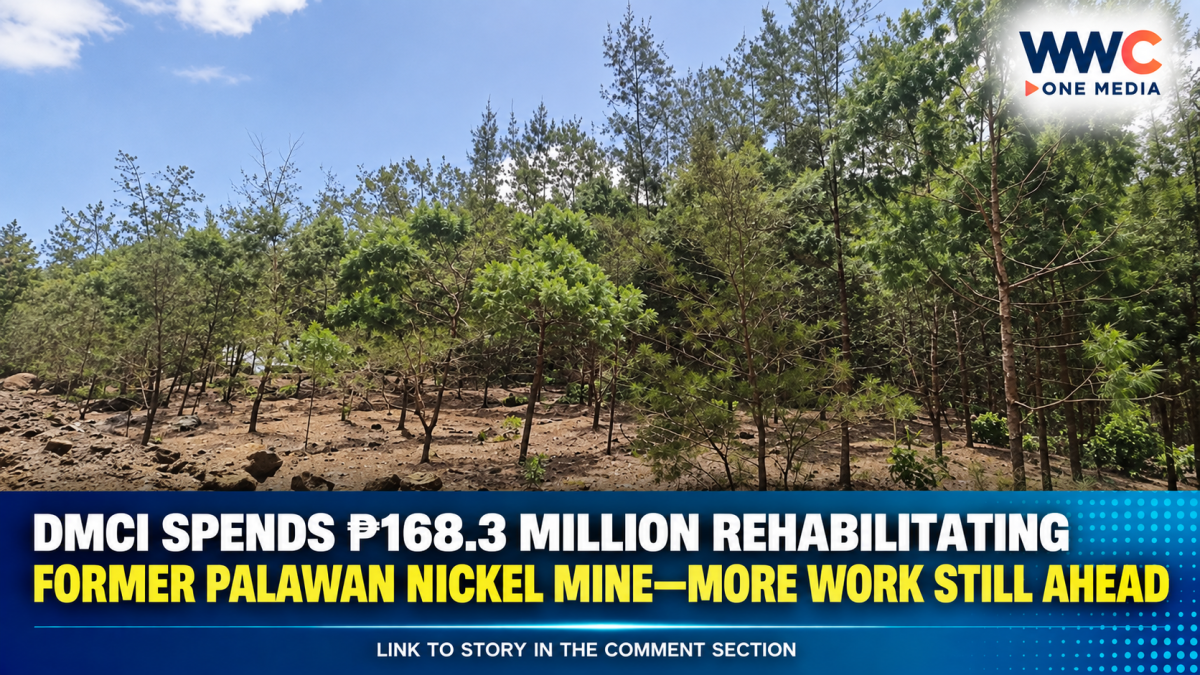
QUEZON, Palawan — DMCI Mining Corp. has spent ₱168.3 million rehabilitating its former Berong nickel mine in Palawan, exceeding its original rehabilitation budget as the company pushes to restore the mined-out area before eventually turning the site over to the government.
The rehabilitation spending covers work carried out from June 2022 through August 2026, according to the company. The amount is about 53% higher than the original ₱110-million budget announced for the six-year rehabilitation program.
DMCI Mining President and COO Tulsi Das Reyes said the company is deliberately going beyond the minimum requirements because it wants the Berong site to become a benchmark for mine rehabilitation.
“We’re actually ahead of schedule,” Reyes said, according to reports on the rehabilitation program.
The mine is closed—but rehabilitation continues
Mining operations at Berong ended in 2021 after the mine was depleted.
Rather than ending activities when mineral extraction stopped, Berong Nickel Corp. began implementing a six-year Final Mine Rehabilitation and Decommissioning Plan (FMRDP) in 2022.
The plan is particularly significant because Berong’s program was the first approved FMRDP for a nickel mine in the Philippines. The rehabilitation is expected to continue through 2027, after which the restored site is scheduled to be turned over to the government.
The Mines and Geosciences Bureau has listed Berong Nickel Corp.’s 288.4-hectare mineral production sharing agreement area in Quezon, Palawan as being under final mine rehabilitation.
More than just planting trees
While tree planting has become one of the most visible parts of the project, the rehabilitation involves considerably more than putting seedlings into the ground.
The program includes slope stabilization, topsoil replacement, erosion control, drainage management, ecological restoration and biodiversity monitoring.
More than 100 hectares of previously disturbed land have already been rehabilitated, according to recent reports.
The company said it has planted nearly 352,000 seedlings, with a reported 97% survival rate. Its nurseries have also produced more than 497,000 seedlings, exceeding its targets for the fourth year of the rehabilitation program.
And the planting will not stop immediately.
DMCI Mining said it expects to plant another 250,000 to 300,000 seedlings through the remainder of the rehabilitation period, while continuing to monitor the restored areas.
Why the extra spending?
The original rehabilitation budget was ₱110 million, but actual spending has now reached ₱168.3 million.
DMCI says the additional expenditure reflects its decision to go beyond minimum compliance and fine-tune the rehabilitation before declaring the project finished.
Reyes said the company could technically finish some aspects earlier but wants to ensure that the restoration is genuinely complete before handing the property over.
In other words, the company is not treating the rehabilitation as simply a box to check before leaving the mine site.
What happens after rehabilitation?
Once the rehabilitation program is completed, the site is expected to be turned over to the government.
Potential future uses discussed for the rehabilitated area include agroforestry, ecotourism and ecological restoration, depending on government and community plans for the property.
DMCI Mining has also indicated that it does not intend to completely disappear once formal turnover occurs.
The company says it wants to remain available to help ensure that the restoration continues to work after responsibility for the site is transferred.
Environmental recovery is already being monitored
The rehabilitation effort is also being watched for signs that ecosystems are returning.
Reports on the Berong project have cited the return of wildlife, including the Palawan horned frog, in areas that were reforested more than a decade ago. Biodiversity monitoring has also detected several bird species in restored areas.
That matters because successful mine rehabilitation is not measured solely by the number of trees planted.
The bigger test is whether soil, vegetation, water systems and wildlife can gradually support a functioning ecosystem again.
Palawan’s mining debate continues
The Berong rehabilitation comes as DMCI expands its presence in Palawan through other nickel operations, including the Long Point project in Aborlan.
GMA News reported earlier this year that DMCI Mining was targeting higher nickel production in 2026, while the company continued developing its Palawan operations.
That makes the rehabilitation of Berong particularly important.
The company is simultaneously pursuing new mining opportunities while restoring a former mine site—putting its environmental commitments under greater scrutiny.
The Department of Environment and Natural Resources has emphasized that mine rehabilitation is a legal requirement under the country’s mining framework, alongside environmental safeguards and monitoring. PNA reported that mining companies operating in Palawan are required to undertake rehabilitation and environmental monitoring as part of their operations and mine-closure obligations.
A bigger test for responsible mining
For DMCI, the Berong project is now more than a cleanup operation.
It is becoming a test of whether a mined landscape can actually be restored after extraction ends—and whether a mining company can demonstrate environmental responsibility beyond the period when it is earning from the mine.
The ₱168.3-million investment is significant, but the real measure of success will come later.
When the equipment is gone, the mine is closed and the government takes control of the property, will the restored land continue to thrive?
That may ultimately be the real test of DMCI’s ambitious rehabilitation program.



Leave a Reply