
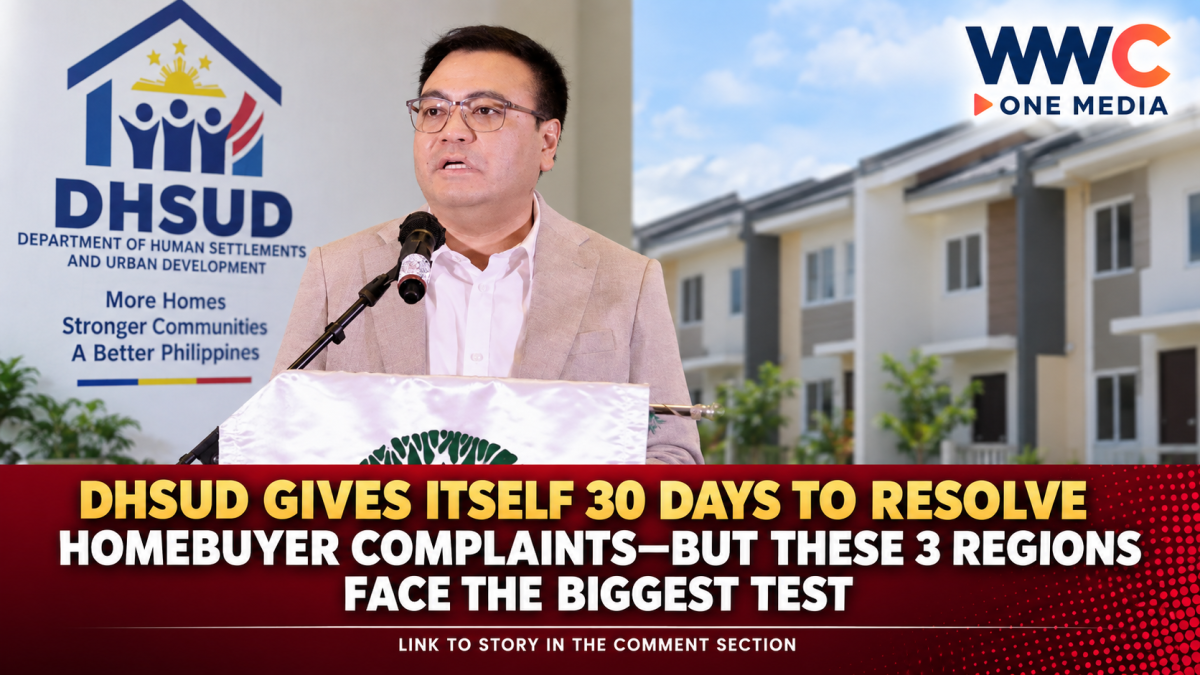
MANILA, Philippines — Homebuyers and homeowners’ associations with long-pending complaints before the Department of Human Settlements and Urban Development (DHSUD) may soon see faster action after the agency ordered its regional offices to resolve outstanding cases within 30 days.
DHSUD Secretary Jose Ramon Aliling directed regional offices, as well as the department’s central-office Homeowners Associations and Community Development Bureau, to immediately act on pending complaints involving homebuyers, developers and homeowners’ association concerns.
The directive was issued as the department shifts its attention from clearing its regulatory backlog to speeding up the resolution of complaints affecting people who have invested their savings in homes and property.
“Concerns and complaints brought to us should not be allowed to drag on, especially those raised by homebuyers who have spent their hard-earned money to own a home,” Aliling said, according to reports from the Philippine News Agency and Daily Tribune.
Three regions get priority
DHSUD has identified Calabarzon (Region 4-A), the National Capital Region and Central Luzon (Region 3) as priority areas because of the volume of complaints and cases handled in these regions.
Regional directors have been instructed to prepare a comprehensive inventory of unresolved homebuyer and homeowners’ association complaints and explain why each case remains pending.
The move is significant for property buyers who have waited months—or longer—for government action on disputes involving developers or community-management issues.
From 3,000-item backlog to a new complaints deadline
The 30-day directive follows DHSUD’s Zero Backlog Program, which the department says cleared more than 3,000 inherited actionable regulatory items, including matters dating as far back as 2021.
According to the PNA, DHSUD cleared the backlog within two months after an internal audit launched in March uncovered pending regulatory applications at the regional level. Officials were subsequently deployed to regional offices to help address the outstanding workload.
The department has also reported that its regional offices have been certifying zero overdue regulatory applications since June.
Under existing DHSUD procedures, regulatory applications are generally required to be acted upon within 15 days, either through approval, denial or issuance of a notice of deficiency in requirements.
The new 30-day directive therefore represents a separate push focused specifically on pending complaints and disputes involving homebuyers and homeowners’ associations.
Why this matters to Filipino homebuyers
For many Filipinos, buying a house, condominium unit or subdivision property represents one of the largest financial commitments they will ever make.
When disputes involving developers, property turnover, contracts or homeowners’ associations remain unresolved, the consequences can extend well beyond paperwork. Buyers may face prolonged uncertainty over their property, payments and community concerns.
DHSUD has previously emphasized the importance of protecting homebuyers and checking whether housing projects have the necessary Certificate of Registration and License to Sell before entering into transactions.
The department has also said it intends to strengthen mechanisms for directly assisting homebuyers and homeowners and to encourage the amicable resolution of homeowners’ association disputes.
DHSUD says mass conciliation will be intensified
Aliling said the department will intensify efforts to resolve concerns through mass conciliation activities in the regions, rather than allowing complaints to remain unresolved indefinitely.
That approach could become particularly important in areas where DHSUD offices are handling large numbers of complaints.
The Human Settlements Adjudication Commission (HSAC), meanwhile, serves as the government’s quasi-judicial body for certain disputes involving real estate developments and homeowners’ associations, including appeals from relevant local and regional planning and zoning decisions.
This means the DHSUD’s administrative and regulatory work and HSAC’s adjudicatory functions can play different roles depending on the nature of a property dispute.
The bigger test begins now
The announcement gives DHSUD a clear target: pending complaints must no longer simply sit in the queue.
But the real measure of the new policy will not be the announcement itself. It will be whether long-delayed complaints are actually resolved within the promised period—and whether homebuyers and homeowners see faster, fairer and more transparent action from the agency.
With Calabarzon, Metro Manila and Central Luzon identified as priority areas, the first major test of the 30-day push is now underway.
For thousands of Filipinos waiting for answers on property-related complaints, the question is no longer simply whether DHSUD has set a deadline.
The bigger question is whether that deadline will finally bring a resolution.
WWC ONE MEDIA J.M.D

Leave a Reply