GWANGJU — What happens when K-pop fandom, religious imagery and queer identity collide inside an art installation?
For Korean artist Dew Kim, the answer is a world where bodies become stages — objects of attention, devotion, desire and scrutiny.
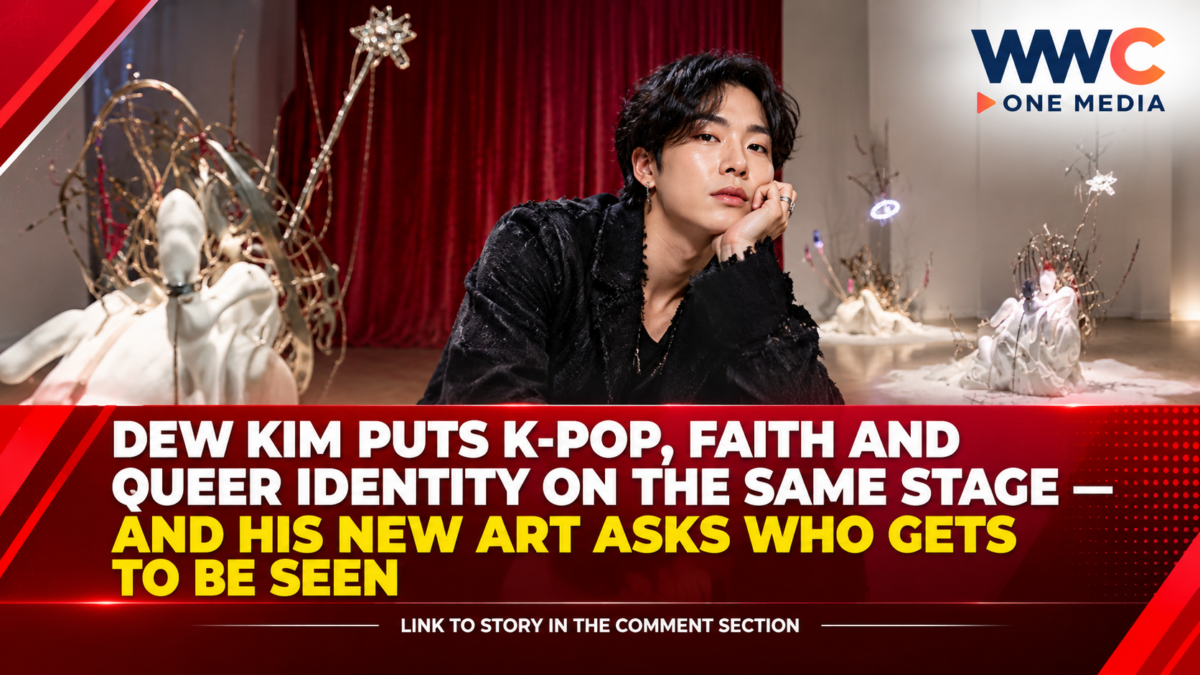
His latest installation, “Legion, Nowhere Whole” (2026), brings together fragmented human and animal-like forms, K-pop symbols, religious references and smartphone screens to explore the pressure to constantly present ourselves to an audience.
The work is currently featured in “The Look is A Li(k)e” at the Italian Pavilion at Donggok Museum as part of the 16th Gwangju Biennale. The exhibition runs through Feb. 14, 2027.
When a K-Pop Light Stick Becomes Part of the Artwork
Kim’s installation immediately plays with familiar symbols of performance.
A pink microphone, a K-pop light stick and a glowing circular light sit above three pale, soft-edged bodies. Chains and metal structures connect the forms, while smartphone screens bring the digital world directly into the physical installation.
The imagery evokes idols, soldiers and religious figures — people whose bodies can become symbols for much larger communities.
Kim said the title was inspired by Roman soldiers who were expected to continue fighting until their bodies were no longer intact.
For the artist, that idea mirrors modern life, where people can feel pressured to continually display themselves, seek recognition and maintain visibility.
Social Media Turns Attention Into Currency
Kim’s work also examines the growing relationship between identity and social media.
He describes digital platforms as spaces where virtually anyone can put themselves on display, build an audience and potentially turn attention into a form of capital.
That visibility can create opportunities, but Kim argues that it can also come with pressure to continually reveal more of oneself to maintain public attention.
The artist does not portray social media as entirely negative, however.
He points to the way digital platforms have helped people who were historically less visible in mainstream media find audiences and communities of their own.
Korean transgender entertainer Pungja, for example, first developed a major audience on YouTube before moving into mainstream television. Kim sees that trajectory as evidence of how digital visibility can open doors for queer communities.
K-Pop and Religion Share an Unexpected Connection
Kim’s interest in K-pop is deeply personal.
He has described the music as having a spiritual presence in his life since childhood and recalled dreaming of becoming a girl-group member.
At the same time, he grew up in a religious household. His father is a pastor, and religious stories surrounding sacrifice and suffering became part of his early imagination.
That combination eventually became important to his artistic practice.
After studying metal craft at Konkuk University and sculpture at the Royal College of Art in London, Kim developed HornyHoneydew, a fictional queer shaman-idol persona that explores his relationship with Christianity, queerness and alternative spiritual traditions.
The Stage, the Altar and the Screen
For Kim, the connection between K-pop, religion and queer performance is not accidental.
An idol performs before fans.
A religious figure can be elevated before followers.
A shaman performs rituals for a community.
Each involves a body being placed before an audience and given meaning through spectatorship.
That relationship between performer and audience is central to Kim’s work because visibility can create power — but that power can also disappear.
The person placed on a pedestal remains vulnerable to the audience watching them.
His Art Is Moving Beyond Gwangju
Kim’s exploration continues beyond “Legion, Nowhere Whole.”
At the Busan Biennale, his installations include stages, microphones, red fabric and intertwined bodies, creating environments shaped by ideas of devotion, collective desire and performance.
The works continue his examination of what happens when people are transformed into objects of attention — whether through pop culture, religion, art or digital platforms.
At the heart of Kim’s practice is a question that feels increasingly relevant in an age of constant posting, fandom and online visibility:
When being seen can create power, what happens to the person who must keep performing to remain visible?
WWC ONE MEDIA G,A