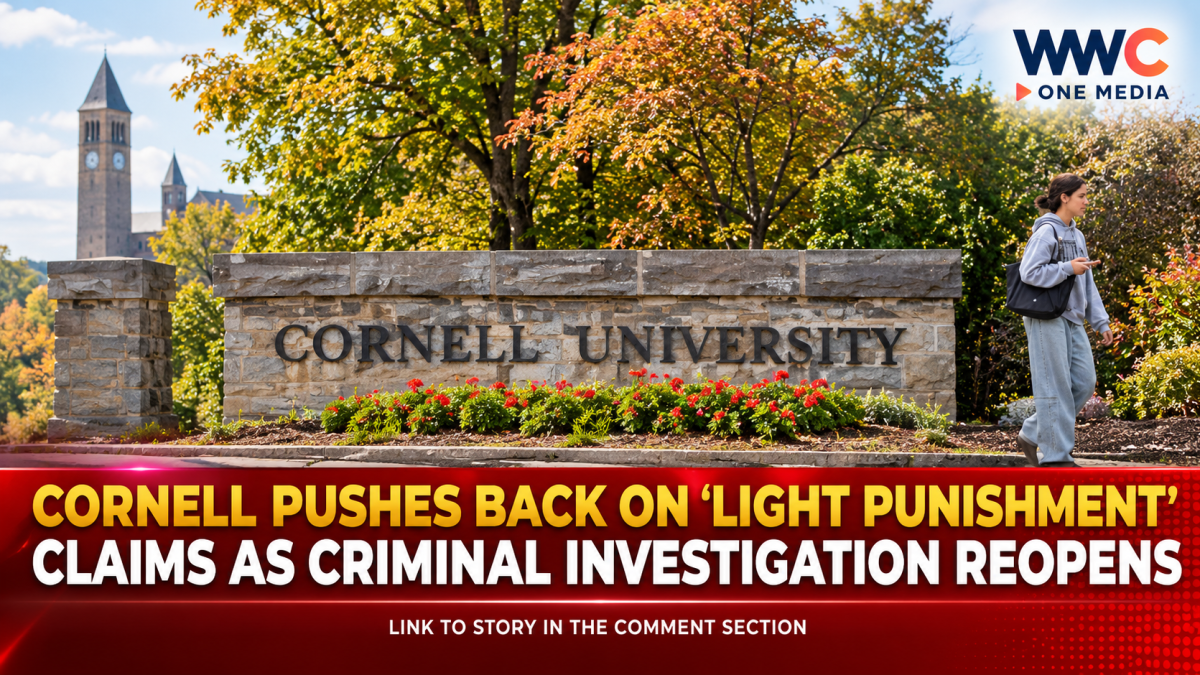
ITHACA, New York — Cornell University is pushing back against claims that students accused in a sexual assault lawsuit received only minimal disciplinary consequences, as prosecutors in New York reconsider whether criminal charges should be pursued in the 2024 case.
The dispute follows a civil lawsuit filed this month by a former Cornell student, identified as Jane Doe, who alleges that seven members of the university’s Chi Phi fraternity sexually assaulted her after she was allegedly drugged at the fraternity house in October 2024.
The allegations have triggered renewed scrutiny of both Cornell’s handling of the case and the original decision not to bring criminal charges. The Tompkins County District Attorney’s Office has now begun reconsidering the matter and plans to present relevant evidence to a grand jury.
Cornell Rejects Claims of Minimal Punishment
Cornell said Tuesday that descriptions of the university’s disciplinary response as offering only light punishment are inaccurate.
The university said it conducted a months-long Title IX investigation, during which temporary suspensions and other restrictions were imposed. A hearing panel made up of trained faculty and staff later reviewed evidence over multiple days, with both the complainant and respondents given opportunities to testify and present evidence.
Cornell said the resulting sanctions included expulsions and suspensions.
The university also rejected claims that students could simply submit essays as their sole punishment. Cornell said the Chi Phi chapter itself was closed in 2024 and remains barred from campus.
Cornell said that portraying the case as one in which there were no meaningful consequences could undermine survivors’ confidence in reporting sexual assault.
Criminal Case Now Back Under Review
The university investigation and criminal process are separate matters.
No criminal charges were filed after the initial police investigation. But Tompkins County District Attorney Matthew Van Houten announced that his office has begun revisiting whether charges should be pursued against the seven fraternity members named in the lawsuit.
Van Houten said the case will be reviewed in light of the allegations contained in the new civil complaint and any additional evidence that emerges.
His office plans to determine what charges, if any, are appropriate before taking the matter to a grand jury. A senior prosecutor has been assigned to prepare the case.
Dispute Over What Investigators Previously Heard
A major issue in the renewed review is the difference between the account authorities say they received in 2024 and the allegations contained in the new lawsuit.
Van Houten said the student’s original sworn statement differed significantly from the account presented in the civil complaint filed nearly two years later.
The plaintiff’s attorney, Thomas Giuffra, disputes that characterization and has criticized the initial investigation, saying important evidence was not adequately pursued.
The disagreement means that the renewed criminal review could focus not only on the allegations themselves, but also on evidence and information that prosecutors say may now warrant another examination.
Cornell Supports Renewed Review
Cornell said it supports the district attorney’s decision to reconsider the criminal case.
The university has maintained that its own disciplinary process resulted in significant sanctions and that its Title IX investigation was conducted separately from any criminal proceeding.
Meanwhile, the civil lawsuit remains an allegation-based proceeding, and the defendants have not been convicted of the alleged offenses.
The renewed criminal review now places the Cornell case back in the spotlight, with prosecutors weighing whether the evidence should lead to criminal charges.
For Cornell, the controversy is no longer only about what happened in 2024 — it is also about how universities, police and prosecutors respond when allegations are revisited years later and new evidence or accounts come forward.
WWC ONE MEDIA G,A