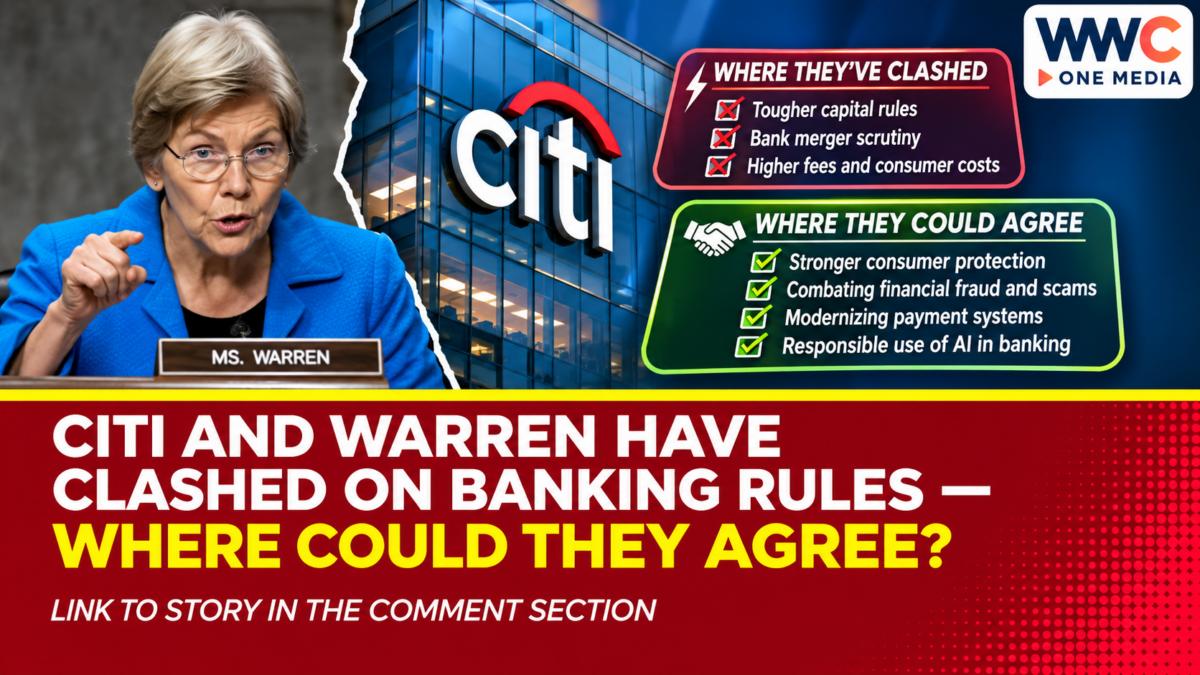
NEW YORK — Nov. 19, 2026. Citigroup chief executive Jane Fraser and US Senator Elizabeth Warren have different publicly documented positions on bank expansion, while an earlier Senate hearing also records agreement on anti-money-laundering standards for cryptocurrency businesses. Citi’s latest quarterly earnings show a growing financial institution facing continuing questions about regulation, risk controls and the limits of consolidation.
The record points to a practical distinction: cooperation on a specific policy is possible without agreement on whether a major bank should grow larger. A newly reported remark about Fraser’s willingness to work with Warren was not independently authenticated from an original recording or company statement for this article.
Citi and Warren: Where Agreement Already Exists
At a December 2023 Senate banking hearing, Warren asked the leaders of major US banks whether cryptocurrency companies should be covered by anti-money-laundering requirements comparable to those applying to established financial institutions. Her official hearing account records Fraser among the executives agreeing with that proposition.
The agreement was on a defined regulatory principle. It did not amount to an endorsement of every cryptocurrency bill, a commitment to a joint legislative proposal or a broader alliance between Fraser and Warren.
For banks, common standards can address an uneven compliance environment. For consumers and regulators, their value depends on how requirements are designed, supervised and enforced. A shared objective does not remove disagreements over the legal details or costs.
That distinction is especially relevant when considering banking oversight priorities in the next Congress. Congressional scrutiny and industry participation can occur simultaneously, even where political priorities differ substantially.
Warren’s July Letter Shows a Significant Divide
On July 8, 2026, Warren, then ranking member of the Senate Banking Committee, publicly released a letter to Fraser questioning reports of potential major acquisitions by Citi. Her statement raised concerns about financial stability, managerial capacity and the public benefits of further bank consolidation.
The senator urged Citi to stop any ongoing acquisition discussions and consider simplifying its structure. Her request is an expression of legislative oversight and policy concern, not a finding that Citi had completed an illegal merger or that a specific proposed transaction had been rejected by regulators.
The statement itself acknowledged uncertainty about whether the bank had concrete plans to pursue an acquisition. That qualification matters: a possible future deal, a formal application and an approved transaction are three different stages.
In March 2024, Warren and Senator Ed Markey also questioned Citi’s earlier role as a lender or adviser in transactions involving Steward Health Care. The senators sought information and raised concerns; their letter did not by itself establish wrongdoing by the bank.
Citi’s Financial Results Give the Debate Commercial Weight
Citi reported third-quarter 2026 revenue of US$23.8 billion, an increase of 8% from the comparable period, and net income of US$5.2 billion. The company identified growth across Services, Wealth, Markets and Banking.
Services generated US$6.6 billion in revenue, up 15%, while Wealth revenue also increased 15%. These are bank-reported operating results, not evidence that every division performed identically or that Citi’s regulatory remediation work has been completed.
At its 2026 investor presentation, Citi described a strategy concentrated on Services, Markets, Banking, Wealth and US Consumer Cards. Management placed emphasis on stronger client relationships, technology and more consistent execution across businesses.
The business model creates policy questions about efficiency and size. Scale may help an international bank offer extensive payment and capital-market services, but it also creates demands for reliable data, controls and supervision.
WWC’s coverage of DBS and Citi’s cross-border payment demonstration provides an example of banking innovation. A successful technology demonstration is different from proof that institution-wide regulatory concerns have been resolved.
Regulatory History Makes Oversight More Than Rhetoric
The Office of the Comptroller of the Currency amended a previous Citibank enforcement action in July 2024 concerning risk management, data governance and internal controls. It also assessed a US$75 million civil penalty, citing failures to meet required remediation milestones and related violations of its earlier order.
That was a formal regulatory action, not a fresh finding about conduct in November 2026. Its existence helps explain why discussions about Citi’s management capacity and operational safeguards have featured in congressional scrutiny.
It would also be wrong to assume that the bank has made no progress. The regulator’s historical action and Citi’s subsequent investor statements describe different points in time and different kinds of evidence. Determining whether specified requirements have been satisfied requires current supervisory records, rather than either a politician’s criticism or management’s optimism alone.
What Cooperation Could Mean — and What It Would Not
Analysis: One plausible area of common interest is preventing financial crime while preserving reliable payment services. Both banks and policymakers can favour robust customer checks, even if they disagree about the scope of regulation or which businesses should bear compliance costs.
Another practical discussion involves technology-related fraud and consumer safeguards. But the reviewed records do not establish that Fraser and Warren reached a new agreement on those subjects in November or decided to jointly sponsor legislation.
Citi also operates in international markets, where regulatory approvals have their own conditions. WWC’s examination of Citi’s expansion into Chinese securities and payments markets offers context for why policy certainty matters to cross-border banking. Foreign market access cannot be taken as evidence of agreement with US lawmakers.
A constructive conversation is not a concession on mergers, and a critical oversight letter is not proof that dialogue is impossible. Both claims would oversimplify the record.
What Happens Next
The strongest evidence of renewed cooperation would be an authenticated joint statement, a published policy proposal or a documented hearing exchange outlining specific commitments. On acquisitions, a formal application and the relevant regulator’s decision would provide a clearer basis for judgment than hypothetical merger discussions.
Meanwhile, Citi’s future disclosures may show how revenue growth, investment in controls and regulatory remediation develop. Its financial performance and its policy relationship with Warren should be measured separately.
For now, the verified picture contains both a real disagreement over large-bank expansion and a prior instance of agreement on financial-crime rules. It does not establish a new political partnership.
Frequently Asked Questions
Has Jane Fraser formally agreed to work with Elizabeth Warren in 2026?
The newly reported remark was not authenticated from an original interview recording or Citi statement reviewed here. Official records do document past agreement on a specific anti-money-laundering principle.
Why has Warren criticised Citigroup?
Her July 2026 letter questioned potential acquisitions and identified concerns about systemic risk, managerial capacity and public benefit. These were the senator’s arguments, not a ruling that a particular acquisition was unlawful.
How did Citi perform in the third quarter of 2026?
Citi reported US$23.8 billion in revenue, up 8%, and US$5.2 billion in net income. Services revenue increased 15% to US$6.6 billion.
Can Citi and Warren agree on financial regulation?
They have agreed on the principle that cryptocurrency companies should meet comparable anti-money-laundering requirements. That does not mean they share positions on bank mergers, enforcement or every proposed law.