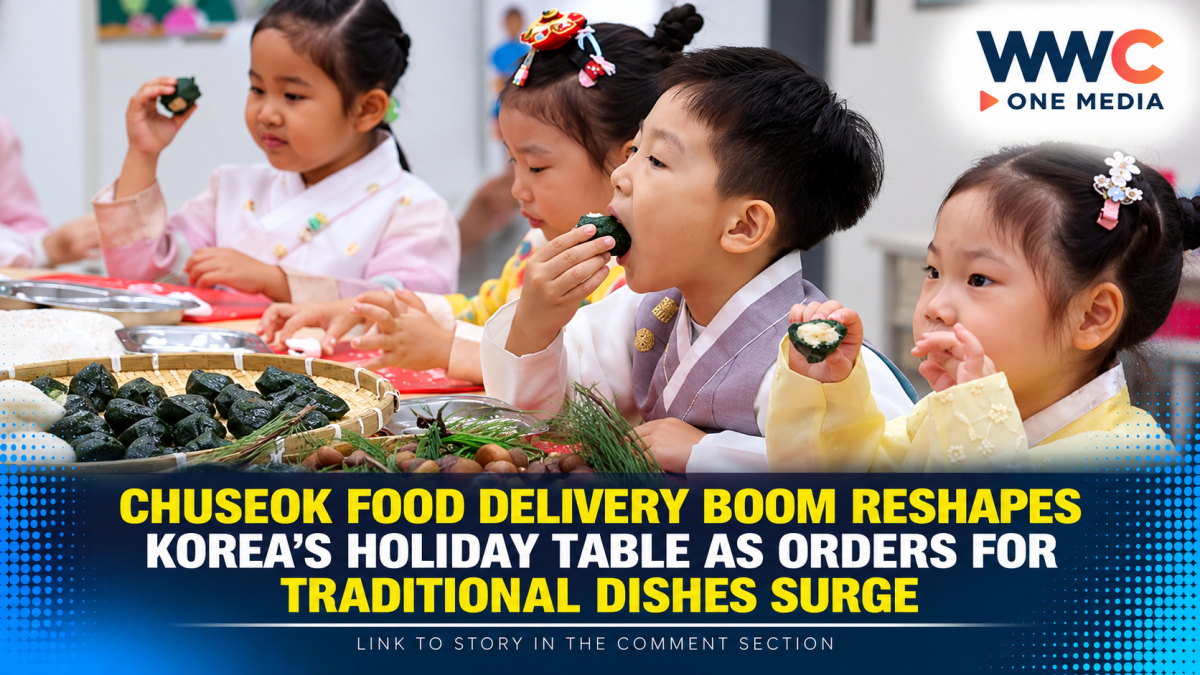
SEOUL — South Korea’s traditional Chuseok holiday is increasingly being celebrated with a modern convenience: food ordered straight to the doorstep.
As the four-day Chuseok holiday runs from September 24 to 27, delivery platforms and retailers are seeing strong demand for traditional holiday dishes, ready-to-eat meals and food designed for family gatherings.
Data released by Woowa Brothers, operator of Baedal Minjok (Baemin), showed just how sharply demand can rise during Chuseok. On Chuseok Day last year, orders for songpyeon, the traditional rice cake associated with the holiday, jumped 4.8 times compared with the same day of the previous week.
Other classic dishes also recorded significant increases. Orders for assorted jeon (modumjeon) rose 270 percent, while orders for namul, or seasoned vegetable dishes, climbed 135 percent. Orders for galbijjim, a braised beef-rib dish, increased 39 percent, while traditional sweets including yakgwa and hangwa rose 44 percent.
From Home Cooking to One-Tap Holiday Meals
The numbers point to a broader change in how Korean households prepare for major holidays.
Rather than buying ingredients and spending hours preparing multiple dishes, some consumers are choosing completed meals that can be delivered or purchased ready to eat.
Baemin’s data also showed that orders were particularly concentrated on Chuseok Day itself. About 40 percent of the day’s orders last year came between 8 a.m. and 11 a.m., suggesting that consumers were placing orders early as families prepared for holiday meals and gatherings.
The platform also found that consumers were increasingly trying restaurants they had not previously ordered from. On Chuseok Day last year, 67 percent of completed Baemin orders were first-time orders from particular merchants, compared with 49 percent during the previous week. The increase was partly associated with people spending the holiday in different areas or seeking alternatives when their usual restaurants were closed.
A Shorter Holiday Could Intensify Delivery Demand
This year’s Chuseok holiday is relatively short, running from September 24 through 27. That compressed schedule could further concentrate demand for convenient meals.
Seoul Economic Daily reported that Yogiyo’s analysis of last year’s holiday orders showed increases in group-oriented foods, including pizza, Western food, burgers and chicken. Pizza and Western-food orders rose 21.8 percent from the previous week, while burger and chicken orders increased 13.8 percent and 13 percent, respectively.
A separate survey of 1,000 adults conducted ahead of Chuseok found that 59.6 percent selected staying home as a holiday plan, compared with 40 percent who planned to visit their hometown. Because respondents could select multiple answers, the figures do not represent mutually exclusive groups.
That preference for staying home is helping reshape the holiday food market around convenience and shared meals.
Convenience Stores Join the Chuseok Food Shift
The change is not limited to delivery apps.
Korea JoongAng Daily reported that major convenience-store chains CU, GS25, 7-Eleven and Emart24 expanded their Chuseok offerings this year, targeting people who are celebrating alone or want smaller portions.
Their holiday selections include boxed meals, individual dishes, gimbap, rice balls and desserts, reflecting the growing demand for flexible portions rather than the large traditional spread associated with extended-family gatherings.
Retailers are also expanding the ready-made holiday-food market.
According to Yonhap, Emart offered discounts on 55 varieties of Peacook Chuseok ready-to-eat ancestral-rite foods, including songpyeon and assorted jeon. The retailer said sales of several prepared holiday foods increased last year, including a 14 percent rise in prepared namul sales and a 29 percent increase in fried foods and neobiani.
The Cost Factor Is Also Changing the Holiday Table
Convenience is only part of the story.
The Korea Times reported that the average cost of preparing a charye meal for a family of four was estimated at 313,089 won this year, down 2.3 percent from the previous year. Lower prices for some fruit, seafood and processed foods contributed to the decline, although some livestock products became more expensive.
That means households have more options than simply choosing between a fully homemade holiday table and restaurant food. Prepared dishes, convenience-store meals, supermarket offerings and delivery services are creating a much broader middle ground.
Chuseok Tradition Meets the On-Demand Economy
The rise in holiday food delivery does not necessarily mean traditional Chuseok food is disappearing.
Instead, the data suggests that the way people obtain traditional food is changing.
Songpyeon, jeon, namul and other familiar dishes remain closely associated with the holiday, but consumers increasingly have the option to order them rather than prepare every dish from scratch.
For businesses, that shift creates a concentrated opportunity during the holiday period. For consumers, it means a Chuseok meal can increasingly be assembled with a few taps rather than hours of shopping, preparation and cooking.
And as more Koreans spend the holiday at home, live alone or celebrate in smaller groups, the biggest change may not be what’s on the Chuseok table — but who prepares it.
WWC ONE MEDIA G,A