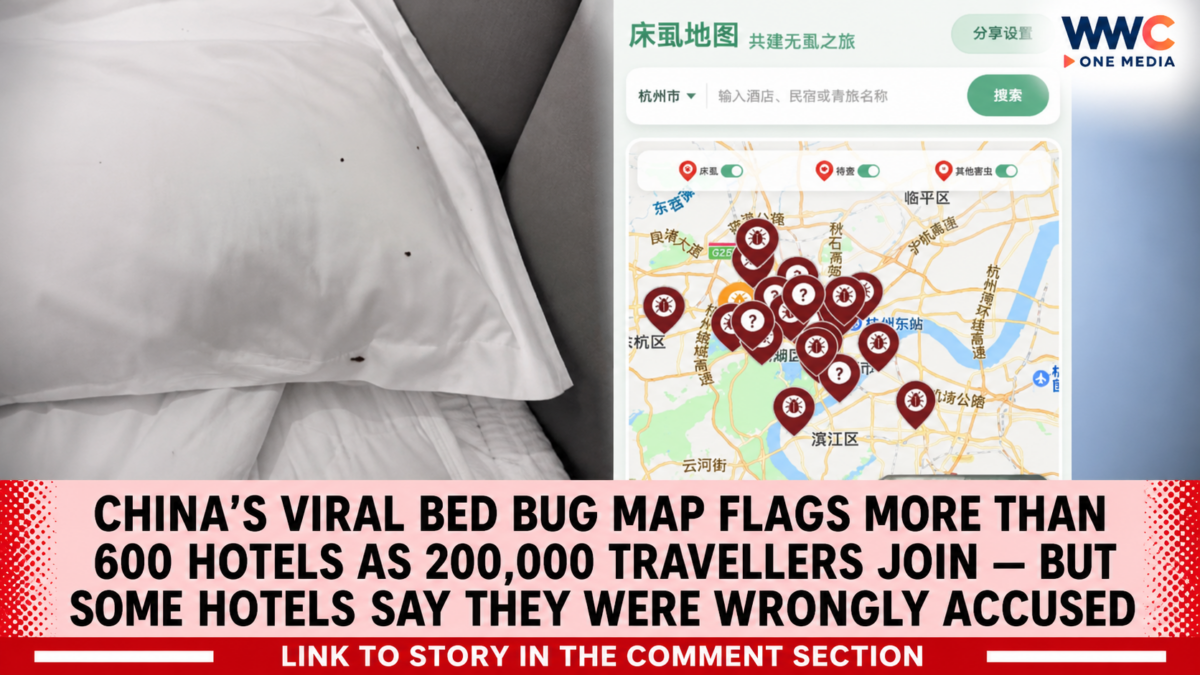
A crowdsourced hotel bed bug tracking map has exploded in popularity across China, attracting more than 200,000 users and flagging over 600 hotels in a controversy that is putting accommodation hygiene, consumer protection and hotel reputations under the spotlight.
The digital platform, known as Bedbug Map, allows travellers to identify hotels where they claim to have encountered bed bugs and share the reported locations with other users. What began as an effort to help people avoid unpleasant hotel stays has quickly become a contentious issue for the hospitality industry, with some establishments challenging the accuracy of the allegations.
The platform’s popularity reflects a growing concern among travellers about hotel cleanliness. But it has also exposed a difficult question: how can consumers share warnings about possible infestations without unfairly damaging businesses through unverified claims?
More Than 200,000 Users Join China’s Viral Bedbug Map
According to reports by AsiaOne and the South China Morning Post, Bedbug Map attracted more than 200,000 users after its September 21, 2026 launch, with reports identifying more than 600 hotels across China.
The WeChat mini-program allows users to locate hotels on a digital map and submit reports about suspected bed bug sightings. Its purpose is to bring together information that might otherwise remain scattered across social media posts and individual travel reviews.
The platform was developed by a manufacturing engineer identified as Wang, who reportedly had no previous programming experience.
His motivation came from a personal experience. After being bitten by an insect while moving house, he searched online for information about bed bugs and discovered that complaints about hotel infestations were difficult to find in one place.
Using artificial intelligence tools to help develop the software, he created a platform where travellers could share information and warn others about potential accommodation problems.
The idea quickly attracted public attention, particularly among people who regularly travel for work or leisure.
For travellers, the appeal is straightforward: being able to check reported pest problems before paying for a hotel room could help them make more informed accommodation decisions.
Hotels Push Back Against Allegations of Bed Bug Infestations
The platform’s rapid growth has not been welcomed by everyone.
Several hotel operators have complained that their establishments were listed despite disputes over whether bed bugs were actually present.
One major concern was the platform’s original reporting system, which allowed users to flag hotels without initially providing photographic evidence.
That created opportunities for inaccurate reports, mistaken insect identification and potentially malicious complaints.
One widely reported dispute involved Guangzhou Mansion in central Beijing.
A guest reportedly demanded a refund of approximately 3,000 yuan for a four-night stay after claiming to have suffered bed bug bites. The complaint was subsequently shared online and the hotel was flagged on the map.
The hotel disputed the allegation and hired an independent pest-control company to inspect the guest’s room and 23 other randomly selected rooms.
According to the hotel’s account, the inspection found no bed bugs or eggs.
The establishment submitted its inspection findings and pest-control records through the platform’s appeals process. Its appeal was accepted, and the disputed marker was removed.
The incident illustrates why a reported bite or online complaint should not automatically be treated as proof that a hotel has an infestation.
Developer Introduces Stricter Verification After Backlash
Following complaints from hotels and concerns about the reliability of reports, the platform’s creator introduced changes to its verification process.
Users are now required to submit photographic evidence when reporting suspected bed bugs. The developer also reviews submissions manually and may seek help from other people to determine whether the insects shown in photographs are actually bed bugs.
Hotels have also been given an opportunity to challenge reports by submitting supporting documents, including business registration information, disinfection records and third-party pest-control inspection reports.
The platform was reportedly suspended twice in October before returning with stricter reporting requirements.
However, the changes have not completely resolved concerns about accuracy and accountability.
A report published by Sixth Tone on November 4 described further adjustments, including tighter manual screening and the rejection of questionable submissions. It reported that the number of marked hotels had fallen to 232 during its review, while 36 hotels had successfully appealed their listings.
These figures reflect different reporting snapshots and moderation stages, rather than necessarily indicating that all previously reported infestations had been disproved.
The developer has acknowledged that operating the platform alone has limitations and that its verification process still needs improvement.
Experts Warn That Skin Bites Do Not Automatically Prove Bed Bugs
The controversy has also drawn attention to the difficulty of identifying bed bugs correctly.
Bed bugs are small insects that hide in places such as mattress seams, bed frames, furniture joints and cracks in walls. They typically emerge to feed during the night, making them difficult to detect during routine daytime room cleaning.
However, not every insect found in a hotel room is a bed bug, and not every unexplained skin reaction is caused by one.
Experts cited by Chinese media have warned that mosquito bites, allergic reactions and other insect bites can look similar. A photograph of skin irritation alone cannot conclusively establish that a hotel room contains bed bugs.
This distinction is important because an incorrect identification could lead to a hotel being publicly associated with an infestation even when the claim has not been professionally verified.
An expert quoted by Shanghai’s City News Service also noted that bed bugs can be transported into accommodation through guests’ luggage and belongings. Their presence does not automatically establish that an entire hotel is infested.
Even when an insect is discovered in one room, that does not prove every room in the establishment has the same problem.
Hotels Face Reputation Risks as Legal Questions Emerge
Beyond accommodation hygiene, the growing controversy has raised questions about online accountability and the legal consequences of publishing unverified allegations.
A hotel can suffer reputational damage when its name appears on a public map associated with pests, particularly if the listing spreads through social media before the business has an opportunity to respond.
Lawyer Lin Feiran of Beijing Jindu Law Firm, cited in reports about the platform, warned that inaccurate infestation claims could trigger disputes involving business reputation.
Legal and verification safeguards could include requiring users to agree that their reports are truthful and introducing professional insect-identification checks.
The challenge is to protect travellers’ right to share genuine experiences while ensuring that businesses are not unfairly targeted.
A platform that accepts public complaints also needs a transparent process for reviewing evidence, correcting mistakes and removing inaccurate information.
The Bed Bug Map Is Also Exposing a Gap in Hotel Hygiene Information
The platform’s popularity points to a wider problem in China’s accommodation industry: travellers often have limited access to reliable, centralised information about pest complaints and hotel hygiene inspections.
Consumers may find individual complaints on social media, but those posts can quickly disappear beneath newer content or become difficult to locate when researching a hotel.
Bedbug Map attempts to address that problem by gathering reports in one place.
However, Chinese media commentary has argued that crowdsourced platforms should complement, rather than replace, official inspection and complaint systems.
Hotel booking platforms could also improve their reporting procedures by allowing guests to submit evidence of suspected infestations and giving hotels a formal opportunity to respond.
More transparent inspection records and professional pest-control verification could help consumers distinguish confirmed problems from unsubstantiated allegations.
The controversy is particularly relevant as China continues to attract large numbers of domestic and international tourists. WWC ONE MEDIA previously examined the country’s massive holiday travel demand in China Braces for Record 2.13 Billion Trips as Golden Week Travel Rush Reaches Historic Scale.
What Travellers Should Check Before Booking a Hotel
The viral map may offer an additional source of information, but travellers should avoid treating every marker as an official finding.
Before booking or checking into accommodation, travellers can take several practical precautions:
- Read recent guest reviews and look for repeated, specific complaints rather than relying on a single accusation.
- Check mattress seams, bed frames, headboards and nearby furniture for live insects, shed skins, eggs or small dark spots.
- Keep luggage away from beds and upholstered furniture until the room has been inspected.
- Photograph any suspected infestation and notify hotel management immediately.
- Request a room change or alternative accommodation if a genuine concern is identified.
- Keep booking records, photographs and written communications if a dispute or refund request becomes necessary.
Travellers should also remember that bed bugs can travel in luggage and clothing. Finding them in a hotel does not necessarily mean they originated there.
China’s Hotel Industry Faces a New Test of Consumer Trust
Bedbug Map has become more than a travel convenience. Its rapid rise has exposed the tension between consumers demanding greater transparency and hotels seeking protection against inaccurate public accusations.
For travellers, the platform offers a new way to discover potential accommodation problems before making reservations. For hotel operators, it creates pressure to maintain effective pest-control procedures and respond quickly when complaints arise.
But its long-term credibility will depend on whether reports can be verified consistently and whether hotels have a fair opportunity to challenge mistakes.
The bigger lesson is that online reviews and crowdsourced warnings can help consumers make better decisions, but they should never be confused with professional inspections or official hygiene assessments.
As China’s viral hotel bed bug map continues to attract attention, travellers may gain a powerful new tool for checking accommodation risks. Yet one inaccurate report could also put an innocent hotel’s reputation at risk.
For more travel industry developments, read WWC ONE MEDIA’s coverage of Singaporean Content Creators Warning Tourists About Their Chongqing Experience, Booking Holdings’ Travel Industry Warning, Taiwan’s New China Group-Travel Rules and the Shift in Filipino Travel Demand Towards China and Vietnam.