
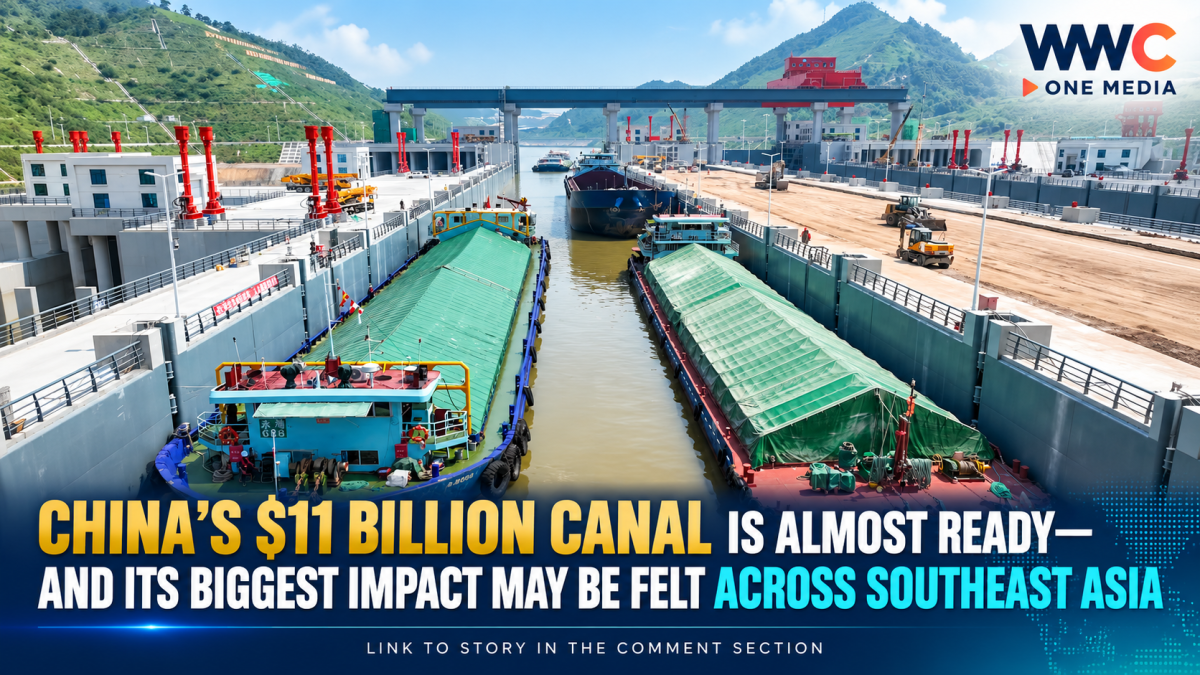
At the foot of the green hills of southern China’s Guangxi region, a massive engineering project is moving closer to reality.
The Pinglu Canal, a 134.2-kilometer waterway linking inland rivers in Guangxi to the Beibu Gulf and the South China Sea, is preparing for vessel trials ahead of its expected opening. But the project is about far more than moving ships and cargo.
It is increasingly being seen as a powerful symbol of China’s strategic shift toward Southeast Asia and ASEAN, as Beijing looks for new trade routes, stronger economic partnerships and deeper regional connections amid growing geopolitical and trade tensions with the United States and Western countries.
China’s New Gateway to the Sea
The Pinglu Canal is designed to connect China’s western and inland regions directly to the sea, allowing cargo to move more efficiently toward Southeast Asian and global markets.
Chinese authorities say the canal will accommodate vessels of up to 5,000 tonnes, making it a major new transport artery for the country’s interior provinces.
According to China’s State Council Information Office, the canal stretches from the Pingtang River in Hengzhou, Guangxi, to the Beibu Gulf. It is also a key component of China’s New International Land-Sea Trade Corridor, a transport network designed to link inland China more closely with ASEAN and international markets.
The strategic importance is already visible in the growth of that broader trade network. China’s official figures show the New International Land-Sea Trade Corridor handled a record 1.425 million twenty-foot equivalent units of cargo in 2025, while its network had expanded to reach hundreds of ports worldwide by 2026.
For Beijing, the message is clear: China’s next phase of economic connectivity may increasingly run south.
Why Southeast Asia Matters More Than Ever
For years, China’s economic strategy focused heavily on links with Europe, the United States and major global shipping routes.
But the geopolitical landscape is changing.
Trade tensions, tariffs, supply-chain restrictions and growing strategic competition with Washington have pushed Beijing to strengthen relationships closer to home.
That makes Southeast Asia increasingly important.
ASEAN is not just China’s neighbor. It is one of the world’s fastest-growing economic regions, home to hundreds of millions of consumers and rapidly expanding manufacturing, energy and logistics industries.
A recent Reuters analysis noted that Southeast Asia has become an increasingly important market for Chinese exports and investment, including clean energy technology, batteries, electric vehicles and solar equipment.
At the same time, countries across the region are trying to maintain strategic flexibility rather than choosing between China and the United States.
Leaders and policymakers across Asia have increasingly emphasized the need to attract investment, build resilient supply chains and preserve economic independence amid the intensifying rivalry between the world’s two largest economies.
That makes infrastructure projects like the Pinglu Canal more than just domestic construction projects.
They could become part of a much larger economic contest.
A Direct Route to ASEAN Markets
The canal is expected to reduce transportation distances and logistics costs for manufacturers and exporters in inland China.
For Guangxi and neighboring provinces, it could provide a faster route to ports and shipping lanes serving Southeast Asia.
That matters because Guangxi occupies a strategically important position along China’s southern frontier and has increasingly been promoted as a gateway connecting China with ASEAN.
The Pinglu Canal could allow goods from inland Chinese regions to move toward the Beibu Gulf before continuing to markets across Southeast Asia and beyond.
Supporters believe the project could transform Guangxi from a regional transport hub into one of China’s most important international trade gateways.
But the bigger question is whether this infrastructure boom will also strengthen China’s influence across Southeast Asia.
China’s Infrastructure Strategy Is Evolving
The Pinglu Canal comes at a time when Beijing is adjusting its international infrastructure strategy.
Massive overseas projects under the Belt and Road Initiative have faced growing scrutiny over debt, environmental risks and financial sustainability.
In response, China has increasingly emphasized smaller, more commercially viable projects while continuing to invest heavily in strategic infrastructure and supply chains.
A 2026 research brief from the East Asian Institute at the National University of Singapore noted that China’s Belt and Road strategy has been evolving toward projects described as more sustainable, technologically focused and economically targeted, while infrastructure remains an important tool of Beijing’s broader economic engagement.
The shift does not necessarily mean China is building less.
It may mean China is becoming more selective about where infrastructure can deliver both economic and strategic value.
And Southeast Asia appears to be at the center of that calculation.
Cambodia Shows How the Strategy Extends Beyond China’s Borders
China’s growing infrastructure focus in Southeast Asia is also visible in Cambodia.
The China-backed Funan Techo Canal has been promoted by Cambodia as a potentially transformative project that would connect areas near Phnom Penh with the Gulf of Thailand.
The project has also attracted international attention because of its potential economic, environmental and strategic consequences.
Reports from the Associated Press said Cambodia and China reached agreements involving financing and construction for the canal, with Cambodian and Chinese investors involved in the project.
However, the project has also faced questions about financing, environmental effects and its potential impact on water flows affecting the Mekong River and Vietnam’s Mekong Delta.
The Mekong River Commission has sought further information regarding the potential impact of the canal, while reports have highlighted concerns about how changes to regional water systems could affect downstream communities.
Meanwhile, China and Cambodia reaffirmed supply-chain and infrastructure cooperation during Chinese President Xi Jinping’s Southeast Asia trip in 2025, underlining Beijing’s broader effort to strengthen economic partnerships throughout the region.
Together, projects like the Funan Techo Canal and the Pinglu Canal illustrate a larger trend:
China is investing heavily in the infrastructure that connects it to Southeast Asia.
The New Battle May Be Over Supply Chains
The Pinglu Canal is being built at a time when global supply chains are undergoing major changes.
Companies are diversifying manufacturing. Governments are looking for secure shipping routes. Countries are competing for investment in ports, industrial zones, clean energy and logistics.
Southeast Asia has become one of the biggest beneficiaries.
Vietnam, Indonesia, Malaysia, Thailand, the Philippines and other ASEAN economies are attracting increasing investment as companies seek alternatives or additions to traditional manufacturing centers.
China remains deeply integrated into these supply chains.
Reuters has reported that ASEAN countries face the difficult challenge of balancing economic ties with China while also managing pressure from the United States to diversify supply chains and reduce certain forms of dependence on Chinese manufacturing.
That means the competition is not simply about who sells more goods.
It is increasingly about who controls the routes, infrastructure, technology and logistics systems that move those goods.
More Than a Canal?
For China, the Pinglu Canal could deliver significant economic benefits by lowering transport costs and improving access to international shipping routes.
But its strategic value may be just as important.
The canal gives China another way to connect its vast inland economy to southern maritime routes. It strengthens Guangxi’s position as a gateway to ASEAN. And it reinforces Beijing’s effort to build deeper economic relationships across Southeast Asia.
The project also arrives at a moment when Southeast Asia is becoming increasingly important to China’s exports.
Reuters reported this month that ASEAN has become a major destination for Chinese clean-energy products, with Southeast Asian demand helping absorb billions of dollars in Chinese exports ranging from solar panels to energy-storage systems and other technologies.
The Pinglu Canal could eventually help move more of those goods.
What Happens Next?
With vessel trials underway ahead of the canal’s opening, attention is now turning to whether the massive project will deliver on its promise.
Will it significantly reduce shipping costs?
Can it accelerate development in Guangxi and China’s inland provinces?
And perhaps most importantly, will it help cement Southeast Asia as China’s most important economic frontier in the years ahead?
The answer could have consequences far beyond southern China.
As the United States and China compete for influence, technology and supply-chain control, Southeast Asia is emerging as one of the world’s most important strategic economic battlegrounds.
And somewhere between China’s inland rivers and the ports of the Beibu Gulf, an $11 billion canal is preparing to carry that competition into a new era.
The canal may be built in China—but its biggest story could unfold across Southeast Asia.


Leave a Reply