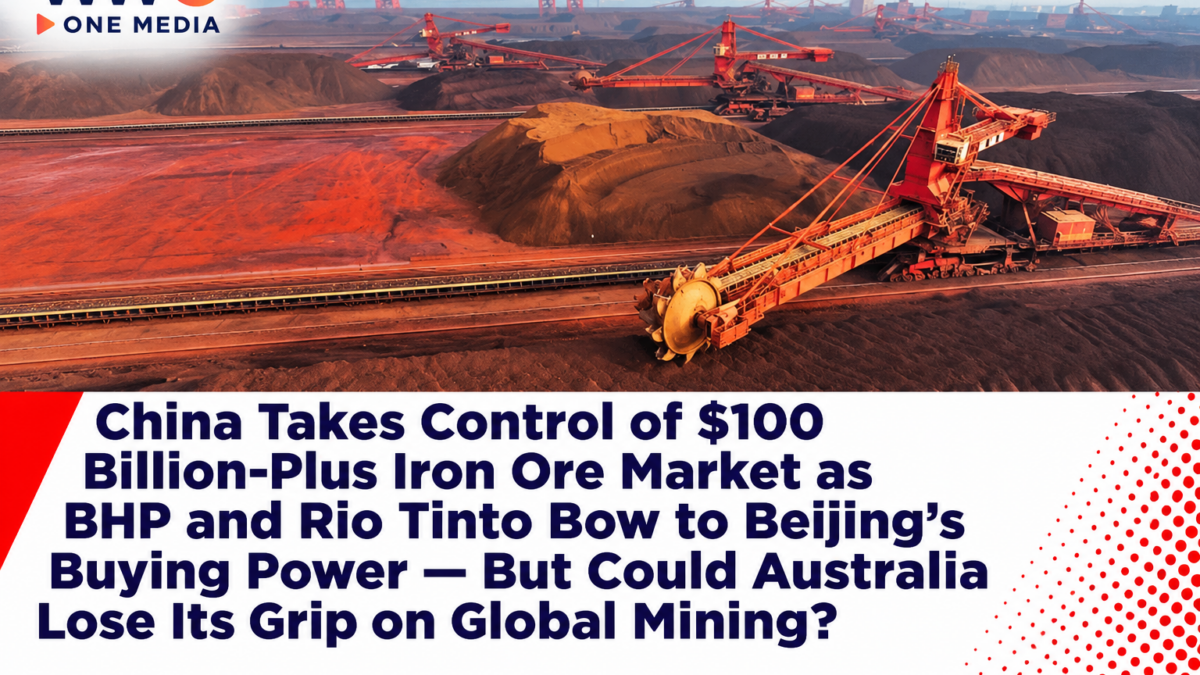
BEIJING / SINGAPORE / SYDNEY / MANILA — November 11, 2026 | WWC ONE MEDIA | Global Business, Mining, Commodities and Financial Markets
China is reshaping one of the world’s most important commodity markets, using its enormous purchasing power to secure major iron ore agreements with global mining companies and challenge the pricing arrangements that have governed international trade for decades.
At the center of Beijing’s strategy is China Mineral Resources Group (CMRG), the state-backed purchasing organization established in 2022 to consolidate the bargaining power of Chinese steelmakers.
According to Bloomberg’s November 10 report, CMRG has achieved a series of important negotiating victories in 2026, securing agreements involving mining giants BHP Group, Rio Tinto and other international suppliers.
The developments have established the Chinese buyer as an increasingly influential participant in an iron ore market worth more than US$100 billion annually.
But the implications extend well beyond mining contracts.
China is also promoting greater use of the yuan in iron ore transactions, challenging the traditional dominance of US-dollar pricing benchmarks.
For Australia, whose resource industry depends heavily on Chinese demand, the shift creates a complicated commercial challenge.
For global investors, it raises questions about commodity prices, corporate profitability and the long-term balance of power between the world’s largest iron ore consumer and its major suppliers.
China has already demonstrated that its purchasing decisions can move international markets. But could its latest agreements mark the beginning of a wider transformation in how the world trades essential industrial commodities?
China Mineral Resources Group Becomes a Powerful Force in Global Iron Ore
China is the world’s largest iron ore importer and steel producer.
Its demand supports major mining operations in Australia, Brazil, South Africa and other resource-exporting countries.
The country purchases roughly three-quarters of internationally traded seaborne iron ore, according to Reuters.
Yet despite this enormous influence, Chinese steel companies historically negotiated many supply arrangements individually.
That fragmented structure limited their collective bargaining power against large mining companies.
In 2022, Beijing established China Mineral Resources Group to consolidate procurement and negotiate more favorable commercial terms.
The idea was straightforward: if Chinese steelmakers purchased iron ore through a coordinated organization, they could potentially negotiate more effectively with major suppliers.
CMRG has since expanded its influence across negotiations involving some of the world’s largest mining companies.
Research firm Wood Mackenzie estimated in August 2026 that the organization was negotiating for more than half of China’s annual iron ore import volumes.
That estimate does not mean CMRG owns all those supplies or directly controls every purchase.
It does, however, illustrate how much purchasing influence has become concentrated within a single state-backed organization.
For mining companies, dealing with CMRG increasingly means negotiating with an institution capable of influencing demand across a large group of customers.
BHP Ends Months of Conflict With China’s State Buyer
One of the most closely watched developments involved Australian mining giant BHP Group.
The dispute began when CMRG pushed for changes to purchasing arrangements and pricing terms.
During negotiations, some Chinese steelmakers and traders were instructed to suspend purchases of selected BHP iron ore products.
The restrictions complicated the miner’s access to its largest export market.
Reuters and Bloomberg reported that the dispute continued for months before an agreement was reached in April 2026.
Under the new arrangement, BHP accepted changes that included greater use of yuan-denominated pricing.
The agreement demonstrated China’s ability to use its purchasing scale to influence the commercial terms offered by a major international supplier.
However, the settlement should not be interpreted as BHP abandoning US-dollar transactions entirely.
Nor does it mean that Beijing acquired operational control over BHP’s mines.
BHP remains an independent Australian mining company.
The development instead illustrates how the balance of negotiating power is changing.
When a buyer represents a substantial share of market demand, even the largest producers may need to accommodate its commercial preferences.
Rio Tinto Reaches Major Supply Agreement Through May 2028
China’s negotiating influence became even more apparent in October.
CMRG reached an agreement with Rio Tinto, another major Australian iron ore producer.
According to Bloomberg’s October 22 reporting, the agreement covers supply arrangements from November 2026 through May 2028.
Reuters separately confirmed that CMRG had informed some Chinese steelmakers of a new supply arrangement with Rio Tinto.
The agreement followed a period of negotiations during which CMRG instructed some mills to suspend discussions or purchases involving selected Rio Tinto products.
That approach increased pressure on the miner as the parties sought to settle commercial terms.
The final agreement reduced uncertainty surrounding future supply.
However, the complete pricing formula, contract volumes and other commercial details have not been publicly disclosed.
Rio Tinto has emphasized its longstanding relationship with Chinese customers while declining to comment on confidential negotiations.
The outcome represents another significant step in CMRG’s efforts to centralize China’s international iron ore procurement.
It also reinforces the importance of China’s steel industry to Australia’s resource sector.
Fortescue Faces Pressure as Negotiations Threaten Production Outlook
Not every major mining company has reached a similar resolution.
Fortescue, one of Australia’s largest iron ore exporters, has faced continuing uncertainty surrounding its negotiations with CMRG.
The dispute has affected sales of certain products and contributed to inventory accumulation.
According to Reuters, Fortescue’s shipments and sales diverged during its September quarter.
The company shipped approximately 46.8 million metric tons of iron ore but recorded sales of around 42.9 million tons.
That difference highlighted the commercial challenges created by purchasing restrictions.
Fortescue also warned that prolonged negotiations could affect its production and shipment plans.
The company maintained its fiscal 2027 shipment guidance of 197 million to 207 million tons, but cautioned that unresolved discussions could require adjustments.
This is particularly important because mining operations involve substantial fixed costs.
Companies may continue producing and shipping ore even when sales arrangements become less favorable.
If unsold material accumulates, working capital requirements can increase and cash flow may come under pressure.
For Fortescue, reaching commercially acceptable terms with China could therefore have important implications for its financial performance.
The dispute also demonstrates that CMRG’s negotiating influence remains subject to resistance from suppliers.
China Expands Its Influence Beyond Australian Mining Companies
CMRG’s strategy does not involve Australian suppliers alone.
Reuters reported in August that the organization had also secured an agreement involving Anglo American’s South African iron ore business, Kumba Iron Ore.
The arrangement covers approximately 10 million metric tons of ore for participating Chinese steelmakers, according to sources familiar with the agreement.
It runs through March 2027.
Under the arrangement, CMRG became the exclusive sales agent in China for certain Kumba products covered by the deal.
The development shows that China’s procurement strategy extends across different producing regions.
This diversification is important because it gives Chinese buyers additional sources of supply.
However, reliance on alternative suppliers also has limitations.
Australia remains a major source of relatively efficient, large-scale iron ore exports.
Replacing that supply would require substantial investment in other mining regions, along with railways, ports and shipping capacity.
China’s purchasing strength therefore remains part of a relationship of mutual dependence.
The country needs reliable supplies of high-quality iron ore.
Mining companies need access to the enormous Chinese market.
The Yuan Challenge: Could China Weaken the Dollar’s Dominance?
One of the most significant developments involves the currency used to price iron ore transactions.
For decades, international commodity markets have relied heavily on the US dollar.
Iron ore contracts have commonly referenced dollar-denominated benchmarks.
But China has been pushing for greater use of the yuan in international trade.
The agreement involving BHP included provisions for increased yuan-based pricing.
This development could potentially reduce the industry’s reliance on existing dollar-linked pricing systems.
It could also support China’s broader efforts to internationalize its currency.
However, several distinctions are essential.
Using yuan-denominated pricing does not automatically eliminate dollar settlement from all transactions.
Likewise, a contract involving Chinese pricing benchmarks does not mean the entire international iron ore market has abandoned established indexes.
Global mining companies continue to operate across numerous currencies and financial systems.
The US dollar remains important to international commodity trade.
Nevertheless, the expansion of yuan-based pricing could gradually increase China’s influence over market conventions.
If more suppliers adopt Chinese benchmarks, the country’s domestic commodity exchanges and financial institutions could become more important to international price discovery.
For Beijing, that could represent a strategic achievement extending beyond any individual supply contract.
Iron Ore Prices Fall as China’s Steel Industry Struggles
China’s stronger negotiating position comes during a difficult period for the global iron ore market.
The country’s steel industry is facing weak domestic demand, pressure on profit margins and a prolonged downturn in property construction.
Iron ore prices have consequently come under significant pressure.
In October, benchmark Singapore iron ore futures fell below US$90 per metric ton.
The weakness reflected concerns about sluggish steel consumption and expectations of increasing supply from major mining companies.
The market also experienced a partial rebound in early November.
Reuters reported that Singapore iron ore futures reached approximately US$92.95 per ton on November 5 as improving sentiment and stronger steel margins supported prices.
These movements illustrate the volatility facing producers.
For CMRG, weaker demand may strengthen the case for seeking better commercial terms.
For miners, lower prices can reduce revenue and make negotiations more sensitive.
But China’s bargaining power is not unlimited.
If restrictions prevent steelmakers from obtaining suitable ore, Chinese producers could face higher operational costs or supply disruptions.
The challenge for both sides is finding agreements that reflect their commercial interests without unnecessarily destabilizing trade.
China Imports More Than 1 Billion Tons Despite Weak Steel Demand
One of the most striking features of the iron ore market is that China’s imports have remained substantial even as its steel industry experiences difficulty.
According to China’s General Administration of Customs, the country imported approximately 1.061 billion metric tons of iron ore during the first ten months of 2026, an increase of 3.1% from the corresponding period last year.
October imports totaled approximately 105.66 million tons, down 3.8% from September.
The figures demonstrate China’s extraordinary scale as an international buyer.
However, rising imports do not necessarily indicate strong steel production.
Iron ore can accumulate at ports or in inventories when shipments exceed immediate consumption.
High inventories may weaken demand for additional purchases.
This helps explain why China’s purchasing strategy has become particularly important.
CMRG is negotiating with major suppliers at a time when buyers are monitoring demand, profitability and stock levels closely.
The organization can use coordinated purchasing decisions to influence the timing and terms of some transactions.
But it must still account for the operational requirements of Chinese steelmakers.
China’s Property Crisis Remains a Threat to Global Mining Demand
The underlying challenge for iron ore producers remains China’s property sector.
Construction consumes substantial quantities of steel, particularly reinforcing bars used in residential buildings and other infrastructure.
When developers reduce construction activity, demand for steel can weaken.
That eventually affects demand for iron ore.
China has been attempting to stabilize its housing market after years of financial pressure, stalled projects and declining buyer confidence.
Those reforms could improve the sustainability of the housing market over the longer term.
However, the transition may also involve slower construction activity.
For mining companies, this creates an important uncertainty.
Even if China continues importing enormous volumes of iron ore, its future growth in demand may be weaker than during the country’s earlier construction boom.
That could place additional pressure on prices and increase competition among international suppliers.
Australia Faces a Strategic Dilemma
Australia is among the countries most directly exposed to China’s changing procurement strategy.
Its economy benefits substantially from iron ore exports.
Large mining companies support employment, investment, government revenue and export earnings.
China purchases a significant proportion of Australia’s iron ore.
But commercial dependence creates risks when negotiations become contentious.
Disagreements over pricing, contract terms or shipment arrangements can influence mining company profitability.
At the same time, China remains dependent on Australia’s large-scale production capabilities.
The relationship therefore cannot be understood simply as one country controlling the other.
It is a negotiation between a dominant buyer and a group of powerful suppliers.
The commercial relationship also exists alongside broader diplomatic and security tensions.
Iron ore remains one of the clearest examples of the economic interdependence between the two countries.
Both sides have reasons to avoid a prolonged disruption.
But the creation of CMRG has made negotiations more centralized and potentially more consequential for global markets.
Guinea’s Simandou Project Could Change the Balance of Power
Another development that could strengthen China’s long-term position is the expansion of iron ore production in Guinea.
The Simandou project in West Africa contains substantial high-grade iron ore resources.
Its development has attracted international interest because of its potential to introduce a major new source of supply.
Chinese companies are involved in the broader project structure and supporting infrastructure.
As production expands, additional Guinean ore could give international buyers more alternatives to existing supply from Australia and Brazil.
For China, diversification could eventually strengthen bargaining power.
However, building a major mining export system requires enormous investment.
Mines must be connected to railways, ports and international shipping networks.
Production cannot immediately expand to full planned capacity.
The project’s effect on global markets will therefore depend on its development timetable and the volume of ore actually delivered.
For Australian producers, Simandou represents an emerging competitive challenge rather than an immediate replacement for their established operations.
Why the Global Steel Industry Is Watching China Closely
The iron ore negotiations are also taking place during wider changes in the global steel market.
Countries are introducing tariffs, import restrictions and trade-defense measures as they attempt to protect domestic manufacturers.
China’s steel industry has been affected by weak domestic demand, while some producers have sought additional overseas customers.
That has intensified competition in international markets.
The relationship between steel demand and iron ore purchasing is central to understanding these changes.
When steelmakers earn weak profits, they may demand lower raw-material costs.
When international competition increases, producers become more sensitive to input prices.
CMRG’s efforts to secure favorable terms must therefore be understood within the broader financial pressures affecting China’s steel industry.
However, lower iron ore purchasing costs alone cannot resolve the industry’s challenges.
Steelmakers also need sustainable demand for their products.
Without stronger consumption, cheaper raw materials may improve margins but will not necessarily revive production growth.
What This Means for the Philippines
Although the Philippines is not a major exporter of seaborne iron ore on the scale of Australia or Brazil, developments in China’s mining negotiations could still influence the Philippine economy.
Iron ore is a key input in steelmaking.
Changes in global iron ore prices can eventually influence steel production costs, international steel prices and construction-material markets.
For Philippine property developers and infrastructure contractors, lower international steel prices could potentially reduce certain project costs.
However, local prices also depend on exchange rates, transportation, tariffs, manufacturing expenses and domestic market conditions.
A decline in global iron ore prices does not automatically produce an equivalent reduction in Philippine steel prices.
The issue also matters to the country’s broader mining sector.
China is a major destination for Philippine mineral exports, particularly nickel ore.
Nickel and iron ore are different commodity markets, with different industrial uses and pricing structures.
Nevertheless, both illustrate the importance of Chinese demand to Asian mineral exporters.
For Philippine policymakers, China’s increasing purchasing coordination raises broader questions about export diversification and reliance on individual markets.
Four Questions That Could Determine the Future of Iron Ore Trading
1. Will China secure more favorable agreements with major miners?
CMRG has already demonstrated substantial bargaining influence, but negotiations involving individual suppliers remain commercially complex.
2. Will more iron ore contracts use yuan pricing?
Greater adoption could strengthen Chinese pricing benchmarks, although the dollar remains important in international commodity trade.
3. Could Australia’s mining giants lose market share?
Additional supply from Guinea and other producing regions may increase competition over time, but Australia’s established operations remain major suppliers.
4. Will China’s steel industry recover?
A sustained improvement in construction and manufacturing demand could support iron ore consumption and commodity prices.
Conversely, prolonged weakness could maintain pressure on suppliers and strengthen buyers’ negotiating positions.
The Bottom Line: China Is Changing the Rules of Iron Ore Negotiations
China Mineral Resources Group has become a major force in one of the world’s most important industrial commodity markets.
Its agreements involving BHP, Rio Tinto and Kumba demonstrate how coordinated purchasing can influence international supply arrangements.
The organization has also applied pressure through restrictions affecting selected iron ore products during negotiations.
Meanwhile, increased use of yuan-based pricing represents a potential shift in commodity-market practices.
For Beijing, the objective is to convert China’s enormous purchasing scale into stronger commercial influence.
For major mining companies, the challenge is preserving profitability while maintaining access to their largest customer.
The outcome could affect Australia, Brazil, South Africa, Guinea and other resource-producing economies.
But China’s dominance as a buyer does not eliminate its dependence on international suppliers.
The global iron ore market remains shaped by production costs, supply availability, steel demand, contractual arrangements and competing commercial interests.
China has already shown that a negotiation with its state-backed buyer can become a major international market event. But as Beijing consolidates its purchasing influence and pushes for greater yuan pricing, could the next generation of iron ore deals permanently reshape who sets the terms of global commodity trade?