
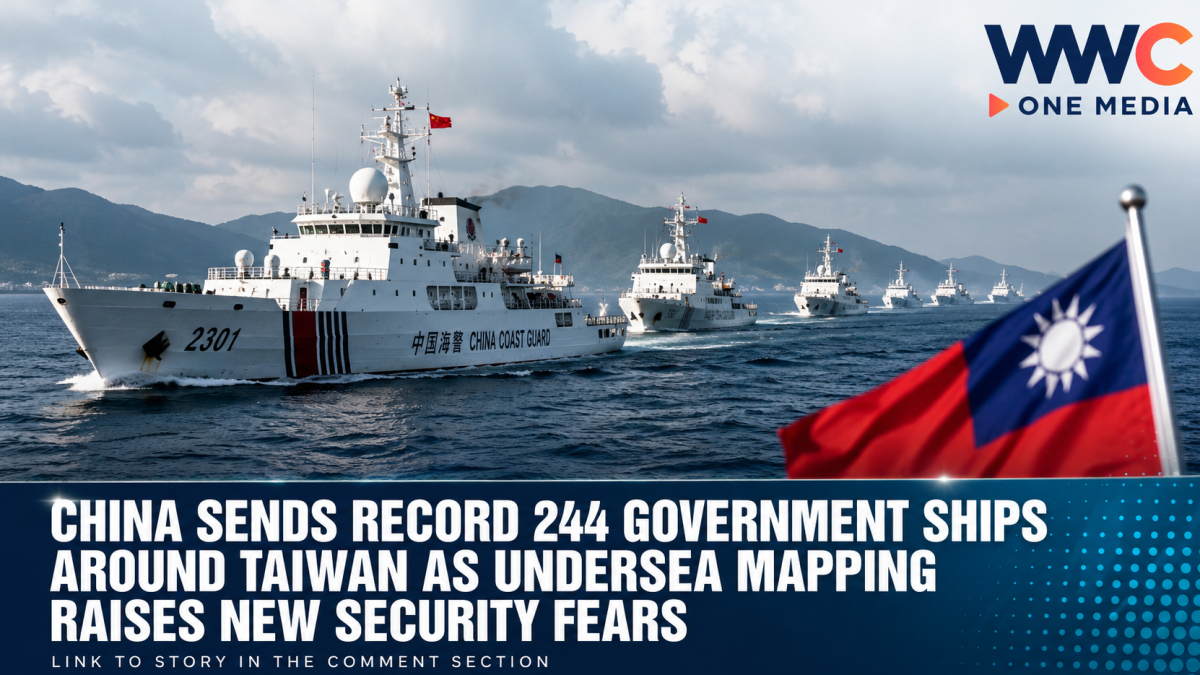
TAIPEI — China dramatically increased its government-vessel presence around Taiwan in July, setting a new monthly record and adding to concerns that Beijing is steadily expanding its ability to operate around the self-governed island without triggering an outright military confrontation.
Taiwan’s Coast Guard Administration recorded 244 Chinese coast guard, scientific research and other government vessels around Taiwan’s main island in July 2026, according to figures reported by AFP and the Taipei Times.
That works out to nearly eight Chinese government vessels per day.
The increase was striking. Taiwan recorded only 55 such vessels in June and 30 in May, while the July 2025 figure was 58. Roughly 60% of the vessels recorded in July were China Coast Guard ships, with research vessels and other government-operated vessels accounting for the remainder.
And those numbers do not include People’s Liberation Army Navy warships, which operate around Taiwan separately and are frequently detected in the region.
The broader July picture is even larger
A CNN report published Saturday, August 29, added important context to the 244-vessel figure.
According to CNN, the 244 count covers vessels operating around Taiwan’s principal island and does not include Chinese ships detected near Taiwan-controlled outlying islands such as Kinmen, Matsu and the Pratas Islands.
Once those areas are included, CNN reported that Taiwan recorded 425 Chinese government vessels in July, compared with 233 in July 2025.
That distinction matters because China’s maritime pressure is not concentrated in one location. It increasingly stretches from waters close to Taiwan’s western coast to areas east of the island that would be strategically important during a military crisis.
August activity remained elevated
The surge did not immediately disappear when July ended.
Taiwanese authorities detected another 152 Chinese government vessels during the first 21 days of August, according to Coast Guard figures cited by AFP.
Taiwanese officials describe the growing maritime presence as part of an increasingly serious security environment in which China can apply continuous pressure without crossing the threshold into conventional warfare.
This type of activity is frequently described as gray-zone pressure: operations designed to alter conditions on the ground or at sea gradually while remaining below the level that would normally trigger armed conflict.
But the numbers themselves may not be the most strategically important part of the story.
Why China’s research ships are attracting attention
Some of the vessels surrounding Taiwan are scientific and oceanographic research ships.
On paper, those ships conduct civilian research. Security analysts, however, warn that detailed information about ocean depth, seabed terrain, currents, temperature and underwater acoustics can also have substantial military value.
Ryan Martinson of the US Naval War College’s China Maritime Studies Institute told AFP that information gathered by civilian Chinese research institutions can be shared with China’s military and is particularly valuable for submarine and anti-submarine operations.
Recent activity east of Taiwan has therefore drawn especially close scrutiny.
The Chinese research vessel Xiang Yang Hong 03 was observed operating east of Taiwan in August under China Coast Guard escort, according to satellite and vessel-tracking analysis cited by AFP and the Institute for the Study of War.
ISW said the vessel repeatedly traveled between waters near Taiwan’s contiguous zone off Hualien and locations roughly 155 nautical miles east of the island.
Taiwan News also reported that the vessel traveled around deep-sea areas and important undersea telecommunications infrastructure while accompanied by a China Coast Guard vessel and a fishing boat identified by analysts as belonging to China’s maritime militia.
Jason Wang of satellite-analysis company ingeniSPACE said it was the first time his organization had observed a Chinese maritime-militia vessel escorting a research ship in Taiwanese waters.
Analysts believe the operation could allow China to refresh hydrographic information about the Ryukyu Trench and East Taiwan Trench, data that could assist submarine navigation, detection and anti-submarine warfare.
ISW separately assessed on August 25 that Beijing appears to be expanding and normalizing research, coast guard, law-enforcement and military operations around Taiwan while collecting information that could support future underwater military operations.
The Tong Ji had already raised similar alarms
Concerns over China’s research fleet did not begin with Xiang Yang Hong 03.
Earlier this year, the Chinese research vessel Tong Ji repeatedly operated close to Taiwan.
Taiwan’s Coast Guard said the vessel deployed scientific equipment during operations southeast of Taiwan in May, prompting Taiwanese patrol ships to order it away.
Taiwanese authorities said equipment aboard the vessel could collect information such as water characteristics and seabed conditions — information they warned could also contribute to military hydrological, acoustic and anti-submarine databases.
ISW reported that Tong Ji later appeared near Penghu again in August and noted that the ship is equipped with multiple sensors and can deploy unmanned underwater and surface vehicles.
Could this also prepare China for a blockade?
Another concern is that the expanding Chinese maritime presence could help Beijing practice something short of a full-scale amphibious invasion: a quarantine or blockade of Taiwan.
Taiwan depends heavily on maritime routes for energy, commodities and international trade.
CNN reported that a Taiwanese official said Chinese activity east of Taiwan could represent preparation for disrupting the island’s Pacific supply routes during a conflict.
The official said Taiwan’s Coast Guard would work with the navy to protect crucial maritime routes if the situation escalated into a blockade.
That does not prove China has decided to blockade Taiwan. But repeated operations by coast guard ships, research vessels, naval forces and other state-linked vessels could give Beijing valuable knowledge and operational experience if it ever attempted one.
Beijing’s strategy increasingly operates below the threshold of war
Beijing claims Taiwan as part of China and has never renounced the possible use of force to achieve unification. Taiwan has been separately governed since 1949, and the People’s Republic of China has never exercised control over the island.
The maritime activity illustrates why tensions across the Taiwan Strait are increasingly about more than fighter jets and major military exercises.
Coast guard patrols can test Taiwan’s response. Research vessels can collect potentially valuable environmental information. Maritime militia can complicate identification and enforcement. Meanwhile, naval forces remain nearby.
Individually, each operation might stop well short of war.
Together, analysts increasingly see them as part of a broader effort to make China’s presence around Taiwan routine — while steadily increasing Beijing’s knowledge of the waters that could become critical in any future confrontation.
For Taiwan, therefore, the most important number may not simply be 244 ships.
The bigger question is what China is learning every time those vessels return.

Leave a Reply