
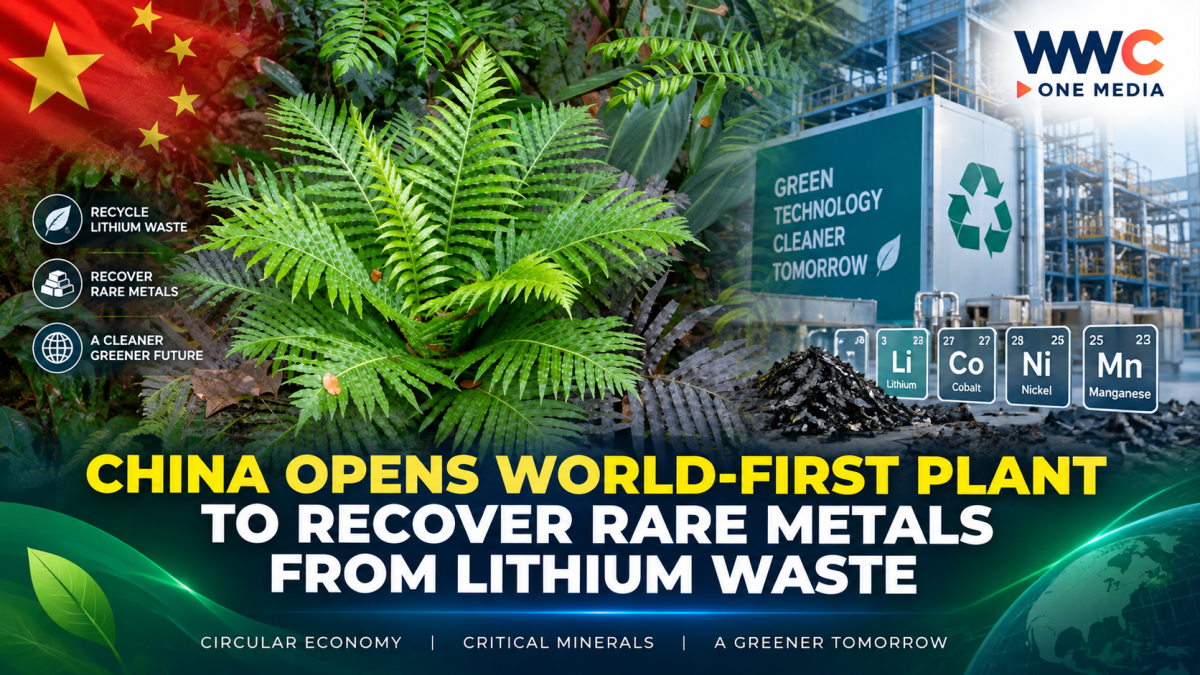
China has launched what researchers describe as the world’s first continuous industrial production line designed to recover the critical metals rubidium and caesium from waste generated during lithium processing.
The 500-tonne-a-year demonstration facility in Jiangxi province marks a significant step toward turning lithium-processing waste into a source of valuable materials used in advanced technologies ranging from aerospace to quantum computing.
The project was developed with support from the Institute of Process Engineering under the Chinese Academy of Sciences.
Turning lithium waste into valuable metals
The new facility is designed to extract low-grade rubidium and caesium that would otherwise remain in waste produced during lithium processing.
Rather than treating the material simply as industrial waste, researchers have developed a continuous extraction and separation process capable of recovering the two metals at production scale.
The Jiangxi demonstration line has now achieved stable operation, according to the Chinese Academy of Sciences.
Its annual capacity of 500 tonnes makes it the first production line of its kind to continuously extract and separate low-grade rubidium and caesium using a tower-based process.
Why rubidium and caesium matter
Rubidium and caesium are relatively uncommon metals, but they play important roles in a number of high-technology industries.
Rubidium is used in areas including electronics, specialised glass, research equipment and certain advanced energy applications.
Caesium is particularly valuable for technologies such as precision timekeeping, specialised electronics, medical applications and research.
Both metals are also considered strategically important for emerging technologies, including aerospace and quantum computing.
Their recovery from existing industrial waste could therefore provide an additional source of materials without requiring entirely new mining operations.
China seeks more efficient use of critical resources
The project comes as countries around the world are trying to secure supplies of critical minerals needed for advanced manufacturing and the energy transition.
China already plays a dominant role in the processing of many critical minerals, including lithium and a range of materials used in batteries and high-tech manufacturing.
Recovering additional valuable elements from waste could further strengthen that position while reducing the amount of material that needs to be discarded.
It also reflects a broader shift towards extracting more value from resources that were previously considered uneconomical to recover.
A new approach to lithium-industry waste
Lithium processing can generate large quantities of residual material containing small concentrations of other elements.
Recovering those elements has traditionally been difficult because their concentrations can be extremely low and the materials can contain multiple chemical components.
The new process is designed to overcome those challenges through continuous separation rather than relying solely on conventional batch processing.
If the technology can be expanded successfully, it could provide lithium-processing companies with an additional revenue stream while reducing waste.
Potential impact on critical-mineral supply chains
The development has implications beyond China’s lithium industry.
Demand for critical minerals is expected to continue increasing as electric vehicles, renewable energy, energy storage, semiconductors and other advanced technologies expand.
At the same time, governments are increasingly concerned about concentrated supply chains and the risks associated with relying on a small number of countries for critical mineral processing.
China’s ability to recover rubidium and caesium from existing industrial waste could give its manufacturers another source of strategically important materials.
It could also demonstrate how waste streams from one part of the energy industry can become feedstock for another high-value supply chain.
From demonstration to wider commercial use
The Jiangxi facility is currently described as a demonstration production line, meaning its successful operation does not automatically guarantee that the technology will be deployed on a much larger scale.
The next challenge will be determining whether the process can remain economically competitive as capacity increases.
Researchers and industry will need to assess operating costs, recovery rates, product quality and the consistency of lithium-processing waste as a feedstock.
If those conditions prove favourable, similar facilities could eventually be integrated into more lithium-processing operations.
China’s circular-economy push
The project also fits into China’s wider effort to improve resource efficiency and develop technologies capable of recovering valuable materials from industrial waste.
Instead of relying exclusively on new mining projects, governments and companies are increasingly exploring recycling and secondary sources of critical minerals.
For China, which already has extensive lithium-processing infrastructure, recovering rubidium and caesium from existing waste could offer a particularly attractive opportunity.
The world-first production line therefore represents more than a new industrial process.
It points to a future in which waste from the lithium economy could become an important source of materials for the next generation of high-tech industries.



Leave a Reply