
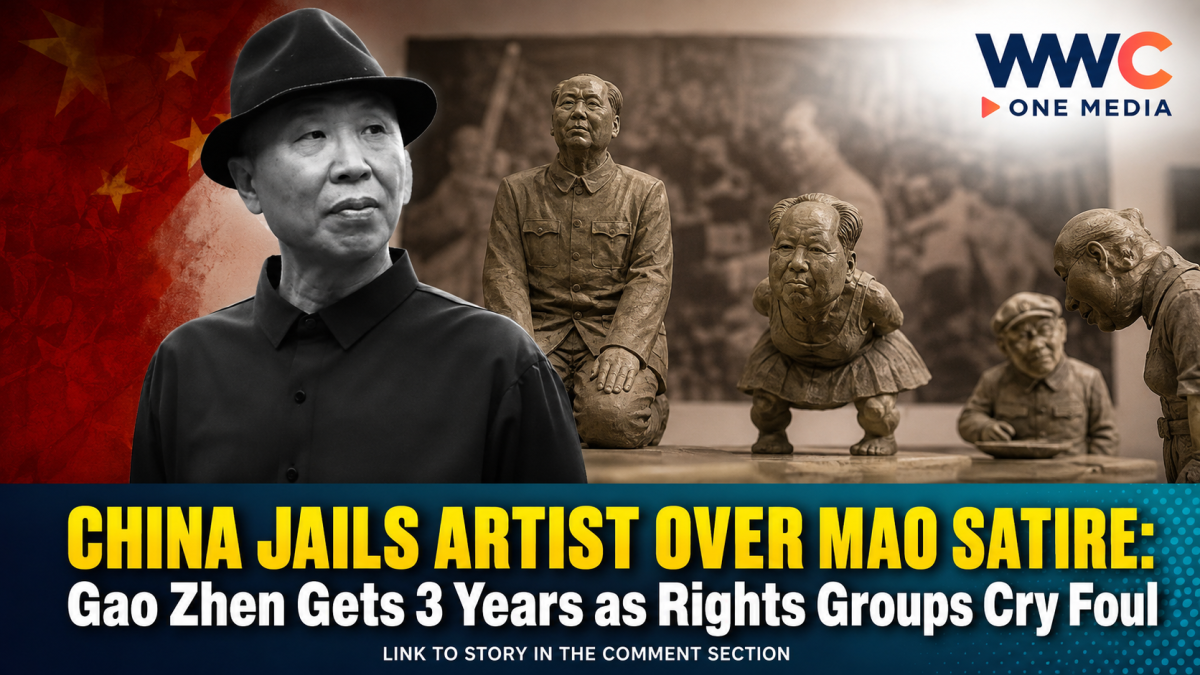
BEIJING — Chinese artist Gao Zhen has been sentenced to three years in prison over satirical artworks depicting former Chinese leader Mao Zedong, triggering renewed international criticism over artistic freedom and the use of China’s laws protecting “heroes and martyrs.”
The 70-year-old artist was sentenced on August 25, 2026, by the Sanhe City People’s Court in Hebei province after being convicted of “slandering China’s heroes and martyrs,” according to Reuters, the Associated Press and Amnesty International.
The case has attracted particular attention because the artworks at the center of the prosecution were created years before the law used against Gao came into effect.
Gao, a U.S. permanent resident and member of the internationally known Gao Brothers artistic duo, was arrested in August 2024 while visiting China from the United States. He remained in detention for roughly two years before the sentencing.
SATIRICAL MAO WORKS AT THE CENTER OF THE CASE
Gao and his brother, Gao Qiang, became known for provocative works examining Mao Zedong, China’s Cultural Revolution and the legacy of political power.
Among the works cited in reports about the case are “Mao’s Guilt,” which depicts Mao kneeling in a posture of apparent remorse, and the “Miss Mao” series, which portrays a caricatured Mao with exaggerated physical features.
Another controversial work, “The Execution of Christ,” depicts figures resembling Mao holding Jesus Christ at gunpoint.
The works were exhibited as early as 2009, according to Reuters and The Art Newspaper. Authorities later seized artworks from Gao’s studio after his arrest. The Art Newspaper reported that 118 works were confiscated in 2024.
THE LAW CONTROVERSY
At the heart of the international criticism is China’s Law on the Protection of Heroes and Martyrs, enacted in 2018 and strengthened in 2021.
Rights advocates argue that using the legislation against Gao for artworks produced before the law existed raises serious concerns about retroactive criminal punishment.
Reuters reported that Gao’s works cited in the case date from 2005 to 2009, while the law came into effect in 2018.
The United Nations Human Rights Office had previously raised concerns about Gao’s detention and the legal basis of the case. In an April 2026 statement, the UN said his situation raised concerns relating to the application of criminal law and his continued detention.
AMNESTY: “ASSAULT ON ARTISTIC FREEDOM”
Amnesty International strongly condemned the sentence, describing it as an assault on artistic freedom.
The organization said Gao’s lengthy pretrial detention and three-year sentence could have a broader chilling effect on artists whose work challenges official narratives or encourages critical discussion of history.
Amnesty also criticized what it described as the retroactive use of broadly worded laws to punish artistic expression.
Gao has decided to appeal his conviction and sentence, according to Amnesty International. His current sentence is scheduled to end on August 25, 2027, taking his time already spent in detention into account.
U.S. RAISES “SIGNIFICANT CONCERNS”
The case has also drawn criticism from the United States.
The U.S. State Department said it had “significant concerns” about Gao’s case, particularly because the alleged conduct occurred years before the law under which he was convicted.
U.S. diplomats and representatives from other missions reportedly attempted to attend the August 25 sentencing hearing in Sanhe, but courthouse officials denied them entry.
FAMILY ALSO CAUGHT IN THE CASE
The controversy extends beyond Gao himself.
Rights groups and international media reports say his wife, Zhao Yaliang, and their U.S.-citizen son have been unable to leave China since Gao’s detention.
Amnesty International said the family members have not been accused of a crime but have reportedly faced restrictions, harassment and intimidation.
Gao’s wife described the sentencing as devastating and said he intends to challenge the conviction.
A BIGGER QUESTION ABOUT ART AND HISTORY
Gao’s imprisonment has become more than a case involving one artist.
For rights organizations, it raises a broader question: How far can governments go in regulating historical interpretation, satire and political art?
The Gao Brothers built their reputation by confronting difficult chapters of China’s modern history through provocative imagery. Their work has frequently examined authoritarianism, political trauma and the legacy of the Cultural Revolution.
For Chinese authorities, however, the issue is framed differently. Gao was convicted under legislation designed to protect the reputation and honor of national heroes and martyrs.
That clash — between the state’s protection of official historical figures and an artist’s freedom to reinterpret history — is now at the center of the international debate surrounding Gao’s imprisonment.
And with Gao preparing to appeal, the case may not end with this sentence.
The appeal could determine not only Gao Zhen’s fate, but also send a wider signal about the limits of artistic expression in China — especially when an artist’s work challenges officially sanctioned versions of the country’s past.

Leave a Reply