
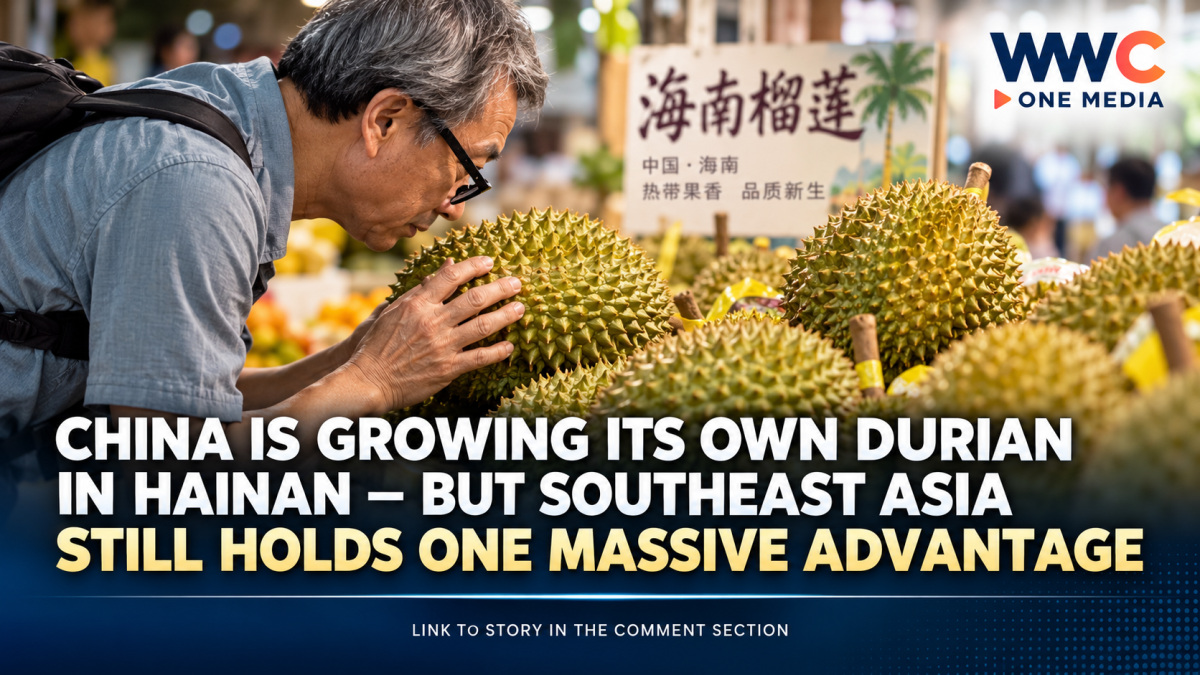
SANYA, China — China is attempting something that once seemed unlikely: growing its own commercial supply of durian, the famously pungent tropical fruit whose booming popularity has turned Southeast Asian orchards into suppliers for one of the world’s most lucrative fruit markets.
On the tropical island of Hainan, plantations are spreading across Sanya, Lingshui, Baoting and other parts of the southern province. Growers are investing millions of yuan in irrigation systems, greenhouses, new varieties and even scanning technology designed to inspect fruit without cracking open its thorny shell.
But despite the ambition—and the attention surrounding China-grown durian—Hainan is nowhere close to replacing the enormous volumes arriving from Thailand, Vietnam and Malaysia.
And that may not even be its goal.
China’s $7.5-Billion Appetite for Durian
China imported a record 1.87 million tonnes of fresh durian in 2025, worth roughly US$7.5 billion, according to figures cited by CNA. The volume was more than six times what China imported a decade earlier, highlighting how dramatically the fruit has moved into the Chinese mainstream.
Demand has been supported by rising incomes, improved transportation links, e-commerce and durian’s transformation from an exotic luxury fruit into a widely marketed premium food.
The momentum continued in 2026.
Chinese imports reached 1.07 million tonnes during the first half of 2026, up from about 708,000 tonnes in the same period a year earlier—a rise of roughly 47 percent, according to Chinese customs figures reported by the South China Morning Post.
Thailand alone shipped nearly US$3.79 billion worth of durian to China during those six months, maintaining about 81 percent of the market by value. Vietnam ranked second, while Malaysia’s fresh durian shipments jumped sharply from a much smaller base.
That enormous demand is exactly what Hainan’s growers hope to tap.
From Accidental Experiment to Commercial Industry
Durian trees are not entirely new to Hainan. Experimental planting dates back decades, but commercial cultivation never developed at meaningful scale.
According to CNA, the industry’s modern breakthrough can be traced to 2014, when a Hainan farmer looking for mangosteen seedlings in Vietnam returned with around 100 durian seedlings. Roughly 40 eventually produced fruit.
The results helped convince Chinese farmers and agricultural companies that commercial cultivation might actually be possible.
Small-scale commercial production started in 2023, and by 2026 Hainan had more than 50,000 mu—roughly 3,300 hectares—of durian plantations, with about 30 percent already bearing fruit. Separate Chinese reporting in July placed the planted area at approximately 3,333 hectares and said about 15,000 mu had begun fruiting.
Sanya has emerged as one of the centres of the experiment, with dozens of growers and agricultural companies now involved.
Industry officials say survival rates for newly planted trees in Sanya have climbed to around 95 percent, suggesting growers are becoming substantially better at adapting the notoriously demanding crop to local conditions.
The Biggest Enemy May Be the Weather
Hainan has warmth and humidity, but it also has something that makes commercial durian farming unusually risky: typhoons.
Durian trees can take years before producing commercially valuable crops. A severe storm can damage mature trees—or destroy them entirely—after growers have invested years of money and labour.
Some Hainan plantations therefore deliberately keep trees shorter than those commonly seen in Southeast Asia, pruning them at around six or seven metres. Others use ropes, metal supports and wind barriers to reduce storm damage.
Water presents another problem.
Durian trees need consistently moist soil but can suffer root damage if conditions become waterlogged. Chinese growers are responding with automated irrigation and fertilisation systems, with some farms using reservoirs and smartphone-controlled equipment to regulate water precisely.
Researchers from China Agricultural University are also experimenting with cultivation techniques tailored specifically to Hainan’s soil and climate.
Some growers are even testing greenhouses in hopes of shielding trees from excessive rain while exerting greater control over growing conditions.
China Is Bringing Technology Into the Durian Orchard
Hainan’s strategy increasingly appears to be about technology and premium quality rather than sheer volume.
At one Sanya packing facility visited by CNA, workers still use the traditional technique of tapping durians and listening to the sound to judge maturity.
But the fruit then passes through a scanner capable of producing images of what is inside—allowing operators to estimate edible flesh, maturity and possible defects without cutting the durian open.
Another agricultural group is developing a traceability system in which individual durian trees are linked to digital records and China’s BeiDou satellite-navigation system. Customers would be able to scan a code and trace the fruit back to its farm of origin.
The technology is unlikely to make Hainan durians cheaper immediately. In fact, industry executives acknowledge that these systems require additional investment.
The bet is that consistency, traceability and freshness will allow locally grown fruit to command premium prices.
But Southeast Asia Has a Massive Head Start
That distinction matters because China’s Southeast Asian suppliers operate on an entirely different scale.
Thailand remained the leading supplier by value in 2025, shipping just under US$4 billion worth of durian to China, while Vietnam exported around US$3.44 billion. CNA, however, reports that Vietnam moved ahead of Thailand by volume in 2025—showing how the identity of the “largest supplier” depends on whether the market is measured by tonnes or by dollars.
Thailand came roaring back in the first half of 2026, accounting for roughly four-fifths of China’s imported durian value during the period.
Malaysia is also expanding its presence after China opened its market to fresh Malaysian durians. Malaysian fresh durian exports to China reached more than US$30 million in the first six months of 2026, more than four times the year-earlier level.
Hainan therefore is not battling one established supplier. It is entering an increasingly competitive Southeast Asian race.
Imported Durian Is Also Getting to China Faster
There is another complication for Hainan.
China has spent years improving transportation connections with Southeast Asia, making imported fruit faster and cheaper to deliver.
A refrigerated rail service linking Thailand through Laos to China began carrying durians in 2026. The journey to Kunming takes about three days, while shipments can reach Chengdu in roughly five days.
Chinese state-media figures cited by the South China Morning Post suggested the increased supply helped push imported durian prices down by around 30 percent.
That creates an unusual competitive equation.
Hainan has the advantage of being inside China, meaning fruit can remain on trees longer and potentially reach consumers only hours after harvesting.
But Southeast Asian exporters have scale, established varieties, generations of farming expertise and increasingly efficient transport networks.
Hainan’s Real Opportunity: Freshness, Not Dominance
Chinese agricultural researchers themselves appear realistic about the limits.
CNA reported that about 3,300 hectares are currently planted with durian in Hainan, while one local expert estimated Southeast Asia already has more than 660,000 hectares of durian plantations.
Even if Hainan expanded to 20,000 hectares, it would remain a relatively small producer.
That is why the emerging strategy is increasingly described as “small and beautiful”: grow varieties suited to Hainan, concentrate on quality and freshness, and target customers willing to pay for premium tree-ripened domestic fruit.
That could become Hainan’s strongest advantage.
Imported durians have to survive harvesting, packing, customs clearance and long-distance transportation. A Hainan-grown durian, by comparison, could theoretically be harvested in the morning and served to a Chinese customer later the same day.
So the biggest threat to Southeast Asia may not be China suddenly replacing millions of tonnes of imported durian.
Instead, Hainan could carve out the most profitable end of the market: ultra-fresh, traceable, premium Chinese-grown fruit.
For Thailand, Vietnam and Malaysia, that means China’s durian experiment is worth watching—but the numbers show that Southeast Asia’s dominance is nowhere close to disappearing.
For now, China may be growing its own “king of fruits.”
But Southeast Asia still owns most of the kingdom.




Leave a Reply