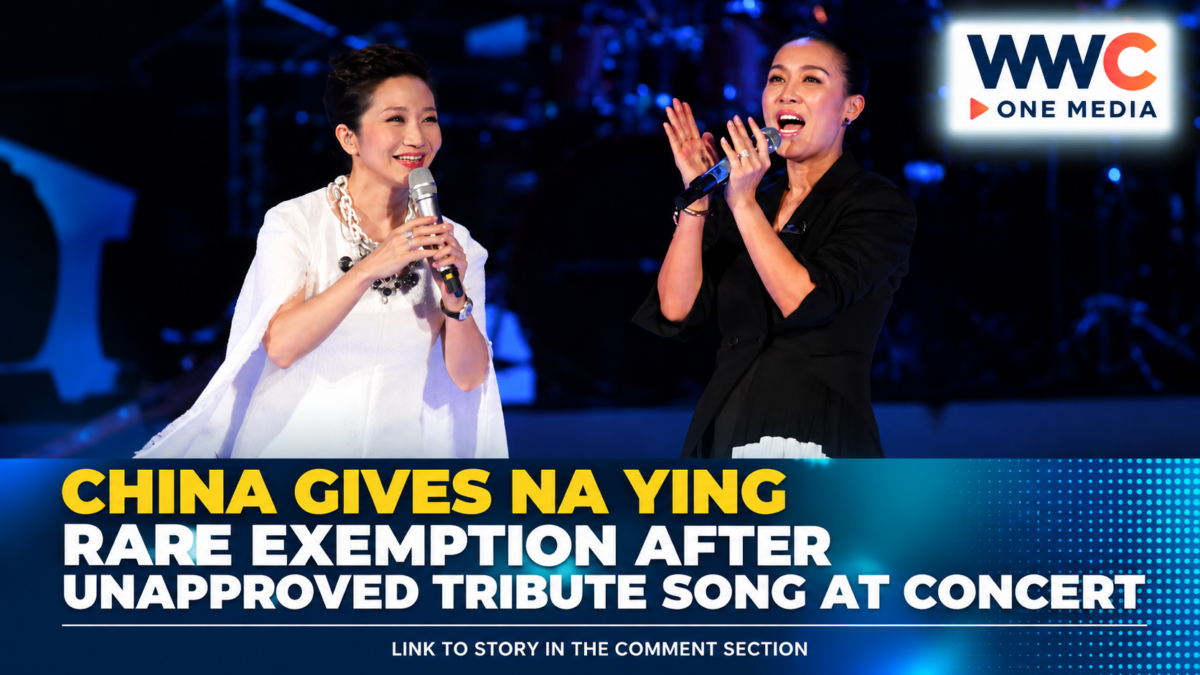
Chinese singer Na Ying has received a rare exemption from potential penalties after performing an unapproved song during a concert in Chengdu, drawing renewed attention to the country’s strict rules governing live entertainment.
Na Ying sang a portion of “Curved Moon” during her concert on Sept. 26 to pay tribute to her longtime friend and fellow singer Liu Huan, who had died the previous day at the age of 63. The song was not part of her approved set list.
The singer introduced the tribute during an interaction with the audience, explaining that she wanted to perform a song Liu had previously sung on the same stage. Videos shared online showed Na dressed in black as she sang, with her voice appearing to tremble during the emotional moment.
The unexpected performance quickly drew attention online. Some social media users praised Na for honoring Liu, while others expressed concern that she could face punishment for adding a song that had not received prior approval.
Under China’s long-standing rules for live entertainment, content such as concert set lists and stand-up comedy material generally has to be approved by local authorities before performances. Artists who violate those requirements can face fines, restrictions on future performances or other sanctions.
However, Chengdu authorities determined that Na had not violated the approval requirement in this case.
The Chengdu Municipal Bureau of Culture, Radio, Television and Tourism said the performance was a brief and fragmentary segment delivered during audience interaction rather than a complete rendition of the song. On that basis, the authorities said additional approval was not required.
The clarification effectively spared Na from the type of disciplinary action that some online users had feared. Her case has nevertheless highlighted the degree of regulatory oversight surrounding China’s entertainment industry, where performers are expected to follow approved material during public events.
The decision also comes at a time when authorities have continued to enforce rules governing live performances.
Just weeks earlier, authorities in Wuhan fined a prominent Chinese comedian after he changed the lyrics of a patriotic song during a performance. That case had also generated discussion about the limits placed on performers and the consequences of deviating from approved material.
Na’s situation differed because authorities classified her rendition as only a short portion of a song performed during an audience interaction rather than a formal addition to the concert programme.
The song choice also carried particular significance because of Na’s relationship with Liu Huan, one of China’s best-known musicians. Liu had been a major figure in Chinese popular music for decades and was also known for his work in music education.
Liu died on Sept. 25 at the age of 63. He had taught music history for more than three decades and was widely recognised for his contribution to Chinese music.
International audiences may also remember Liu for his appearance at the opening ceremony of the 2008 Beijing Olympic Games, where he performed the event’s theme song alongside British soprano Sarah Brightman.
Brightman later paid tribute to Liu on social media, describing him as a talented musician and a gentleman who would be missed.
For Na, the Chengdu concert became an opportunity to remember a close friend through one of his well-known songs. Her decision to perform the piece without it being part of the approved programme initially raised concerns because of China’s strict entertainment regulations.
The authorities’ subsequent explanation, however, meant that the singer would not face penalties over the tribute.
The episode has nevertheless sparked wider discussion about how China’s entertainment rules are applied in practice, particularly when performers make spontaneous changes during live shows. While the rules remain strict, Na’s case shows that authorities may distinguish between a formal change to an approved programme and a brief, unscheduled performance during interaction with an audience.
For now, Na Ying’s tribute to Liu Huan has ended without the punishment that some fans had feared, while the incident has renewed public attention on the rules that govern live performances across China’s entertainment industry.