
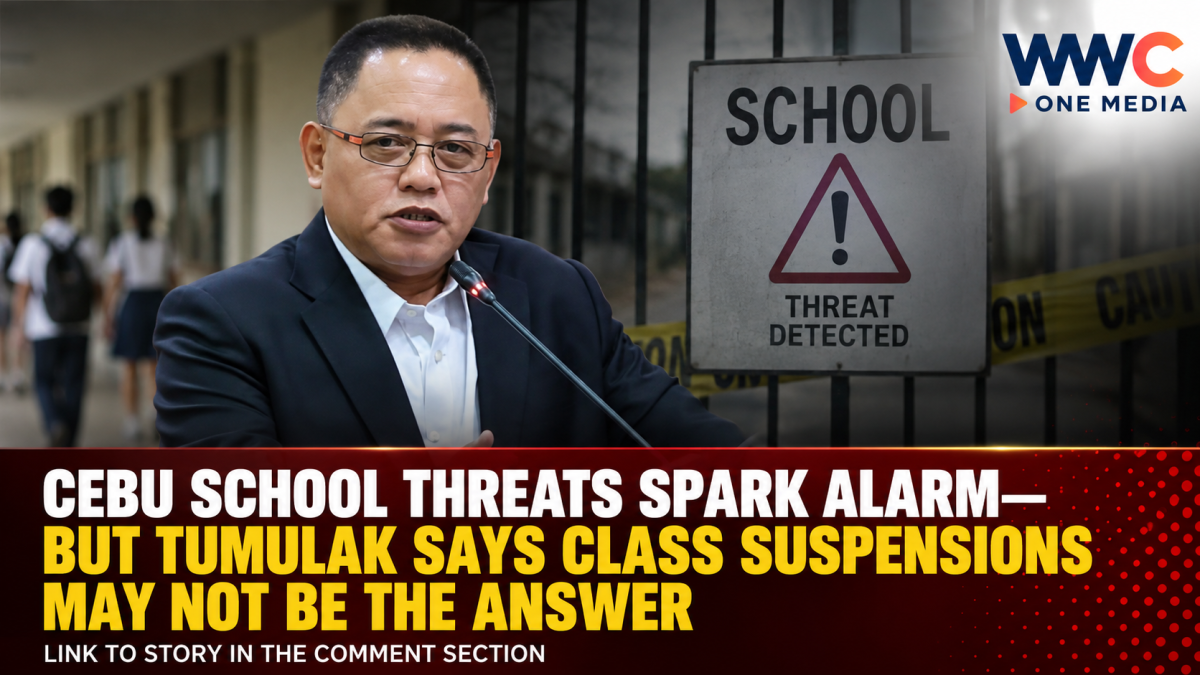
CEBU CITY, Philippines — A wave of security threats involving schools in Cebu is putting parents, students and school officials on heightened alert, but Cebu City Disaster Risk Reduction and Management Office (CCDRRMO) head and City Councilor Dave Tumulak is urging authorities to avoid automatically suspending classes every time a threat surfaces.
Tumulak’s position comes as Cebu continues to deal with a series of online threats against schools, some of which have triggered precautionary class suspensions and major security operations.
The latest concern involves an alleged online death threat against students of the University of Southern Philippines Foundation (USPF)–Lahug Campus. Police responded after a Facebook post reportedly threatened to kill students. The account owner later claimed that the Facebook account had been hacked and denied making the post.
Despite the denial, police continued verifying the authenticity and source of the threatening material and coordinated with the school administration on security measures.
Tumulak: Verify first before suspending classes
The issue has renewed debate over how schools and local governments should respond when threatening messages appear online.
Tumulak’s position is that a reported threat should trigger an immediate security assessment and coordination with law enforcement, but a blanket suspension of classes should not necessarily be the automatic response when a threat has yet to be verified.
The approach reflects what happened during an earlier shooting scare at Cebu Eastern College in July.
Authorities responded with police, disaster-response personnel, K9 units and specialized teams after a shooting threat circulated on social media. The campus was inspected and security measures were imposed. No explosives or suspicious items were found, and classes were eventually allowed to continue while the investigation proceeded.
The incident demonstrated that authorities can respond aggressively to a threat without necessarily shutting down an entire school day—provided that security assessments indicate that students and personnel can safely remain on campus.
But Cebu has also suspended classes when threats raised concerns
The situation has not always resulted in classes continuing.
In August, several Cebu schools temporarily suspended face-to-face classes following online threats.
In Pinamungajan, Lut-od National High School canceled classes after receiving a shooting threat. Authorities coordinated with the school and local social welfare officials while investigating the incident. The threat came only days after a 14-year-old Grade 9 student at the school was reportedly found carrying a firearm during a bag inspection.
In Lapu-Lapu City, Mactan National High School also suspended face-to-face classes after a threatening message appeared in a private group chat. The school shifted to modular learning while authorities investigated.
Meanwhile, several schools in Cebu City’s mountain barangays were previously targeted by an online shooting threat, prompting authorities to temporarily halt classes while the reports were investigated.
These incidents show why officials face a difficult balancing act: keeping students safe without allowing unverified online threats to repeatedly disrupt education.
Some threats have turned out to be hoaxes
Cebu has also seen cases where alleged threats were later traced to students.
In Talisay City, police identified two minors who reportedly admitted posting shooting threats against schools. Authorities said the students told investigators they wanted classes suspended because they were unprepared for an examination.
The incidents underscore the potential consequences of treating every online post as either completely harmless or automatically credible.
A threat can create genuine fear even when it is later found to be a hoax. It can also mobilize police, emergency responders and school personnel and disrupt thousands of students and families.
DepEd warns that threats and dangerous pranks are serious violations
The Department of Education has also strengthened its response to false information and dangerous threats in schools.
Under DepEd Order No. 006, series of 2026, or the Guidelines on Ensuring a Safe and Motivating Learning Environment, spreading false information that causes confusion or disruption is classified as a minor offense, while bomb threats or similar dangerous pranks are treated as a serious, third-level offense because of the potential danger and emergency response they trigger.
DepEd said such incidents can cause panic, interrupt classes and consume emergency-response resources.
That policy places greater emphasis on accountability while requiring schools to maintain a safe learning environment.
Cebu is strengthening school security
The debate over class suspensions is unfolding alongside broader efforts to improve school security throughout Cebu.
Cebu Governor Pamela Baricuatro earlier ordered heightened security measures in schools across the province following an online threat against a school in Bantayan Island.
The Cebu Police Provincial Office was directed to increase police visibility, conduct security inspections and coordinate with school administrators. Police units were also instructed to implement a one-police-to-school scheme at the city and municipal levels.
The province has also established the Cebu Safe Schools Program through Executive Order No. 35, which provides a broader framework for violence prevention, emergency preparedness, mental health support and incident response in schools.
Nationwide school safety concerns add pressure
Cebu’s school threats are occurring amid a wider national discussion on campus safety.
The Philippines recently conducted nationwide school safety drills following two high-profile school shooting incidents. Reuters reported that students and teachers participated in simulated active-shooter scenarios involving lockdown procedures, police coordination, evacuation, headcounts, first aid and psychosocial support.
The national response highlights an important distinction: school safety is not simply about canceling classes. It also involves preparedness, rapid verification, communication, police coordination, emergency protocols and support for students and personnel.
The challenge: safety without unnecessary disruption
For parents, any threat involving their children’s school naturally creates anxiety. For school administrators and local officials, however, the decision to suspend classes can have consequences beyond a single day of lost instruction.
Cebu has already experienced repeated disruptions from security threats, weather-related events and, most recently, unhealthy haze conditions.
The Freeman’s editorial board noted that repeated disruptions can affect students’ education even when suspensions are justified, while emphasizing that learner safety must remain the priority.
The emerging lesson from Cebu’s recent experience is therefore not that threats should be ignored.
Rather, credible threats must be acted upon immediately, while unverified reports need careful assessment before authorities make decisions affecting entire school communities.
For Tumulak, the answer appears to lie in a more targeted response: verify the threat, secure the campus, coordinate with police and school officials, and suspend classes when circumstances genuinely require it.
As online threats continue to circulate, the bigger question facing Cebu may no longer be whether classes should be suspended every time a threatening post appears—but whether schools and authorities have the systems in place to quickly determine when a threat is real, when it is a hoax, and when immediate action is necessary.




Leave a Reply