
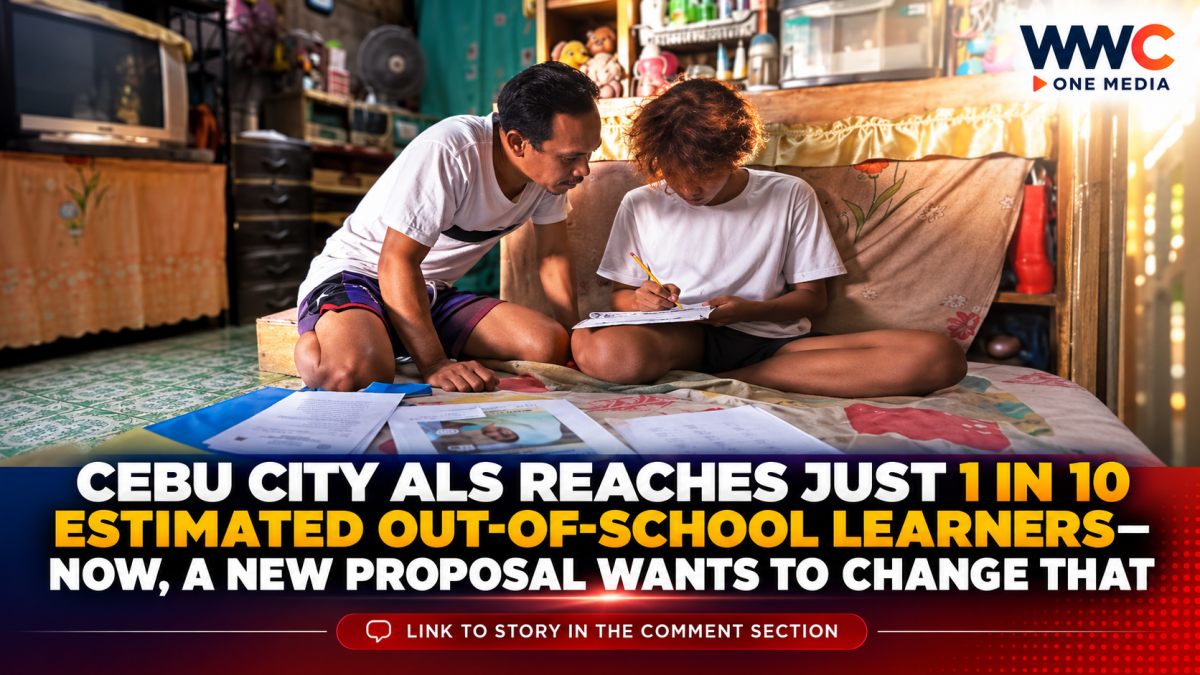
CEBU CITY, Philippines — Cebu City’s Alternative Learning System (ALS) may be reaching only about one in every 10 estimated out-of-school learners, prompting calls for a stronger and more coordinated approach to bring more young people and adults back into the education system.
The issue has placed renewed attention on one of the country’s most important alternative education pathways as Cebu City continues to deal with school dropouts and learners who remain outside the formal education system.
A proposal cited in a recent report by Cebu Daily News seeks to address the gap by strengthening the city’s approach to ALS and expanding its reach among potential learners.
The concern is significant because ALS is designed specifically to provide a flexible alternative for people who cannot, or have not been able to, complete basic education through the regular school system.
Cebu City has already faced a dropout problem
The latest concern comes on top of previously reported dropout figures in Central Visayas.
In 2025, SunStar Cebu reported that 21,650 learners across 20 education divisions in Central Visayas had dropped out of school as of August 16, 2024, based on Department of Education data.
Cebu City accounted for 2,929 of those dropouts, including 828 elementary pupils, 2,032 junior high school learners and 69 senior high school students.
Across the region, lack of interest or support and family-related circumstances were among the factors identified as contributing to learners leaving school.
The figures underline why ALS is particularly important: it can provide another route for learners who have already left the formal school system.
ALS is supposed to be more than a second chance
The Alternative Learning System is not simply a remedial program for school dropouts.
Under Republic Act No. 11510, or the Alternative Learning System Act, ALS was institutionalized as a parallel learning system intended to provide out-of-school children in special cases and adults with opportunities to develop basic and functional literacy, complete basic education and pursue further education, employment or self-employment.
The law also requires government to expand access to ALS, particularly in underserved communities. It provides that DepEd or local governments, or both, should establish at least one Community Learning Center in every municipality and city.
That makes the reported gap in Cebu City more than an enrollment issue. It raises a larger question about whether the existing system is reaching the people it was created to serve.
DepEd is already moving to expand ALS
The national ALS program is also undergoing major changes.
Under DepEd Order No. 1, series of 2026, DepEd issued new implementing guidelines for the Enhanced Alternative Learning System. The revised framework covers learning programs, curriculum, assessment, learning resources and implementation mechanisms for community learning centers.
Beginning School Year 2026-2027, schools divisions are expected to implement the revised ALS curriculum for the Basic Literacy Program and Accreditation and Equivalency programs at the elementary and junior high school levels.
The Philippine Information Agency likewise reported that DepEd is expanding ALS to provide more flexible education pathways for out-of-school children, youth and adults.
The enhanced program recognizes flexible learning options and prior learning while introducing tools such as micro-certifications and pathways designed to make ALS more responsive to learners’ different circumstances.
The challenge: finding the learners who have disappeared from the system
For Cebu City, the problem may not simply be the availability of ALS classes.
A major challenge is identifying and reaching potential learners who are no longer connected to schools.
Some may have left because of financial difficulties. Others may be working, caring for family members, dealing with transportation problems or facing circumstances that make regular classroom attendance difficult.
ALS is designed to respond to precisely those situations because its learning arrangements can be more flexible than conventional schooling.
DepEd’s Cebu City division continues to issue directives and conduct activities related to ALS implementation, including an Alternative Learning System Program Implementation Review and coordination activities involving ALS teachers and personnel.
Cebu’s wider education crisis adds pressure
The ALS issue is emerging as Cebu faces broader education challenges.
At the beginning of School Year 2026-2027, DepEd Region 7 projected approximately 1.6 million learners across Central Visayas, while Cebu City and other areas continued to deal with infrastructure and capacity concerns.
DepEd-7 also reported that regional enrollment had reached more than 1.58 million learners in July 2026, although enrollment remained ongoing at the time.
Meanwhile, separate education assessments have highlighted learning difficulties among younger Cebuano pupils, adding another layer to the region’s education challenges.
Cebu Daily News reported earlier this year that 46.85 percent of learners in Cebu City assessed under a beginning-of-school-year reading assessment were classified as struggling readers, underscoring that simply getting children into classrooms is only one part of the education problem.
What happens next could matter most
The proposed expansion of ALS in Cebu City now puts the spotlight on how the city can turn its existing program into a wider safety net for learners who have fallen out of the formal education system.
That could require closer coordination between DepEd, the city government, barangays and other agencies, particularly in identifying potential learners and removing practical barriers that prevent them from participating.
Republic Act No. 11510 itself emphasizes collaboration among government and other stakeholders in delivering alternative education and calls for the deployment and strengthening of ALS teachers and learning facilitators.
The central issue is therefore no longer simply how many learners are enrolled in ALS.
It is whether the system can find the thousands who may still be outside it.
And if the reported one-in-10 reach is anywhere close to the actual gap, Cebu City may have a much larger education challenge waiting beyond the classroom doors.



Leave a Reply