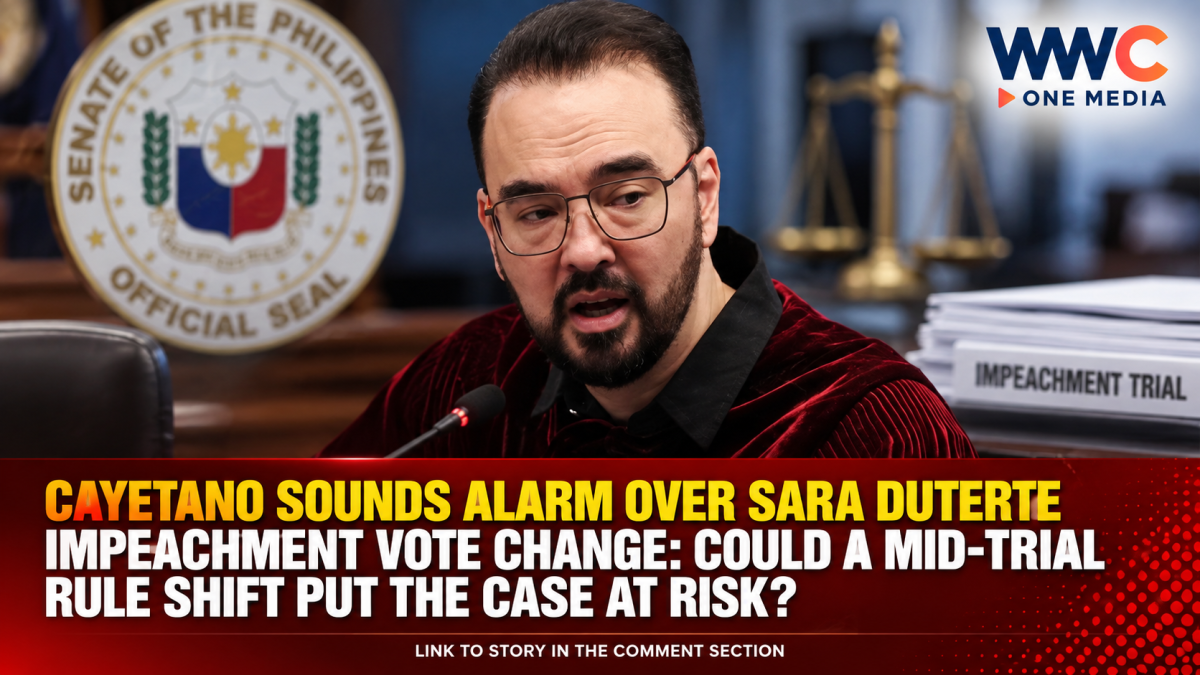
MANILA, Philippines — A dispute over how many Senate votes are needed to convict Vice President Sara Duterte has taken a new turn, with Senator Alan Peter Cayetano warning that changing the voting rules in the middle of the impeachment trial could expose the proceedings to a possible “mistrial.”
For more Philippines political explainers, see our Philippines hub and Politics desk.
Cayetano said the rules governing the case should remain consistent from the beginning of the proceedings through the final judgment, arguing that changing the threshold after the trial has already progressed could raise questions about the validity of everything that has already taken place.
“I don’t want to have a mistrial,” Cayetano said, stressing that the work already completed during the trial should not be placed at risk by a midstream change in the rules. His comments were reported by multiple Philippine news outlets on Sept. 18.
The controversy centers on the number of votes required for a conviction.
Why the 16-vote threshold is being questioned
Article XI, Section 3(6) of the 1987 Constitution states that an impeached official cannot be convicted without the concurrence of two-thirds of all the members of the Senate.
At the beginning of Duterte’s impeachment proceedings, then-presiding officer Francis Escudero ruled that 16 votes would be required, based on two-thirds of the Senate’s 24 members.
That interpretation was later challenged after questions emerged over senators who are not currently participating in the trial.
Senator-judge Erwin Tulfo sought clarification on whether the constitutional phrase “all the Members of the Senate” should continue to refer to all 24 senators or whether circumstances affecting individual senators should be considered in determining the voting base.
The issue is significant because the Senate impeachment court currently has fewer than 24 actively participating senator-judges.
Impeachment court spokesperson Reginald Tongol said the court could potentially hold more than one vote: first, on whether to overturn Escudero’s earlier ruling and then, if necessary, on how the new voting denominator should be determined.
Retired justices offer different legal views
To help resolve the dispute, the impeachment court invited retired Supreme Court justices to serve as amici curiae, or “friends of the court,” and provide independent legal perspectives.
The legal experts did not present a single unified interpretation.
Retired Associate Justice Adolfo Azcuna argued that the constitutional denominator should continue to include all 24 senators as long as they remain members of the Senate.
Azcuna’s position is that the phrase “all the Members of the Senate” refers to Senate membership rather than simply the senators who are present or able to participate at a particular point in the proceedings.
Other retired magistrates raised circumstances that could potentially affect whether an individual senator should be included in the calculation.
Retired Chief Justice Reynato Puno, for example, discussed whether continuous absence and the concept of being beyond the Senate’s coercive power could be relevant in determining a senator’s status.
Retired Chief Justice Artemio Panganiban also discussed voluntary inhibition, saying a senator who believes he or she cannot render a fair judgment could potentially be excluded from the denominator.
Those views differ from Azcuna’s position and illustrate why the Senate impeachment court has not yet settled the question.
Cayetano: Don’t change the rules while the trial is underway
Cayetano’s concern is not simply about whether the threshold should be 16 votes or another number.
His warning focuses on when such a rule is changed.
During the proceedings, Cayetano questioned former Sandiganbayan Presiding Justice Amparo Cabotaje-Tang about whether procedural rules could be altered while a case is already being tried.
Tang responded that, from the perspective of criminal procedure, rules of evidence should not simply be changed in the middle of a proceeding.
Cayetano then drew a comparison to the impeachment proceedings, questioning whether the Senate should likewise alter the voting framework after the trial has already begun.
He has argued that the question could have consequences extending beyond the current impeachment case because the Senate’s handling of the dispute could establish a precedent for future impeachment proceedings.
Legal dispute now separate from the impeachment allegations
The threshold controversy is separate from the substantive allegations contained in Duterte’s impeachment case.
PNA reported that Senator-judge Bam Aquino emphasized that the threshold question is not itself a determination of guilt or innocence. Instead, it concerns the procedural and constitutional question of how a conviction vote should be calculated.
That distinction has become increasingly important as senator-judges examine the constitutional language before proceeding to the eventual judgment.
Meanwhile, former presidential legal counsel Salvador Panelo has publicly argued that the impeachment court should not be able to alter the constitutional two-thirds requirement through its own internal rules.
Philstar reported that Panelo disagreed with retired chief justices who took the position that the 16-vote requirement was not necessarily fixed under all circumstances. He maintained that the Constitution, rather than internal Senate rules, controls the required voting standard.
September 23 arguments could be crucial
The Senate impeachment court is scheduled to hear oral arguments from the prosecution and defense on the disputed voting threshold on September 23.
The court is expected to consider the competing legal interpretations before deciding how to proceed with the appeal of Escudero’s earlier ruling.
The immediate question is therefore not simply how senators will vote on Duterte’s impeachment.
It is also whether the Senate will retain the voting framework established at the beginning of the trial or adopt a different interpretation before the final judgment.
For Cayetano, changing that framework after weeks of proceedings could create a legal and procedural dispute that extends beyond the final vote itself.
As the Senate moves toward the next stage of the trial, the question over 16 votes—or a potentially different threshold—has become a case within the case, with constitutional interpretation, Senate procedure and the integrity of the impeachment proceedings all converging on the same decision.
And until the impeachment court settles that question, the number of votes needed for a conviction remains one of the most closely watched issues surrounding the Duterte impeachment trial.