
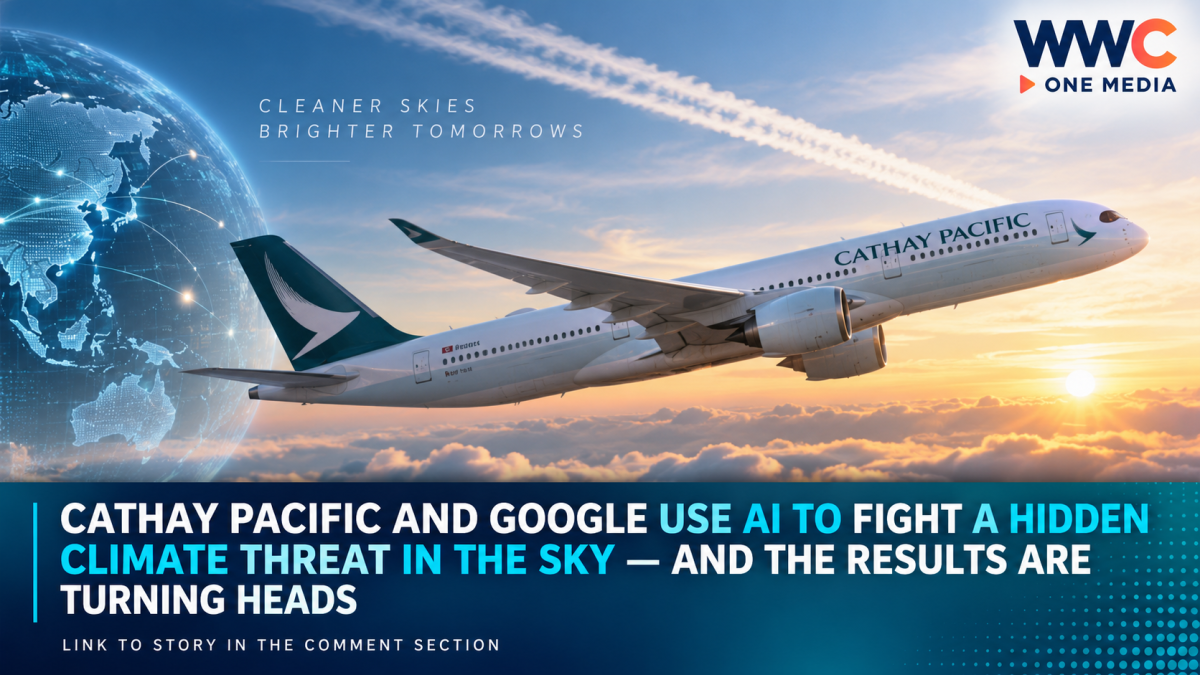
HONG KONG — Cathay Pacific and Google are taking their fight against aviation’s climate impact to the skies, expanding trials of artificial intelligence technology designed to help aircraft avoid producing persistent, climate-warming contrails.
The Hong Kong-based airline and Google announced Monday that the next phase of their partnership will build on an initial trial launched in late 2025, using AI-powered forecasting to identify atmospheric conditions where contrails are most likely to form.
The results so far are promising.
An initial test involving more than 80 Cathay Pacific flights achieved an estimated 40% reduction in contrail warming impact, according to a joint statement reported by Reuters and published by Channel News Asia.
Now, the companies are preparing to expand the trials across Cathay Pacific’s Asian and trans-Pacific network.
The Hidden Climate Problem Flying Above Our Heads
Contrails — short for condensation trails — are the thin white streaks often seen behind aircraft flying at high altitudes.
They form when aircraft exhaust interacts with extremely cold and humid atmospheric conditions, creating ice crystals that can persist and spread into cloud-like formations.
While they may look harmless from the ground, persistent contrails can have a significant warming effect because they trap heat in the Earth’s atmosphere.
Google and Cathay Pacific say persistent contrails could account for roughly one-third of aviation’s total climate impact, making them one of the industry’s most significant — and potentially addressable — climate challenges.
The technology being tested uses Google’s AI-based forecasting tools to predict areas where contrails are likely to form. Pilots can then make targeted adjustments, including changes in altitude, to avoid those atmospheric regions while continuing normal flight operations.
Cathay Pacific Makes History in Asia-Pacific
The partnership gives Cathay Pacific a significant role in the development of AI-powered contrail avoidance.
According to the companies, Cathay is Google’s first commercial airline partner in the Asia-Pacific region for the technology. It is also the first airline globally to test contrail avoidance on ultra-long-haul flights.
That distinction is important because long-haul and ultra-long-haul operations present additional operational challenges when airlines attempt to modify flight plans while maintaining safety, efficiency and fuel performance.
The expanded trial will test whether AI-based contrail forecasting can work at a larger scale across some of Cathay Pacific’s busiest international operations.
Michael Yue, Google’s managing director and general manager for Hong Kong, said the partnership is exploring how predictive AI can be used in real-world airline operations to address contrail warming with today’s aircraft and existing fuel technology.
Cathay Pacific’s Director of Digital and IT, Lawrence Fong, said aviation needs practical solutions to address climate change and that AI could help accelerate progress.
Previous Trials Show Even Bigger Potential
Cathay Pacific’s early results come as Google expands its broader research into AI-powered contrail avoidance.
In a previous partnership with American Airlines, Google said a 2023 trial involving 70 flights recorded a 54% reduction in contrails after pilots used AI-based predictions to avoid contrail-prone atmospheric conditions.
Google later integrated its forecasting technology into flight-planning systems for a larger trial involving approximately 2,400 transatlantic flights. The company reported that flights successfully operating with contrail avoidance plans achieved a 62% reduction in contrail formation rate compared with a control group.
Those findings suggest that the technology could potentially move beyond small-scale experiments and become part of everyday airline flight planning.
Can Small Flight Changes Make a Big Difference?
One of the most interesting aspects of contrail avoidance is that aircraft may not need dramatic route changes.
Research and trials have focused on targeted adjustments to altitude or flight paths to avoid relatively small regions of the atmosphere where persistent contrails are most likely to form.
Google has said previous research suggests that only a small percentage of flights may need to be adjusted to address a large share of contrail warming.
However, there is an important trade-off.
Changing a flight path or altitude can sometimes increase fuel consumption. In Google’s earlier American Airlines trial, flights attempting contrail avoidance used about 2% more fuel on those individual flights. But because only a limited number of flights may need adjustments, Google estimated the overall fuel impact across an airline’s operations could potentially be much smaller.
That balance between fuel efficiency and climate benefits will be a critical issue as Cathay Pacific expands its trials.
The World Is Now Testing AI-Powered Contrail Avoidance at Scale
The Cathay Pacific expansion is part of a much wider push to turn contrail avoidance from an experimental idea into an operational aviation tool.
In August, Google and the UK government announced Operation Blue Skies, a 30-month initiative designed to test AI-powered contrail avoidance across a major North Atlantic airspace corridor.
The program will examine whether coordinated flight adjustments can reduce contrail warming at an airspace-wide scale. Reporting on the initiative said selected aircraft could make relatively small altitude changes to avoid contrail-sensitive conditions.
The project is expected to involve thousands of flights passing through the Shanwick Oceanic Control Area, one of the world’s busiest transatlantic flight corridors.
Why This Matters for the Future of Aviation
The aviation industry faces growing pressure to reduce its climate impact, but many long-term solutions — including sustainable aviation fuel, hydrogen-powered aircraft and electric aviation — require years or even decades of technological development and infrastructure investment.
AI-powered contrail avoidance could offer something different: a potential way to reduce part of aviation’s warming impact using existing aircraft, existing airspace systems and existing fuel.
That does not mean contrail avoidance alone will solve aviation’s climate problem.
Aircraft still produce carbon dioxide and other emissions, and AI-based routing must prove that it can be scaled safely and efficiently without creating unacceptable operational or fuel penalties.
But the growing number of trials suggests the aviation industry is beginning to see contrail avoidance as a potentially important part of its climate strategy.
For Cathay Pacific, the next phase will provide a major test.
Can AI predict the invisible atmospheric conditions that create climate-warming contrails — and can one of Asia’s biggest international airlines turn those predictions into practical changes across real commercial flights?
The answer could help reshape how the world’s airlines plan their routes in the years ahead.
And the next time you look up and see a white trail stretching across the sky, it may soon be something an AI system helped prevent.
WWC ONE MEDIA J.M.S




Leave a Reply