
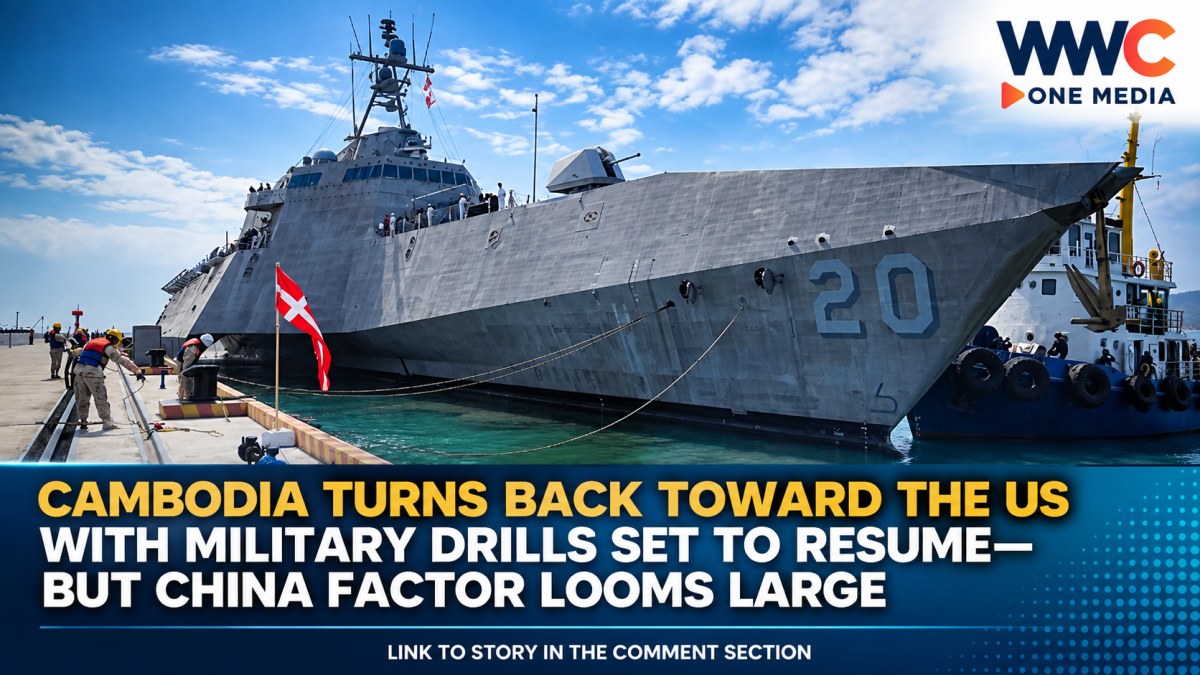
PHNOM PENH, Cambodia — Cambodia and the United States are preparing to revive a major bilateral military exercise in February 2027, marking a significant step in rebuilding defense ties after nearly a decade of suspended drills.
The Royal Cambodian Army announced that the two countries have agreed to resume Exercise Angkor Sentinel, with the upcoming edition scheduled for February 2027. The announcement followed an Initial Planning Conference held in Cambodia from Aug. 31 to Sept. 4 involving Cambodian and US military representatives.
The planned exercise will focus on military interoperability, disaster response and emergency relief, while training activities are expected to include command-post exercises and professional exchanges involving medical services, engineering and explosive ordnance disposal.
A military partnership put on hold
The return of Angkor Sentinel is significant because Cambodia suspended the exercise in 2017, during a period when relations between Phnom Penh and Washington were becoming increasingly strained.
Cambodia had conducted the exercise with the United States for several years before ending the program. Around the same period, Phnom Penh deepened its military relationship with China, including joint Golden Dragon exercises.
The United States subsequently became increasingly concerned about Cambodia’s growing economic and strategic dependence on Beijing, particularly over the development of Ream Naval Base on Cambodia’s southern coast.
China helped finance and upgrade the facility, prompting Washington to question whether Beijing could eventually obtain a strategic military foothold there. Cambodian authorities have repeatedly denied that the base is intended to serve as an exclusive Chinese military facility.
Why the 2027 exercise matters
The planned return of Angkor Sentinel comes amid a broader effort to improve Cambodia-US military relations.
Cambodian Prime Minister Hun Manet met US Under Secretary for Policy Elbridge Colby in Phnom Penh on Aug. 14. Hun Manet described the progress in bilateral defense relations positively and said the renewed exercise could serve as a bridge between the two countries’ armed forces.
US Pacific Fleet Commander Adm. Stephen Koehler also met Cambodian Armed Forces Commander-in-Chief Gen. Vong Pisen in August. Discussions included plans to deepen defense cooperation and potentially restart the CARAT maritime exercise with Cambodia in 2027.
That means the military thaw could extend beyond the Army and into naval cooperation.
China remains the big strategic question
Cambodia’s renewed engagement with Washington does not necessarily mean Phnom Penh is turning away from Beijing.
China remains one of Cambodia’s most important economic and strategic partners, while Cambodia has continued conducting major military exercises with China. In 2025, Cambodia and China held their largest-ever Golden Dragon exercise, featuring artillery, warships and other advanced military equipment.
For Washington, however, the revival of military-to-military engagement provides an opportunity to maintain a security relationship with Phnom Penh while Cambodia balances its relationships with both major powers.
The issue is particularly sensitive because of Ream Naval Base, which sits near the Gulf of Thailand and has strategic relevance to the wider South China Sea region.
More than military training
Officials have emphasized that the renewed exercises are not simply about combat preparation.
According to Cambodia’s National Press Agency, the 2027 Angkor Sentinel planning includes cooperation in medical services, engineering, disaster response and explosive ordnance disposal, areas that can support humanitarian operations and peacekeeping missions.
Cambodia’s armed forces have also highlighted continued cooperation with the United States on counterterrorism, transnational crime, military capacity-building and accounting for missing US service members from past conflicts.
The United States has similarly described its renewed engagement with Cambodia as a pragmatic effort aimed at strengthening the country’s sovereignty and territorial integrity.
A cautious reset in Southeast Asia
The revival of Angkor Sentinel represents a notable reset after years of military distance between Washington and Phnom Penh.
The move also comes as Cambodia seeks to strengthen its defense relationships while maintaining its longstanding partnership with China. Rather than signaling an immediate geopolitical realignment, the 2027 exercise appears to demonstrate Cambodia’s willingness to engage both Washington and Beijing.
For the United States, meanwhile, renewed military cooperation gives Washington another channel to maintain influence and defense ties in mainland Southeast Asia at a time when China’s strategic presence in the region remains a major concern.
The first major test will come in February 2027, when Cambodian and US forces return to the training ground together after nearly a decade apart.
WWC ONE MEDIA J.M.S

Leave a Reply