
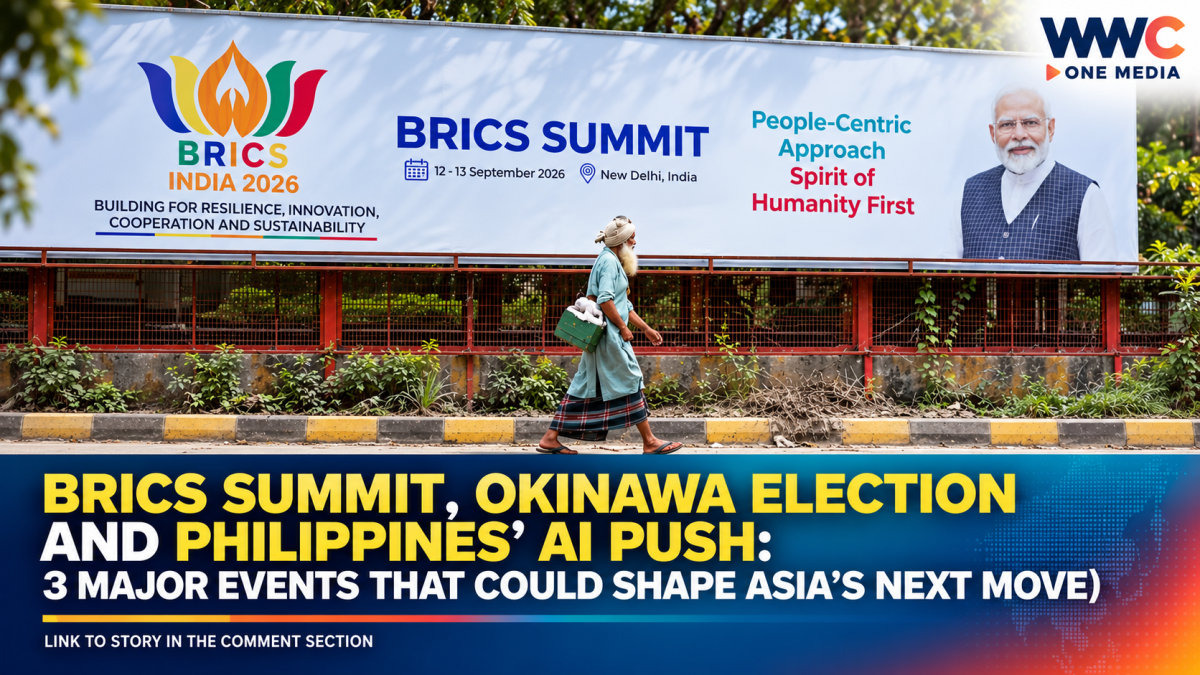
ASIA — From a high-stakes BRICS summit in India to a closely watched election in Okinawa and the Philippines’ growing push to shape Southeast Asia’s artificial intelligence future, the coming days could offer a glimpse into where Asia is heading next.
The events may appear unrelated.
One involves global diplomacy. Another centers on Japan’s security and domestic politics. The third focuses on artificial intelligence and Southeast Asia’s digital future.
But together, they reveal a region facing the same defining question:
Who will shape Asia’s future — and on whose terms?
BRICS Leaders Prepare for Crucial New Delhi Summit
Leaders and senior officials from major emerging economies are preparing to gather in New Delhi for the 2026 BRICS Summit, with the bloc facing growing pressure to prove it can translate its expanding membership and geopolitical influence into concrete action.
The summit, scheduled for Sept. 12-13, comes at a time of increasing tensions over trade, technology, security and the global economic order.
India, Russia, China and other BRICS members will enter the meeting with different national priorities — a challenge that has become increasingly visible as the organization has expanded. Analysts say the central test for BRICS is no longer simply whether it can grow, but whether its larger membership can act with enough unity to influence global policy.
The New Delhi gathering is expected to draw attention to issues including:
- Global trade and economic cooperation
- Reform of international institutions
- Technology and strategic competition
- Security and geopolitical tensions
- The growing influence of emerging economies
BRICS has long positioned itself as a major voice for a more multipolar world.
But as geopolitical divisions deepen, the group’s diversity could also become its biggest challenge.
Can BRICS turn its growing influence into real power — or will competing interests prevent the bloc from moving beyond symbolism?
Okinawa Election Could Test Japan’s Political and Security Strategy
Meanwhile, voters in Japan’s southernmost prefecture are heading toward a Sept. 13 gubernatorial election in Okinawa, a race with implications that extend far beyond local politics.
The relationship between Okinawa and Japan’s central government has emerged as a major issue in the campaign, particularly as the prefecture remains central to Tokyo’s security strategy and hosts a major concentration of U.S. military facilities.
Incumbent Governor Denny Tamaki is seeking another term, while challenger Genta Koja, backed by forces aligned with Japan’s ruling establishment, represents a potentially different approach to relations with Tokyo.
The planned relocation of the U.S. Marine Corps Air Station Futenma remains politically significant. A change in Okinawa’s leadership could affect how strongly the prefectural government challenges the central government’s security agenda.
But recent reporting suggests voters are also increasingly focused on more immediate concerns.
A survey cited by Stars and Stripes found that the economy, employment and rising prices ranked above U.S. bases and security among voters’ biggest concerns, while the race remained competitive with many voters undecided.
That makes the Okinawa election more unpredictable than a simple referendum on military bases.
For voters, the campaign is increasingly about everyday life.
For Tokyo, however, the result could carry major strategic consequences.
Why the Okinawa Vote Matters Beyond Japan
Okinawa occupies a critical position in the Indo-Pacific.
The prefecture sits near key sea lanes and is central to the military posture of both Japan and the United States at a time when tensions involving China, Taiwan and the wider region remain high.
The next governor could therefore influence the political environment surrounding major security and infrastructure decisions.
A victory by Tamaki could preserve Okinawa’s more confrontational relationship with Tokyo over military issues.
A victory by a candidate closer to the central government’s position could potentially ease cooperation between Okinawa and the national government.
But with economic concerns dominating much of the campaign, the election could also demonstrate a broader reality across Asia:
Geopolitics may dominate international headlines, but voters often make decisions based on what is happening in their wallets.
Philippines Steps Up AI Ambitions
While New Delhi and Okinawa focus attention on diplomacy and politics, the Philippines is pushing artificial intelligence higher on its national and regional agenda.
The Department of Information and Communications Technology has promoted a people-centered approach to AI and highlighted the Philippines’ plans to host the ASEAN AI Summit in September 2026 as part of its ASEAN chairmanship.
The broader Philippine agenda is increasingly tied to a regional effort to make AI accessible not only to major technology companies but also to governments, researchers and small businesses.
ASEAN leaders have backed a Philippines-led proposal for an AI MSME Hub, designed to help micro, small and medium-sized enterprises gain access to AI tools, training and advisory services.
The regional initiative also addresses a growing concern across Southeast Asia: access to computing power.
ASEAN has moved toward shared high-performance computing resources, while governments are exploring how to reduce the region’s dependence on technology infrastructure controlled outside Southeast Asia.
The Philippines Wants AI to Reach Beyond Big Tech
For the Philippines, the challenge is not simply adopting artificial intelligence.
It is making sure the technology delivers benefits across the economy.
The government’s people-centered approach emphasizes the potential role of AI in:
- Small and medium-sized businesses
- Government services
- Education and skills development
- Research and innovation
- Digital transformation
- Regional economic competitiveness
The proposal for an AI MSME Hub is particularly important because small businesses make up the overwhelming majority of enterprises across Southeast Asia.
If successful, the initiative could help smaller companies access technologies that have historically been dominated by large corporations with deeper financial resources.
But major challenges remain.
Southeast Asia faces gaps in computing infrastructure, skilled workers, investment and AI governance.
The region is also increasingly caught between competing technology ecosystems led by the United States and China.
Asia Is Facing Three Different Battles — With One Common Theme
The BRICS Summit.
The Okinawa election.
The Philippines’ AI agenda.
At first glance, they belong to three different worlds.
But each involves a struggle over influence.
At the BRICS Summit, the question is whether emerging powers can reshape global institutions.
In Okinawa, voters will help determine the political balance between local priorities and national security strategy.
In the Philippines and ASEAN, governments are trying to ensure that artificial intelligence does not become another technology controlled entirely by the world’s biggest powers.
Together, these developments show that Asia’s future is increasingly being shaped by three forces:
Politics. Security. Technology.
What to Watch Next
BRICS Summit
Watch whether member states can produce concrete agreements despite their differing geopolitical interests.
Okinawa Election
Watch whether economic concerns outweigh security issues — and whether the result changes the relationship between Okinawa and Tokyo.
Philippines AI Agenda
Watch for developments from the ASEAN AI Summit and whether the Philippines can turn its regional AI proposals into practical programs for businesses and governments.
Asia’s Next Big Test Is Already Underway
The coming week could deliver major clues about the region’s future direction.
Can BRICS become more than a symbol of emerging-world influence?
Will Okinawa voters reshape Japan’s political and security debate?
Can the Philippines help position ASEAN as an AI player rather than simply a consumer of technology developed elsewhere?
The answers may begin emerging in the days ahead.
And while the events are happening in three very different places, they could all be part of one much bigger story: the race to decide who controls Asia’s future.




Leave a Reply