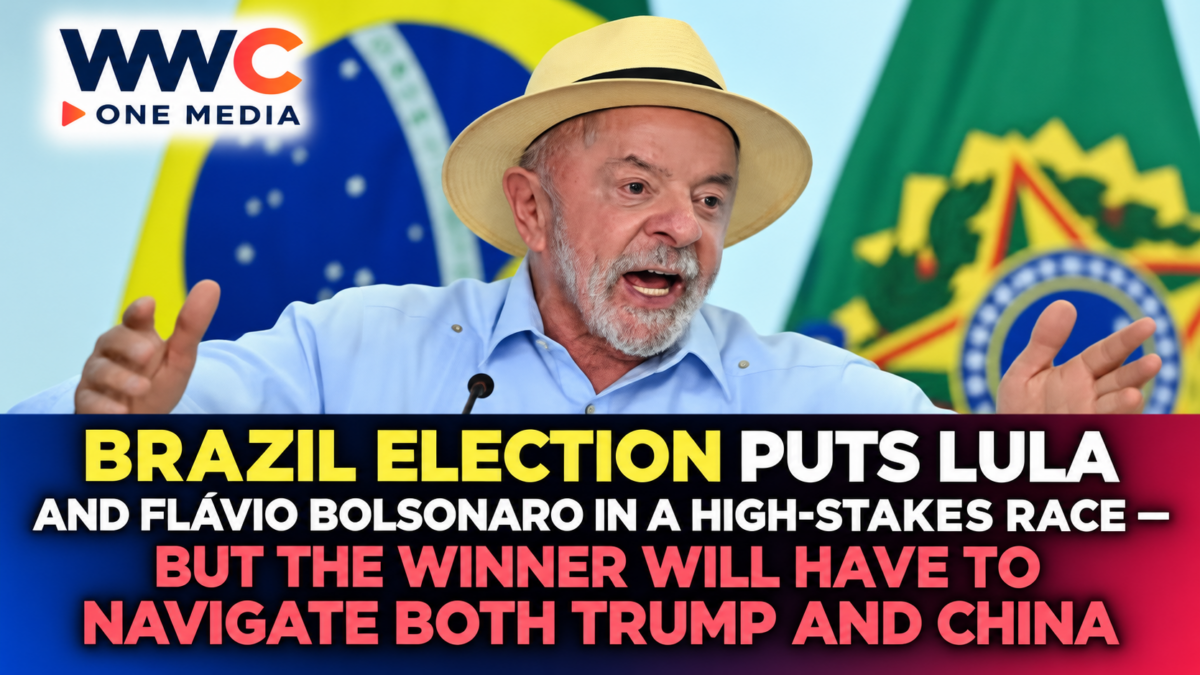
BRASÍLIA — More than 158 million Brazilians are eligible to vote Sunday in a presidential election that could reshape Latin America’s largest economy, its relationship with Washington and Beijing, the future of the Amazon and the direction of one of the world’s most important emerging markets.
At the center of the race are two familiar political forces.
Incumbent President:
Luiz Inácio Lula da Silva
is seeking an unprecedented:
fourth non-consecutive presidential term.
His leading challenger is:
Senator Flávio Bolsonaro,
the eldest son of former President:
Jair Bolsonaro.
But the election is about far more than the two candidates.
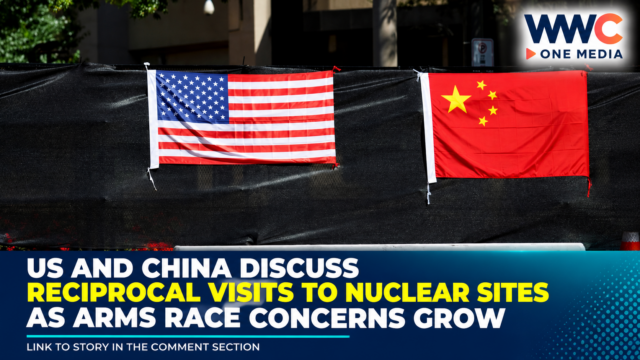
Behind the ballot are two global powers:
The United States
and
China.
U.S. President Donald Trump has repeatedly shaped Brazil’s political and trade debate through tariffs and his close relationship with the Bolsonaro political movement.
China, meanwhile, has become economically indispensable to Brazil.
That creates a difficult reality for whoever wins:
Brazil may choose a different political direction — but it cannot easily choose between Washington and Beijing.
BRAZIL VOTES ON OCTOBER 4
The first round of Brazil’s general election takes place on:
October 4, 2026.
According to Brazil’s Superior Electoral Court, approximately:
158.77 million voters
are eligible to participate.
They will vote for:
President
Governors
Senators
Federal deputies
and
State or district deputies.
Voting takes place nationwide between:
8 a.m. and 5 p.m. Brasília time.
If no presidential candidate receives more than:
50% of valid votes,
the two leading candidates advance to a second round on:
October 25.
POLLS SHOW A CLOSE CONTEST
Polling in the final weeks has shown a highly competitive race.
A Datafolha survey published October 1 measured a hypothetical second-round contest at:
Lula — 48%
Flávio Bolsonaro — 45%.
Earlier polls showed similarly narrow differences, with some surveys placing the two statistically tied within their margins of error.
That means Sunday’s first round will provide a much firmer measure of actual voter support than pre-election surveys.
It also means Brazil could face another three weeks of campaigning before a final result.
THIS IS NOT JAIR BOLSONARO VERSUS LULA AGAIN
The names may look familiar.
But this is not a repeat of Brazil’s:
2022 Lula-Bolsonaro election.
Former President Jair Bolsonaro is not the candidate.
His son:
Flávio Bolsonaro
has inherited much of his father’s political movement.
Jair Bolsonaro lost the 2022 election narrowly to Lula.
He was subsequently convicted over an attempted plot to overturn that result and is serving a lengthy prison sentence.
His political influence, however, remains significant.
Flávio has repeatedly presented himself as an heir to the broader conservative movement his father built.
FLÁVIO RECEIVED HIS FATHER’S BLESSING FROM PRISON
Reuters reported that Jair Bolsonaro encouraged his son to seek the presidency while serving his sentence.
That endorsement gave Flávio access to one of Brazil’s most loyal political constituencies.
The former president’s supporters remain highly mobilized around themes including:
Crime
Social conservatism
Distrust of the judiciary
Smaller government
and
Opposition to Lula’s Workers’ Party.
Flávio has attempted to preserve that political base while presenting himself as his own candidate.
LULA IS ASKING BRAZILIANS FOR ANOTHER TERM
Lula, now 80, is already one of the most important political figures in modern Brazilian history.
He previously served as president from:
2003 to 2010
and returned to office in:
2023
after defeating Jair Bolsonaro.
His current campaign emphasizes:
Social programs
Income redistribution
Employment
Industrial policy
and
Brazilian autonomy in foreign affairs.
Supporters point to improvements in employment and inequality.
Critics focus on:
Living costs
Government spending
Public debt
and
Crime.
Those economic and security concerns have dominated much of the campaign.
COST OF LIVING MAY MATTER MORE THAN IDEOLOGY
For many Brazilian households, the election is fundamentally economic.
Voters are dealing with:
High borrowing costs
Food prices
Household debt
and
Concerns about government finances.
Brazil’s interest rates remain restrictive.
Investors are also closely watching fiscal policy because higher government spending can increase concerns about:
Inflation
Debt
and
Future interest rates.
Those concerns make the election highly relevant to Brazil’s:
Real
Stock market
and
Government bonds.
CRIME IS ANOTHER MAJOR VOTER CONCERN
Security has also become an important campaign issue.
Organized crime and violent crime remain central concerns in many communities.
Flávio Bolsonaro has emphasized tougher security policies.
Lula has also responded with proposals aimed at strengthening public-security efforts.
The issue is politically significant because it can attract voters who might otherwise prioritize economic or social-policy questions.
BUT THE INTERNATIONAL STORY MAY BE EVEN BIGGER
Brazil is not just another emerging economy.
It is:
Latin America’s largest economy
A G20 member
A founding BRICS member
A major food producer
and
Home to most of the Amazon rainforest.
Its foreign-policy choices therefore affect:
Agriculture
Commodity markets
Climate diplomacy
Critical minerals
and
U.S.-China competition.
That makes the 2026 election unusually important outside Brazil.
TRUMP HAS BECOME PART OF THE BRAZILIAN CAMPAIGN
U.S. President Donald Trump has loomed over the race for months.
His administration imposed tariffs on Brazilian goods after alleging unfair trade practices.
Those measures became politically controversial inside Brazil.
Lula has accused Washington of using economic pressure in ways that interfere in Brazilian affairs.
The Trump administration disputes accusations of improper political interference and has framed its actions in terms of U.S. trade and policy interests.
Flávio Bolsonaro, meanwhile, has cultivated significantly warmer ties with Trump and his political allies.
THE U.S. IMPOSED 25% TARIFFS ON MANY BRAZILIAN GOODS
Earlier in 2026, the Trump administration imposed:
25% tariffs
on a range of Brazilian imports.
Washington cited concerns including:
Trade practices
Digital policies
Environmental enforcement
and other commercial issues.
The move created significant tension between the two governments.
But it also became a domestic Brazilian political issue.
Lula’s allies attempted to portray the tariffs as foreign pressure on Brazilian sovereignty.
Flávio Bolsonaro himself argued that additional U.S. tariffs could politically backfire by strengthening Lula.
LULA AND TRUMP HAVE ALSO TALKED DIRECTLY
Despite the public tensions, the relationship has not been completely frozen.
Lula and Trump have held discussions over trade.
In August, Lula asked Trump to restart negotiations over U.S. tariffs on Brazilian goods.
Brazil said Trump agreed that senior officials should continue discussions.
That demonstrates one important reality:
even governments with deep political disagreements still have major economic incentives to negotiate.
FLÁVIO BOLSONARO WOULD LIKELY SEEK A WARMER U.S. RELATIONSHIP
Flávio Bolsonaro’s foreign-policy approach generally points toward closer alignment with Washington.
His political movement has traditionally been much more sympathetic toward:
Trump
and
The United States
than Lula’s Workers’ Party.
A Bolsonaro presidency could therefore reduce some of the political tensions between Brasília and Washington.
But economic interests would still constrain how far Brazil could move away from China.
CHINA IS SIMPLY TOO IMPORTANT TO BRAZIL
This may be the most important economic reality in the election.
China is Brazil’s:
largest trading partner.
Official Brazilian trade data show that in August 2026 alone, Brazil exported approximately:
$8.34 billion
of goods to China.
That represented:
25.2% of all Brazilian exports.
Exports to the United States during the same month totaled around:
$3.19 billion
or
9.6% of the total.
Brazil therefore sells more than twice as much merchandise to China as it does to the United States in many months.
BRAZIL-CHINA TRADE HIT A RECORD IN 2025
Bilateral trade between Brazil and China reached approximately:
$171 billion
in 2025.
Brazil exported about:
$100 billion
to China.
Imports from China reached roughly:
$71 billion.
That left Brazil with a trade surplus of approximately:
$29 billion.
China alone contributed a huge share of Brazil’s overall merchandise trade surplus.
That commercial relationship gives Beijing enormous economic importance regardless of who occupies the presidential palace.
SOYBEANS ARE AT THE HEART OF THE RELATIONSHIP
Brazil is one of the world’s largest producers of:
Soybeans.
China is the world’s biggest soybean buyer.
Brazil exported roughly:
$34.5 billion
in soybeans to China during 2025.
That relationship connects Chinese food security directly with Brazilian:
Farmers
Ports
Railways
and
Agribusiness companies.
Any Brazilian government trying to sharply reduce trade with China would face strong resistance from economically important agricultural interests.
BEEF IS ANOTHER MAJOR LINK
China is also one of the largest destinations for Brazilian beef.
Brazilian agricultural exports to China totaled roughly:
$55 billion
in 2025.
Meat accounted for nearly:
$10 billion.
But the relationship is not without friction.
China introduced safeguard restrictions on beef imports, and Brazil exhausted its annual quota in 2026.
Additional shipments faced much higher tariffs beginning October 1.
That dispute demonstrates that even close economic partners can clash over trade.
IRON ORE MAKES CHINA EVEN MORE IMPORTANT
Brazil is also one of the world’s biggest exporters of:
Iron ore.
China is the dominant global steel producer.
Brazilian mining giant Vale depends heavily on Chinese demand.
Iron ore is therefore another pillar connecting the two economies.
Chinese construction, manufacturing and infrastructure activity can directly influence:
Brazilian exports
Corporate profits
and
Government revenues.
That makes Brazil-China ties much deeper than political symbolism.
CHINESE COMPANIES ARE ALSO INVESTING INSIDE BRAZIL
The relationship increasingly involves investment, not simply exports.
Chinese companies have expanded across Brazilian industries including:
Electric vehicles
Renewable energy
Power transmission
Mining
Telecommunications
and
Infrastructure.
Electric-vehicle manufacturers including:
BYD
have invested heavily in Brazilian production.
That creates Brazilian jobs and physical assets that cannot simply be separated overnight because of a change in government.
THIS IS WHY EVEN CHINESE COMMENTATORS ARE CAUTIOUS ABOUT FLÁVIO
Chinese media have closely followed the Brazilian election.
Some state-linked outlets clearly view Lula’s foreign policy more favorably.
He has strengthened Brazil-China relations and strongly supported BRICS cooperation.
But Chinese commentary has also acknowledged that a Bolsonaro victory would not necessarily destroy the economic relationship.
One widely discussed argument is essentially:
Brazilian cargo ships will continue sailing toward China regardless of who wins.
That reflects commercial reality.
FLÁVIO HAS REPORTEDLY REASSURED BRAZILIAN BUSINESS LEADERS ABOUT CHINA
Chinese reporting cited a closed-door meeting with Brazilian agricultural business leaders in which Flávio Bolsonaro reportedly signaled that commercial relations with China would not be radically disrupted under his government.
That position would represent a pragmatic approach.
Brazilian farmers depend heavily on Chinese demand.
Breaking that relationship would carry substantial domestic economic costs.
It also shows the difference between:
Campaign ideology
and
Government economics.
BRAZIL HAS LONG PRACTICED “MULTI-ALIGNMENT”
Brazil historically avoids choosing one permanent geopolitical bloc.
It frequently maintains relationships with competing powers.
Brazil works with the U.S. on:
Investment
Security
Technology
and
Trade.
At the same time, it works with China on:
Commodities
Infrastructure
Finance
and
BRICS diplomacy.
That tradition of strategic autonomy predates Lula and Bolsonaro.
Whoever wins will face strong incentives to preserve it.
LULA HAS LEANED MORE HEAVILY INTO BRICS
Lula has repeatedly argued that emerging economies deserve greater influence in:
International financial institutions
and
Global governance.
BRICS is central to that agenda.
Brazil, Russia, India, China and South Africa founded the original group, which has since expanded.
Lula has supported:
Greater trade among developing nations
and
Reduced dependence on the U.S. dollar in some transactions.
Those positions sometimes create friction with Washington.
BUT BRAZIL IS NOT A CHINESE ALLY
It is equally important not to overstate the relationship.
Brazil is not a formal Chinese military ally.
It continues to maintain major economic and diplomatic relations with:
The United States
Europe
Japan
and other countries.
Lula’s foreign policy is better described as seeking:
Strategic autonomy
rather than simply aligning with Beijing.
Brazil frequently disagrees with China on trade and commercial issues.
CRITICAL MINERALS ARE BECOMING THE NEXT BATTLEGROUND
Another major issue is emerging:
rare earths and critical minerals.
Brazil possesses significant reserves of minerals important for:
Electric vehicles
Defense systems
Semiconductors
Renewable energy
and
Advanced manufacturing.
The United States wants supply chains that reduce dependence on China.
China already dominates global processing of many critical minerals.
That puts Brazil in an increasingly valuable strategic position.
THE U.S. WANTS MORE ACCESS TO BRAZILIAN MINERALS
Washington has shown growing interest in Brazilian mineral projects.
Some U.S. policymakers want Brazil to become part of supply chains that compete with Chinese dominance.
Reports in Brazil have described disagreements inside the Trump administration over how aggressively Washington should link mineral cooperation to political alignment.
Brazil’s government has resisted demands it believes would restrict its ability to work with multiple countries.
This issue is likely to outlast the election.
THE AMAZON IS ANOTHER GLOBAL STAKE
Brazil contains nearly:
60% of the Amazon rainforest.
That makes environmental policy a global concern.
Under Lula, Amazon deforestation has fallen substantially compared with levels recorded during Jair Bolsonaro’s presidency.
Lula says he wants Brazil to reach:
zero net deforestation by 2030.
Flávio Bolsonaro has also pledged action against illegal deforestation but favors a more development-oriented and less restrictive approach to environmental regulation.
Those different policies could affect:
Agriculture
Mining
Indigenous lands
and
Climate negotiations.
THE ENVIRONMENTAL DIFFERENCE IS SUBSTANTIAL
During Jair Bolsonaro’s presidency, Amazon deforestation rose significantly as his administration weakened some environmental enforcement.
His supporters argued Brazil needed greater freedom to commercially develop its natural resources.
Lula restored stronger environmental enforcement after returning to power.
Flávio’s proposals suggest greater emphasis on:
Economic development
Property rights
and
Resource extraction.
Environmental organizations worry that could weaken conservation.
His campaign argues economic development and environmental enforcement can coexist.
BRAZIL’S NEXT PRESIDENT WILL ALSO HAVE ENORMOUS INSTITUTIONAL POWER
Another less-discussed issue may be equally important.
Brazil’s next president is expected to inherit an unusually large number of vacancies across important state institutions.
Reuters reports that openings have accumulated at:
The Supreme Court
The central bank
and
Major economic regulators.
That means the next administration could make appointments affecting Brazil long beyond the four-year presidential term.
TWO CENTRAL BANK BOARD SEATS ARE ALREADY VACANT
Brazil’s central bank has had two board vacancies since:
January 2026.
That includes a position overseeing economic policy.
Other agencies—including securities and competition regulators—also have unfilled positions.
Brazil’s Senate must approve many major appointments.
That has increasingly turned nominations into political bargaining tools.
The composition of Congress therefore matters almost as much as the presidential result.
CONGRESS IS ALSO BEING ELECTED
Brazilian voters are not electing only a president.
All seats in the:
Chamber of Deputies
and
two-thirds of the Senate
are also being contested.
That will determine whether the next president can actually pass major legislation.
A president without congressional support may struggle to implement:
Fiscal reforms
Tax changes
Environmental legislation
or
Institutional appointments.
Brazil’s coalition-based political system makes congressional alliances essential.
MARKETS ARE WATCHING THE FISCAL QUESTION CLOSELY
Investors are particularly focused on Brazil’s government finances.
The country faces:
High interest rates
Rigid public spending
and
Growing debt concerns.
Lula’s critics argue his administration spends too much.
Supporters counter that social investment supports growth and reduces inequality.
Flávio Bolsonaro has emphasized:
Lower spending
Less bureaucracy
and
More market-oriented policies.
But campaign commitments do not automatically become legislation, especially under a fragmented Congress.
FINANCIAL MARKETS MAY MOVE SHARPLY AROUND THE RESULT
Brazil’s:
Bovespa stock index
Government bonds
and
Real
can react rapidly to political developments.
Foreign investors often focus on:
Fiscal discipline
Central bank independence
Commodity policy
and
Regulatory stability.
Markets may therefore respond not only to who wins the presidency but also to:
Congressional results
and
The eventual economic team.
POLITICAL POLARIZATION REMAINS EXTREME
Brazil has remained politically divided since the 2022 election.
Lula defeated Jair Bolsonaro by a narrow margin.
The aftermath eventually led to investigations and prosecutions related to efforts to overturn the result.
The 2026 campaign has inherited much of that polarization.
Both major political camps accuse the other of threatening important national institutions.
Those claims should be evaluated against specific actions rather than campaign rhetoric.
But the level of distrust itself is politically significant.
BOTH FRONT-RUNNERS SKIPPED THE FINAL GLOBO DEBATE
In another sign of the unusual campaign environment, Lula and Flávio Bolsonaro both declined to attend the final TV Globo presidential debate before the first round.
That contributed to the debate’s cancellation.
Both instead participated in separate online broadcasts.
Analysts cited by AP said both campaigns appeared to see more downside than upside in exposing their candidates to a potentially confrontational live debate.
If the election goes to a runoff, voters could still see a direct confrontation before October 25.
THE U.S. EVEN SUSPENDED CONSULAR SERVICES BEFORE THE VOTE
The tense atmosphere intensified on October 2.
The United States temporarily suspended consular services in Brazil, citing security concerns.
Australia also closed its embassy temporarily.
Brazilian authorities carried out searches connected to alleged threats involving diplomatic facilities.
Authorities had not established publicly that the reported threats were tied directly to any presidential campaign.
The episode nonetheless highlighted the heightened security atmosphere surrounding the election.
THE BIGGER STORY: BRAZIL CAN CHANGE PRESIDENTS — BUT IT CANNOT ESCAPE GEOGRAPHY OR ECONOMICS
The political choice facing Brazilian voters is significant.
Lula and Flávio Bolsonaro offer different approaches to:
The economy
Public spending
Crime
The environment
and
Foreign policy.
Their relationships with Washington are also very different.
Lula has frequently pushed back against Donald Trump while defending Brazil’s strategic autonomy.
Flávio Bolsonaro is far more politically aligned with the U.S. president.
But whoever wins will encounter the same economic map.
The United States remains a crucial:
Investor
Technology partner
and
Diplomatic power.
China remains Brazil’s:
largest trading partner
largest market for many commodities
and
an increasingly important investor.
Brazil cannot easily afford to lose either relationship.
That is why Sunday’s election may not ultimately decide whether Brazil chooses:
Washington
or
Beijing.
The more realistic question is how the next president balances both while protecting Brazilian economic interests.
And with China buying roughly a quarter of Brazilian exports while the U.S. seeks deeper access to Brazil’s minerals, technology and strategic industries, that balancing act is becoming harder.
Brazil’s voters are choosing a president — but the winner will inherit a geopolitical test much larger than the campaign: how to stay economically tied to China, strategically important to the United States and politically independent of both.