
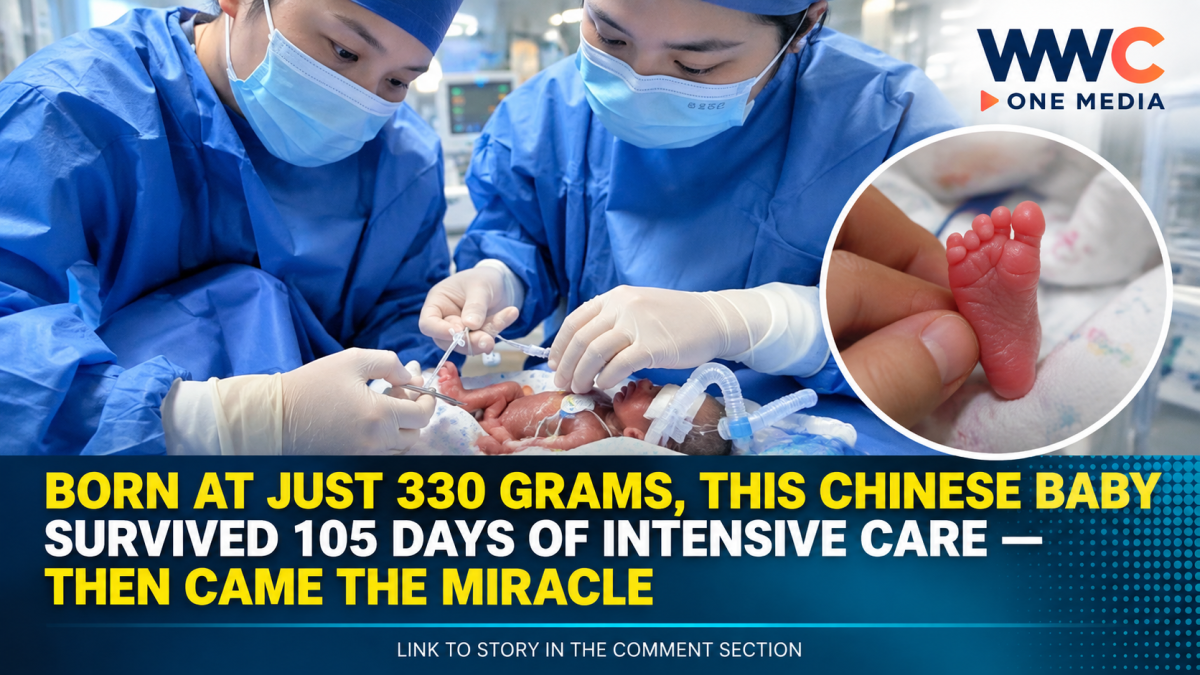
SHENZHEN, China — A premature baby born weighing just 330 grams — roughly the weight of six eggs — has been discharged from a hospital in southern China after 105 days of intensive neonatal care, reaching 2.5 kilograms and showing good overall development.
The baby, nicknamed “Little Zebao” in Chinese media, was born on May 20, 2026, at just 23 weeks and four days of gestation at Shenzhen Maternity and Child Healthcare Hospital.
He was discharged on September 1, weighing about 2.5 kilograms, after what the hospital described as an exceptionally challenging course of treatment for an extremely premature infant.
The case has drawn widespread attention in China because the hospital said the infant was its lightest successfully treated surviving extremely premature baby, while Southern+ reported that the case set a new record for the lowest birth weight among successfully treated extremely premature infants in Guangdong province.
From 330 grams to 2.5 kilograms
At birth, Little Zebao was so small that reports compared his weight to approximately six eggs.
His skin was described as extremely thin, with tiny blood vessels visible underneath, while his feet were reportedly smaller than an adult’s thumb. His organs were profoundly immature because he was born more than 16 weeks before the expected delivery date.
Doctors said his intestinal tract was extremely delicate and his immune system was not yet fully developed, creating major challenges involving breathing, nutrition, infection prevention and circulation.
For the medical team, the objective was not simply to keep the baby alive but to carefully support his development while avoiding the serious complications associated with extreme prematurity.
His mother faced a dangerous pregnancy
The difficult journey began before the baby was born.
According to Shenzhen Maternity and Child Healthcare Hospital, the baby’s mother had chronic hypertension complicated by severe preeclampsia.
Continuing the pregnancy posed serious risks to the mother, while delivering early placed the fetus at an extremely high risk because of his very early gestational age.
Doctors therefore assembled a multidisciplinary team involving obstetrics and neonatology specialists to assess the mother and fetus and prepare for an emergency delivery. The hospital said doctors managed the mother’s blood pressure and closely monitored the fetus while preparing interventions intended to improve the baby’s chances of survival.
The first hours were critical
After the baby was delivered, a neonatal resuscitation team immediately began treatment.
The hospital said that within about 30 minutes of his admission to the neonatal intensive care unit, doctors successfully established umbilical arterial and venous access — a technically demanding procedure in an infant of such small size.
Doctors then had to carefully balance respiratory support, circulation, nutrition, infection prevention and neurological protection.
The hospital described the treatment as requiring extremely precise management, with fluid and nutritional calculations adjusted according to the baby’s changing weight and condition.
A life-threatening crisis struck on Day 3
The baby’s recovery was far from straightforward.
On the third day after birth, Little Zebao reportedly suffered a sudden and potentially fatal deterioration.
His heart rate and blood oxygen levels dropped sharply. An ultrasound examination found pericardial effusion causing cardiac tamponade — a condition in which fluid accumulates around the heart and compresses it, potentially preventing the heart from pumping effectively.
Doctors performed an ultrasound-guided pericardiocentesis, removing the fluid and relieving pressure on the heart.
According to reports, the emergency was brought under control within minutes.
It was one of the most dangerous moments in a 105-day hospitalization that began with the infant already at the extreme limits of premature birth.
The medical team fought complications at every stage
Extreme prematurity can affect virtually every organ system because the infant is born before many critical developmental processes are complete.
In Little Zebao’s case, the medical team closely monitored his respiratory, cardiovascular, neurological and gastrointestinal systems while providing nutritional support.
The hospital said he avoided several major complications, including severe intracranial hemorrhage, severe necrotizing enterocolitis and serious infection during his hospitalization.
His nutrition also required extraordinary precision.
According to the hospital, feeding began at extremely small volumes and was gradually adjusted as his digestive system matured. Medical staff continuously assessed his weight gain, urine output, blood gases and electrolytes to determine how much nutrition and fluid he could safely receive.
From the NICU to his parents’ arms
After 105 days of treatment, the transformation was remarkable.
The 330-gram newborn had grown to approximately 2.5 kilograms, with the hospital reporting good development across his major systems.
His corrected gestational age at discharge was 38 weeks and three days.
On September 1, the baby was finally discharged and returned to his parents.
The hospital said his care will continue through long-term follow-up, reflecting an important reality for extremely premature infants: leaving the hospital is not necessarily the end of medical monitoring.
More than a survival story
Doctors involved in the case emphasized that the achievement was not simply about reaching discharge.
The hospital said its goal was to help extremely premature infants survive while also supporting healthy development, requiring coordinated care from multiple medical specialties and carefully established treatment protocols.
The case also highlights how advances in neonatal intensive care can give some infants born at extremely early gestational ages a chance of survival that would have been far less likely in previous generations.
But medical experts generally caution that outcomes for extremely premature infants vary considerably and depend on gestational age, birth weight, complications and the quality of neonatal care available.
The 105-day journey in numbers
- Birth weight: 330 grams
- Gestational age: 23 weeks + 4 days
- Birth date: May 20, 2026
- Hospital: Shenzhen Maternity and Child Healthcare Hospital
- NICU treatment: 105 days
- Discharge date: September 1, 2026
- Discharge weight: 2.5 kilograms
- Corrected gestational age at discharge: 38 weeks + 3 days
- Major emergency: Cardiac tamponade caused by pericardial effusion on Day 3
- Outcome: Discharged in good condition, with continued follow-up planned.




Leave a Reply