
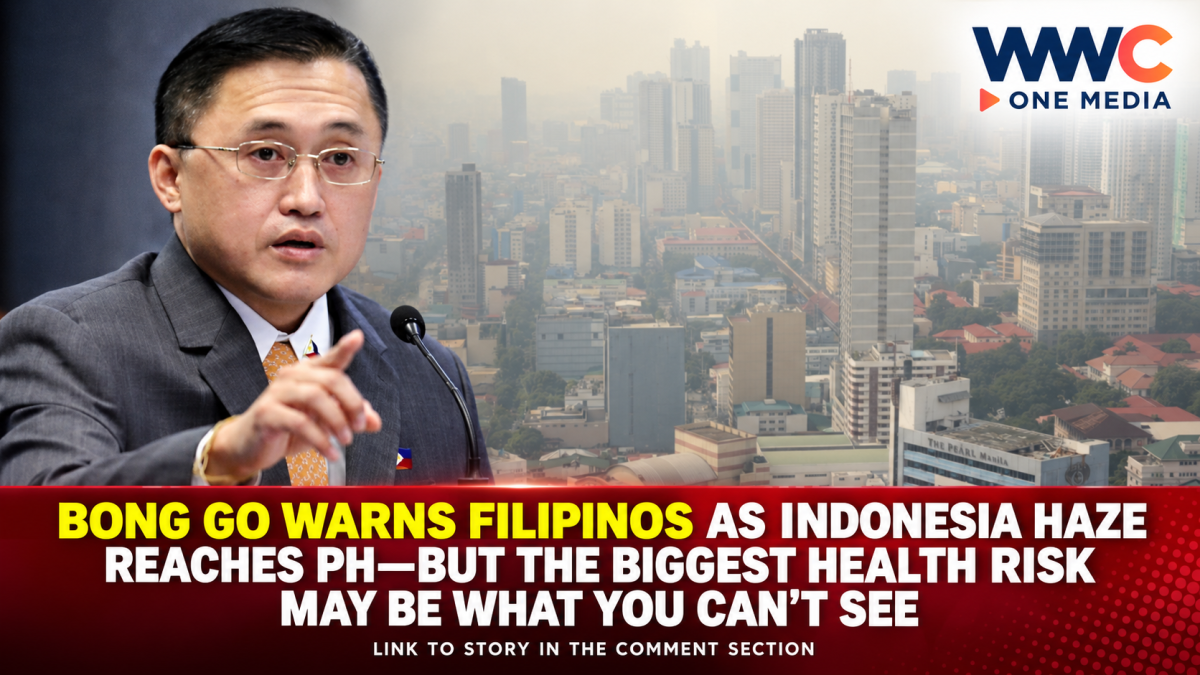
MANILA, Philippines — Senator Christopher “Bong” Go is urging Filipinos to take the health threat from haze drifting from Indonesia seriously as government agencies continue monitoring elevated levels of fine particulate pollution in several parts of the country.
The warning comes as smoke from forest and land fires in Kalimantan, Indonesia, has crossed national borders and affected portions of the Philippines, with authorities recording unhealthy air-quality readings in several areas.
The Department of Environment and Natural Resources–Environmental Management Bureau (DENR-EMB) has been tracking elevated concentrations of PM2.5, microscopic particles that can penetrate deep into the respiratory system.
Go, vice chairperson of the Senate Committee on Health and Demography, said the situation highlights the need to protect vulnerable Filipinos and ensure that communities have access to basic health services while poor air quality persists.
Several Philippine areas record unhealthy air
Data cited in the Manila Times report showed that a number of Philippine locations recorded concerning air-quality readings as of September 2.
Talisay City in Cebu and the DENR monitoring station in Cagayan de Oro City were classified as having “acutely unhealthy” air, while Naga City in Camarines Sur and Barangay Talisayan in Zamboanga City were placed in the “very unhealthy” category.
Other areas, including Batac City in Ilocos Norte, Bacolod City, Calinan in Davao City and Koronadal City, were classified as unhealthy for sensitive groups.
Puerto Princesa also recorded a PM2.5 Air Quality Index reading of 228 on the morning of September 2, placing it in the “very unhealthy” category.
The situation was also concerning in Northern Mindanao. Reports from the Inquirer showed Iligan City recording AQI levels of 203 and 209 on August 31 and September 1, respectively—both within the “acutely unhealthy” range. Cagayan de Oro and Tagoloan also experienced worsening particulate pollution.
How did Indonesia’s smoke reach the Philippines?
Authorities say the southwest monsoon, or habagat, is a major factor.
Satellite observations presented during a government briefing showed smoke from Indonesian fires being transported toward the Philippines by prevailing winds.
The Philippine Information Agency reported that Manila Observatory scientist Dr. Maria Obiminda Cambaliza explained that the smoke plume from Indonesia had reached Metro Manila, although conditions there were beginning to improve. She warned, however, that the situation could change again depending on weather patterns and the continued presence of fires in Indonesia.
PAGASA’s regional climate monitoring information has also identified rainfall deficits across parts of Indonesia, including southern Kalimantan, consistent with the dry conditions contributing to heightened fire risk.
Health officials urge Filipinos to limit exposure
The Department of Health has advised people in affected areas to reduce prolonged or strenuous outdoor activity and to wear protective masks when exposure cannot be avoided.
The DOH specifically recommended N95 masks for people who need to go outdoors.
Haze contains smoke, ash, dust and fine particles that may irritate the eyes and respiratory system. Health authorities warn that exposure can contribute to coughing, difficulty breathing, chest discomfort and worsening symptoms among people with existing respiratory conditions.
Children, older adults, pregnant women and people with respiratory or cardiovascular conditions are among those who need to take additional precautions.
The Philippine News Agency reported that the DOH also advised residents to stay indoors when possible, keep indoor spaces protected from polluted outdoor air and monitor local air-quality conditions.
Northern Mindanao among areas feeling the impact
The haze has been particularly noticeable in parts of Mindanao.
In Cagayan de Oro, local authorities reported deteriorating air conditions, while Iligan crossed into the “acutely unhealthy” range.
The situation prompted local officials to remind residents to monitor air-quality updates and use masks when going outdoors.
Other reports have documented haze across parts of Palawan, Mindoro, the Visayas and other areas, demonstrating how widely smoke from Indonesian fires can travel under favorable atmospheric conditions.
The regional crisis is getting worse
The Philippines is not the only country being affected.
Indonesia’s fires have generated widespread haze across Southeast Asia, with Malaysia also experiencing severe air pollution.
The Associated Press reported that Malaysia declared an emergency in Serian, Sarawak, after its air-pollution index climbed to 521, well above the country’s emergency threshold. Kuching also recorded hazardous pollution levels.
Reuters reported that Indonesia has intensified its response to fires across Sumatra and Kalimantan, including inspections of companies with fires detected within their concession areas. Satellite assessments have shown extensive fire activity during an unusually severe dry period.
Reuters also reported that fires have spread near Indonesia’s planned new capital, Nusantara, prompting additional firefighting and cloud-seeding efforts.
Why Filipinos should pay attention
The concern is not simply the visible haze.
PM2.5 particles are small enough to travel deep into the lungs, making prolonged exposure particularly concerning for vulnerable groups.
And because the movement of haze depends heavily on wind and weather conditions, an area that improves today can potentially experience deteriorating air quality again if the smoke plume shifts.
That is why authorities continue to emphasize monitoring rather than assuming that clearer skies automatically mean the threat has disappeared.
For Filipinos living in areas affected by haze, the message from health authorities is straightforward: check local air-quality readings, limit unnecessary outdoor exposure, avoid strenuous activities outdoors and use an N95 mask when exposure cannot be avoided.
For Senator Go, however, the haze is also a reminder that the country needs stronger and more accessible primary healthcare, particularly for communities and vulnerable Filipinos who may bear the greatest health burden when environmental emergencies strike.
And with Indonesia’s fires continuing, one question remains:
Will the haze finally clear—or could another shift in the winds send another wave of smoke toward the Philippines?
WWC ONE MEDIA J.M.S




Leave a Reply