
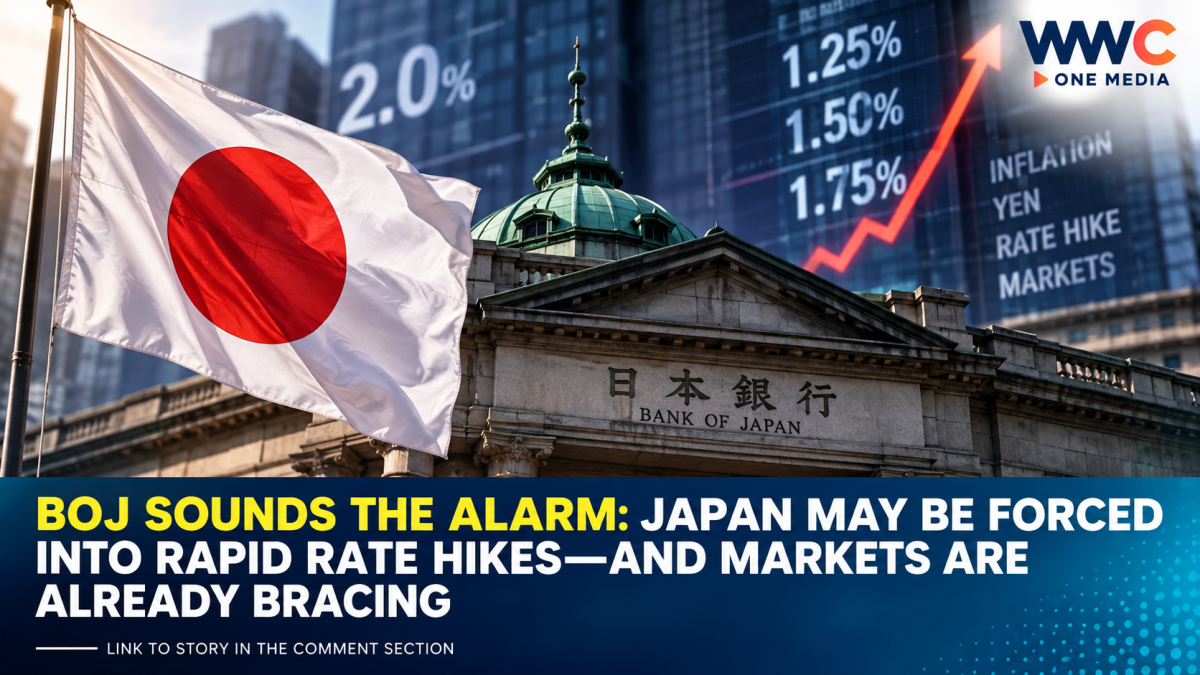
TOKYO, Japan — The Bank of Japan may be forced to raise interest rates at a much faster pace if inflation accelerates further, with growing pressure from higher energy costs, food prices and a weak yen threatening to push price growth beyond the central bank’s comfort zone.
Bank of Japan board member Kazuyuki Masu delivered the warning Thursday, saying Japan’s financial conditions remain highly accommodative even as underlying inflation moves closer to the BOJ’s 2% target.
The message could add fresh momentum to expectations that the BOJ will raise interest rates again at its upcoming policy meeting—and possibly move more aggressively thereafter.
“If inflation accelerates here, there is a risk we might inevitably need to rapidly raise interest rates,” Masu said in a speech.
Inflation Risks Are Building
Masu pointed to a recent rise in producer prices as a major concern, warning that companies are becoming more willing to pass higher costs on to consumers.
The inflation pressure is being driven by several factors, including:
- Rising fuel prices;
- Higher chemical and transportation costs;
- Persistent food inflation;
- The impact of conflict in the Middle East on supply costs; and
- A weak yen that makes imported goods more expensive.
The combination could make inflation more entrenched in Japan, potentially forcing the central bank to react faster than previously expected.
BOJ Policymaker Says Rates Need to Move Higher
Masu said he believes the BOJ needs to continue raising its policy rate toward what policymakers estimate to be a neutral level—giving the central bank greater flexibility to either tighten or loosen policy depending on future economic conditions.
While underlying inflation has not yet firmly reached the BOJ’s 2% target, Masu said it is getting close.
That distinction is increasingly important for investors.
Japan spent decades battling deflation and weak price growth, leading the BOJ to maintain ultra-loose monetary policy for years. But persistent inflation and changing wage dynamics are now raising the possibility that the central bank may need to normalize policy more quickly.
Markets Increasingly Expect a September Rate Hike
Expectations for another BOJ rate increase have strengthened significantly ahead of the central bank’s September 17-18 policy meeting.
A Reuters poll published this week found that economists expect the BOJ to raise its policy rate to 1.25% on September 18, with forecasts also pointing to a move toward 1.75% by the second quarter of 2027—a faster path than previously anticipated.
The BOJ raised its policy rate to 1% in June, its highest level in roughly three decades, before keeping rates unchanged in July.
Japan’s stronger-than-expected economic performance has also strengthened the case for additional tightening. Revised data showed the Japanese economy grew at an annualized 1.4% in the April-June quarter, while real wages posted strong growth in July.
Bloomberg Report: BOJ Leaning Toward Quarter-Point Increase
A separate Bloomberg report last week said BOJ officials were leaning toward considering a 25-basis-point increase from the current 1% policy rate at the September meeting.
The report said policymakers continued to see upside risks to inflation, with rising service prices and continued currency weakness adding to the case for action.
That means Masu’s remarks may be more than just another inflation warning.
They could be interpreted by markets as another signal that the BOJ is preparing investors for a policy shift.
Reuters previously reported that the BOJ had scheduled speeches by several policymakers ahead of the September meeting, raising speculation that officials could use public appearances to signal their thinking before any formal decision.
Why the Yen Is a Major Part of the Story
The yen has become increasingly important to Japan’s monetary policy outlook.
A weaker Japanese currency raises the cost of imported fuel, food and raw materials, increasing pressure on households and businesses. The yen has recently strengthened as investors increasingly bet that the BOJ will raise rates sooner and potentially faster than previously expected.
Higher Japanese interest rates could further strengthen the currency—but they could also have wider consequences for global financial markets.
One major risk involves the so-called yen carry trade, in which investors borrow cheaply in Japanese yen and invest in higher-yielding assets elsewhere. A rapid strengthening of the yen or a faster BOJ tightening cycle could force investors to unwind some of those positions, potentially increasing market volatility.
Rising Japanese Yields Could Also Reshape Global Capital Flows
The consequences may extend beyond currencies.
Fitch Ratings said rising Japanese government bond yields could encourage Japanese institutional investors to keep more money inside the country instead of investing overseas.
That shift could support the yen and gradually change global capital flows, particularly if Japanese assets become increasingly attractive as domestic yields rise.
Japan’s 10-year government bond yield has also reached levels not seen in decades, highlighting how dramatically the country’s financial environment is changing after years of ultra-low interest rates.
What Happens Next?
The biggest question now is whether the BOJ will simply raise rates again—or signal that it is prepared to move faster if inflation worsens.
Masu’s warning suggests policymakers are increasingly worried about being forced to play catch-up.
If energy costs continue rising, companies continue passing higher costs to consumers and the yen weakens again, the BOJ could face a difficult choice: move gradually and risk inflation accelerating, or tighten policy more aggressively and risk disrupting the economy and financial markets.
For now, markets appear to be preparing for another rate hike.
But after Masu’s latest warning, the bigger question may no longer be whether Japan will raise rates again.
It may be how quickly the BOJ could be forced to move if inflation refuses to cool.




Leave a Reply