
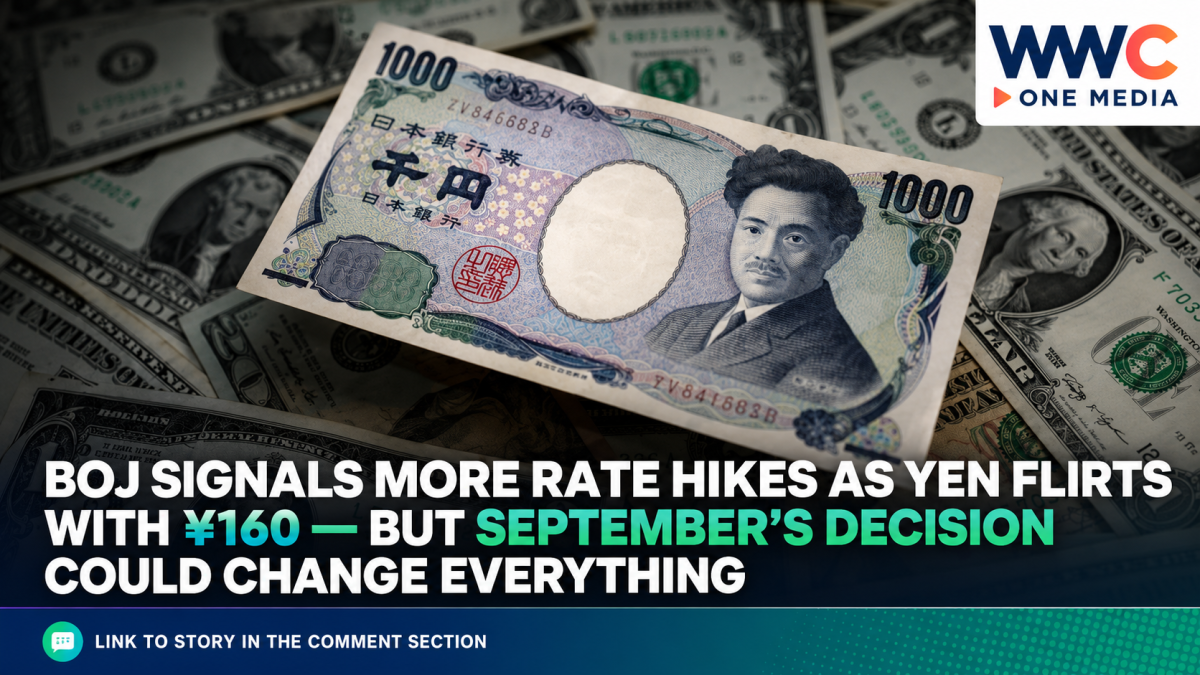
TOKYO — The Bank of Japan is sending one of its clearest signals yet that Japan’s era of ultra-cheap money is fading — and its next move could arrive sooner than markets once expected.
Bank of Japan Governor Kazuo Ueda said the central bank intends to continue raising interest rates if the economy and prices develop broadly in line with its forecasts, while warning that policymakers must pay particularly close attention to the risk that inflation could run hotter than expected.
Speaking after a Group of 20 finance leaders’ meeting in Asheville, North Carolina, Ueda said Japan’s financial conditions remain accommodative and that the BOJ will closely examine both its baseline economic outlook and the risks surrounding it when policymakers meet later this month.
The message immediately puts the spotlight on the BOJ’s September 17–18 monetary policy meeting, where markets have been assigning a high probability to another rate increase. Ueda, however, stopped short of confirming that a hike would happen at that meeting.
The BOJ Is Already at a 31-Year Rate High
Japan is no longer operating under the near-zero interest-rate environment that defined much of the previous three decades.
The BOJ raised its key short-term interest rate to around 1.0% in June 2026, the highest level since 1995, before leaving policy unchanged at its July meeting. The central bank’s official website currently lists its guideline for the uncollateralized overnight call rate at approximately 1%.
But Ueda’s latest comments suggest that 1% may not be the end of the tightening cycle.
The BOJ’s own July economic outlook explicitly states that the central bank intends to continue raising its policy interest rate and reduce the degree of monetary accommodation if economic activity, prices and financial conditions evolve as projected.
The bigger question is now how quickly those increases will come.
Inflation Is Getting Harder to Ignore
Japan spent decades worrying about deflation.
Now policymakers are increasingly focused on the opposite problem.
Tokyo’s core consumer inflation accelerated to 1.8% in August, slightly above expectations, while an index excluding both fresh food and fuel — a measure watched closely for underlying inflation trends — rose 2.0% from a year earlier.
Those numbers matter because the BOJ has long targeted sustainable inflation around 2%.
The central bank’s July outlook projected Japan’s core consumer inflation at about 2.5% in fiscal 2026, 2.4% in fiscal 2027 and 2.0% in fiscal 2028.
More importantly, the BOJ said underlying inflation could rise to a level broadly consistent with its 2% target — and acknowledged the possibility that it could overshoot that level.
That risk has become increasingly important because several inflationary forces are hitting Japan at the same time.
Higher crude oil prices linked to instability in the Middle East are raising import costs. Strong global demand for semiconductors and AI-related equipment is adding additional price pressures. And the weak yen makes imported energy, food and raw materials more expensive for Japanese businesses and consumers.
Wholesale inflation had already surged 7.2% year on year in July, according to Reuters, increasing concern that higher producer costs could eventually filter through to consumers.
The Weak Yen Is Turning Up the Pressure
Then there is the currency.
The yen has again been trading around the psychologically important ¥160-per-dollar region, despite extraordinary efforts to stabilize it.
The Japan Times reported that the currency slipped through ¥160 in late August, while rising expectations of BOJ tightening have intensified as policymakers confront the inflationary effects of a weaker currency.
A weaker yen can help Japanese exporters by increasing the value of overseas earnings, but prolonged depreciation also raises the domestic cost of imported fuel, food and other necessities.
That has transformed the yen from primarily a currency-market story into an inflation and cost-of-living problem.
U.S. Treasury Secretary Scott Bessent has also publicly suggested that Japan and its central bank need to take action that ultimately supports a stronger currency.
His comments helped reinforce market expectations that the BOJ could raise rates again in September.
Still, monetary policy formally remains the BOJ’s decision, and Ueda has avoided committing publicly to a particular outcome.
Japan’s Bond Market Is Flashing Another Warning
The pressure is not confined to the yen.
Japan’s benchmark 10-year government bond yield reached 3% on September 1, a level not seen in roughly three decades.
The Financial Times linked the broader global bond sell-off to persistent inflation concerns, higher energy prices and expectations that major central banks may need to tighten policy further. The Japan Times similarly reported the 3% Japanese yield as a three-decade high amid inflation and fiscal concerns.
That creates an uncomfortable balancing act for the BOJ.
Higher rates could help contain inflation and reduce pressure on the yen.
But moving too aggressively also raises borrowing costs throughout the economy — including for businesses, mortgage holders and a Japanese government already carrying one of the world’s largest public-debt burdens.
Ueda acknowledged that trade-off, stressing that policymakers must examine the cumulative impact of previous rate increases on economic activity before deciding how much further to tighten.
Even BOJ Officials Are Warning Against Waiting Too Long
Ueda is not the only senior policymaker sounding more hawkish.
BOJ Deputy Governor Ryozo Himino said in late August that policymakers need to balance gathering sufficient economic information against the danger of acting too slowly and falling behind inflation.
He warned that the central bank should now pay greater attention to the possibility that underlying inflation could exceed the 2% target.
“Raising rates in a timely manner,” Himino argued, could prevent a larger inflation surge that would eventually require much more abrupt increases.
That language has helped strengthen expectations that the September meeting is very much “live.”
Recent market estimates cited by Bloomberg reporting carried by The Japan Times put the probability of a September increase at roughly 80% to 85% in late August, while Reuters subsequently reported that markets were close to fully pricing in a hike.
So What Happens on September 18?
A quarter-point increase would take the BOJ’s policy rate from around 1% to 1.25%.
But the rate decision itself may not be the biggest story.
Markets will be watching closely for clues about what comes after it.
If Ueda suggests that inflation, the weak yen and higher import costs require a faster normalization cycle, investors could begin pricing in several additional hikes.
Reuters reported that Oxford Economics now expects increases in September and December 2026, followed by another in April 2027, although that remains an analyst forecast rather than official BOJ guidance.
The BOJ also cannot ignore the other side of the equation.
Its July forecasts put Japanese real GDP growth at only about 0.6% in fiscal 2026, meaning policymakers are trying to tame inflation without squeezing an economy that is hardly booming.
That may be the real story behind Ueda’s increasingly careful language.
Japan spent years trying to generate enough inflation to escape deflation.
Now the central bank may be approaching an entirely different problem: making sure the inflation it finally created does not become too difficult to control.
And with the yen near ¥160, Japanese bond yields at three-decade highs and underlying inflation approaching the BOJ’s target, September 18 may reveal not simply whether Japan gets another rate hike — but whether the BOJ believes it is already falling behind the curve.
WWC ONE MEDIA MJE




Leave a Reply