
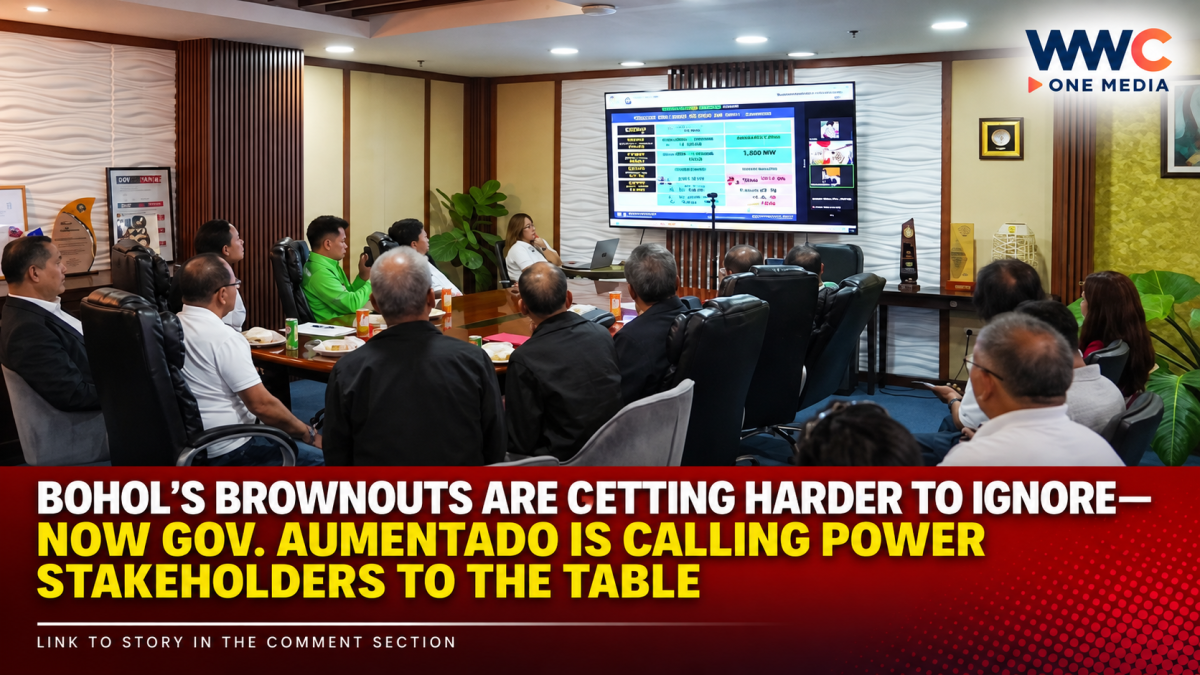
BOHOL, Philippines — Repeated power interruptions in Bohol have prompted Governor Aris Aumentado to call for a meeting with key power-sector stakeholders, as concerns over electricity reliability continue to grow across the province.
The move comes as brownouts and supply constraints remain a wider concern in the Visayas, putting renewed pressure on government officials, power generators, transmission operators and distribution utilities to find both immediate and long-term solutions.
Aumentado’s call for stakeholders to sit down and discuss the province’s power situation underscores a growing concern: Bohol needs a more reliable and resilient electricity supply as demand rises and the province continues to attract tourism, businesses and investments.
Brownouts put spotlight on Bohol’s power supply
The latest concerns come amid broader power-supply problems affecting the Visayas grid.
Recent reports from the Philippine Daily Inquirer said prolonged rotational brownouts in parts of the Visayas have reached several hours, prompting calls for a congressional investigation into the region’s worsening electricity situation. Officials cited supply shortages, generating-unit outages and transmission constraints as factors behind the crisis.
The situation has also highlighted the vulnerability of areas that depend on an already strained regional power system.
In a separate report, the Philippine Information Agency said Cebu residents and businesses continued adjusting to rotational brownouts in September, with students reporting disruptions to online classes and technology-related schoolwork. Energy officials have been working on measures intended to restore normal supply to the Visayas grid.
For Bohol, the issue is particularly significant because reliable electricity is critical to tourism, households, businesses, hospitals, schools and the province’s growing investment sector.
The problem goes beyond a single brownout
The latest developments are part of a longer-running discussion over Bohol’s energy security.
The province has previously established mechanisms for bringing government, utilities, businesses, the academe and energy stakeholders together to address power concerns. The Bohol Energy Development Advisory Group, or BEDAG, was created after serious outages exposed the vulnerability of the island’s electricity system. Its work included planning for additional generation, transmission improvements and potential renewable-energy projects.
More recently, Bohol has intensified its push for renewable energy.
At a June 2026 renewable-energy leaders forum, Aumentado emphasized the importance of transitioning toward renewable energy, describing it as both an environmental responsibility and an economic necessity. The forum brought together government officials, local leaders, energy experts and other stakeholders to discuss ways to strengthen the province’s energy security.
Bohol has been preparing for greater energy demand
The province has also pursued additional power-generation capacity.
A previous Bohol provincial development document discussed a proposed 95.2-megawatt in-island baseload power plant in Ubay, intended to augment Bohol’s electricity supply and respond to rising demand associated with population and economic growth.
The province’s investment push also continues to include energy development. A recent Bohol Investment Board report said energy was among the sectors attracting investments, while Mapalad Power Corp. reported progress related to its project in Ubay.
These developments highlight why the latest brownouts are more than an inconvenience: the reliability of Bohol’s power system is increasingly tied to the province’s economic ambitions.
Why the stakeholder meeting matters
The planned discussions could provide an opportunity to determine exactly where the weaknesses lie—from power generation and transmission to distribution and emergency response.
Among the critical questions are:
- Is available generation sufficient to meet Bohol’s growing demand?
- Are transmission constraints contributing to interruptions?
- What additional generation projects can come online?
- Can renewable-energy projects help reduce dependence on vulnerable supply sources?
- What immediate measures can utilities take when the regional grid comes under stress?
- How can Bohol ensure dependable electricity as tourism, businesses and industries expand?
The answers will matter not only to households dealing with brownouts but also to investors and businesses that require uninterrupted electricity to operate.
A bigger Visayas power crisis is unfolding
The concern in Bohol also comes against the backdrop of a wider Visayas power shortage.
The National Grid Corporation of the Philippines has reported periods when forced outages at several generating units reduced available capacity and triggered grid alerts and manual load dropping. One NGCP-related report cited additional generating units in Cebu, Negros, Bohol and Panay that had gone on forced outage during a period of tight supply.
The issue has become serious enough to draw calls for a congressional investigation. Lawmakers have raised concerns about prolonged rotational brownouts, economic losses and the impact of unstable electricity on schools, healthcare facilities and investor confidence.
For Bohol, the immediate challenge is therefore not simply restoring electricity after each interruption. It is determining how the province can build a stable, diversified and future-ready power system capable of keeping up with demand.
What happens next?
Aumentado’s decision to bring power stakeholders together puts renewed attention on the province’s electricity strategy.
Bohol has already been pursuing renewable-energy development and additional power infrastructure. But with power disruptions continuing to affect parts of the Visayas, residents and businesses are likely to be watching closely for concrete commitments—not just discussions.
The bigger question now is whether the stakeholder meeting will produce immediate solutions to Bohol’s brownouts or become another step in the province’s longer fight for reliable and affordable electricity.




Leave a Reply