
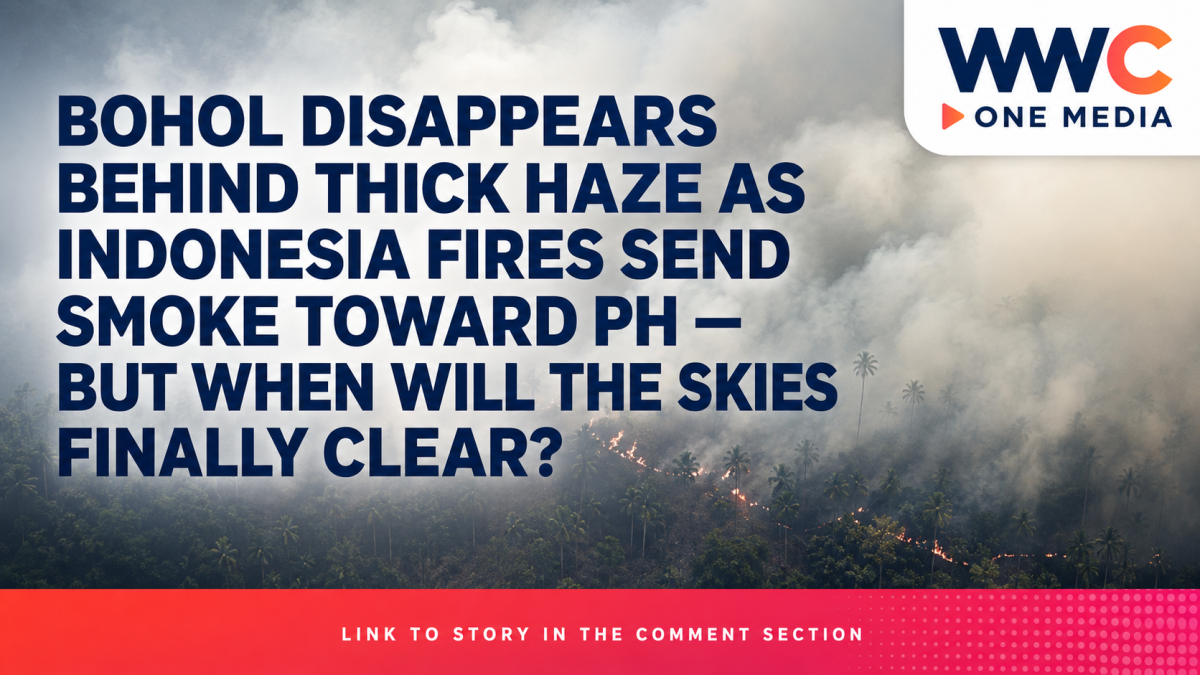
TAGBILARAN CITY, Bohol — Familiar island and mountain views vanished behind a gray curtain Tuesday as thick haze spread across parts of Bohol, prompting authorities to warn residents to limit outdoor exposure and wear protective masks while environmental officials track smoke believed to have traveled hundreds of kilometers from massive fires in Indonesia.
Residents of Tagbilaran City and surrounding municipalities woke on September 1 to unusually hazy skies. From several vantage points, Panglao Island appeared shrouded in smoke, while the mountains of Maribojoc became difficult or impossible to see. Some residents said the haze had already begun appearing a day earlier.
Even Cebu Island, normally visible across the Bohol Strait from parts of Tagbilaran, was barely discernible through the haze.
The Department of Environment and Natural Resources-Environmental Management Bureau in Central Visayas confirmed that haze was affecting Bohol and other parts of the region. Officials said the conditions were likely associated with smoke generated by ongoing forest and land fires in Indonesia and carried northward by prevailing winds.
Cebu Monitoring Station Hits ‘Very Unhealthy’ Level
The regional situation has raised concern because fine-particle pollution has also increased elsewhere in Central Visayas.
At 6 a.m. Tuesday, an air-quality monitoring station in Talisay City, Cebu, registered an Air Quality Index reading of 152 for PM2.5, placing conditions there in the “Very Unhealthy” category, according to the EMB information cited by the Inquirer.
Importantly, that measurement came from Cebu and should not be interpreted as Bohol’s AQI. The visibility problems reported in Bohol confirm haze was present, but the cited report did not provide an equivalent Bohol monitoring-station reading.
PM2.5 consists of microscopic particles measuring 2.5 micrometers or smaller. Because of their tiny size, these particles can penetrate deep into the lungs, making prolonged exposure particularly concerning for people with respiratory or cardiovascular conditions.
Aumentado Tells Boholanos: Wear Masks, Limit Exposure
Bohol Gov. Erico Aristotle Aumentado urged residents to reduce unnecessary time outdoors and use masks when they have to leave home.
The warning echoes national health guidance issued as haze affected several parts of the Philippines.
The Department of Health recommended properly fitted N95 masks when people must spend time outdoors and advised the public to reduce prolonged outdoor activity while haze remains present. Children, senior citizens and people suffering from heart or respiratory illnesses are among those who may face greater health risks from polluted air.
Possible effects of haze exposure can include coughing, breathing difficulty, chest discomfort, watery or irritated eyes and nasal irritation. It can also aggravate conditions such as asthma.
Residents experiencing noticeable haze should also consider keeping doors and windows closed, avoiding strenuous outdoor exercise and regularly checking official air-quality and local government advisories.
Why Is Smoke From Indonesia Reaching the Philippines?
The culprit may be geography combined with the seasonal wind pattern.
DENR-EMB officials said the southwest monsoon, or habagat, has been transporting smoke from fires in Kalimantan toward the Philippines. Depending on the direction and strength of the winds, airborne pollution can travel over the sea and affect areas far from the original fires.
The problem is not confined to Bohol.
Haze or elevated fine-particle pollution has also been observed or monitored across parts of Luzon and the Visayas, including Metro Manila, Mimaropa and Cebu. In Metro Manila, multiple monitoring stations recorded “very unhealthy” to “acutely unhealthy” air-quality conditions on Tuesday.
Indonesia Battles Widespread Wildfires
The smoke comes as Indonesia struggles with significant forest and land fires during a severe dry period.
Reuters reported on August 31 that Indonesian authorities were inspecting 19 companies whose concession areas were linked to more than 11,000 hectares affected by fires. Officials had identified dozens of companies with concessions considered at risk as authorities intensified firefighting operations.
Indonesia recorded nearly 95,000 hectares burned in July alone, according to the Reuters report, highlighting the scale of the regional fire problem. Thousands of personnel and volunteers have been mobilized, alongside aerial firefighting operations.
Forest fires in Indonesia have produced cross-border haze episodes in Southeast Asia before, particularly when prolonged dry conditions coincide with winds capable of carrying smoke toward neighboring countries.
How Long Could Bohol’s Haze Last?
That is now the biggest question for residents looking at Bohol’s washed-out horizon.
DENR-EMB official Jundy del Socorro said smoke from Kalimantan could continue affecting parts of the Philippines from September 1 through September 3, provided the Indonesian fires remain active and the habagat continues transporting the pollution toward the country.
There is, however, one factor that could help: rain.
Environmental officials said periods of rainfall can wash some airborne pollutants from the atmosphere and temporarily improve air quality. Changes in wind direction could likewise alter where the smoke travels.
That means conditions in Bohol may change considerably from one period—or location—to another.
For now, authorities are urging residents not to judge safety simply by how clear the horizon looks.
With fires still burning hundreds of kilometers away and the habagat acting as a possible conveyor belt for smoke, Boholanos may have to keep their masks close and watch both the skies and official air-quality advisories over the coming days.

Leave a Reply