
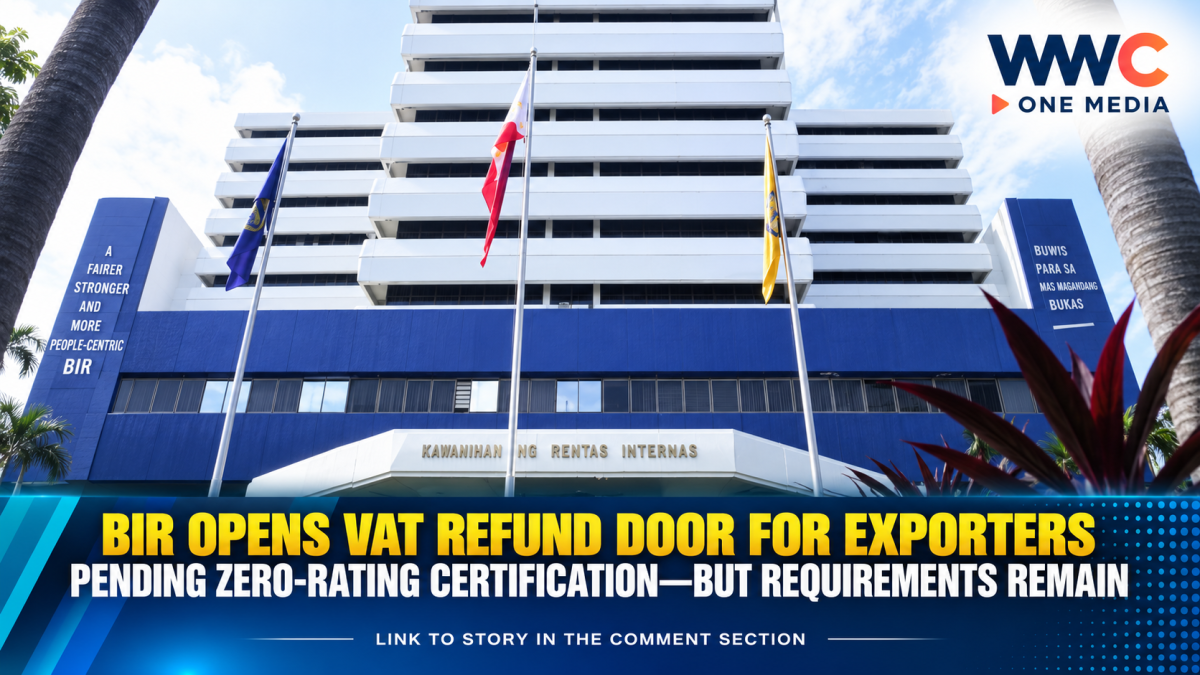
MANILA — Exporters waiting for official zero-rating certification have been given a potential tax-relief lifeline, with the Bureau of Internal Revenue allowing qualified export-oriented businesses to seek VAT refunds on eligible purchases incurred during the transition.
The move addresses a problem facing exporters as the government implements updated rules governing VAT zero-rating and certification.
According to the BIR, the refund mechanism covers VAT incurred on local purchases and importations attributable to qualified zero-rated sales, subject to the requirements under the Tax Code and applicable regulations.
The development could be significant for export-oriented companies because input VAT that cannot immediately be used against output VAT can otherwise become a cash-flow concern.
What the BIR is allowing
The latest clarification means qualified exporters are not necessarily shut out of the VAT-refund system simply because their zero-rating certification is still being processed.
The policy applies to eligible transactions beginning November 28, 2024, according to the Philippine News Agency’s report on the BIR clarification.
However, the measure should not be interpreted as an automatic refund for every exporter.
Businesses still have to establish that the purchases and transactions meet the applicable requirements for VAT refund claims.
Why zero-rating matters
Under Philippine VAT rules, a zero-rated transaction is still within the VAT system but carries a 0% output VAT rate.
That distinction is important because VAT-registered businesses can generally seek recovery of qualified, unutilized input VAT attributable to zero-rated sales, subject to Section 112 of the National Internal Revenue Code and the relevant BIR rules.
VAT-exempt transactions are different and generally do not provide the same input-VAT recovery mechanism.
For exporters, therefore, establishing that sales genuinely qualify for zero-rating is a critical part of the refund process.
The certification transition created a pressure point
The BIR’s latest clarification comes amid changes to the rules governing export-oriented enterprises and VAT zero-rating.
Earlier BIR guidance required businesses seeking certain VAT benefits to satisfy eligibility requirements tied to their export activities and certification.
Tax advisers have warned that exporters that meet the required export threshold but fail to secure the necessary certification can face restrictions on claiming input VAT refunds for subsequent periods.
The latest BIR clarification provides a pathway for eligible claims involving the transition period rather than simply leaving exporters without a potential recovery mechanism while certification is being processed.
Refund claims are still subject to scrutiny
The BIR’s clarification does not remove the evidentiary burden from taxpayers.
Businesses must still properly substantiate their purchases and sales and demonstrate that the input VAT being claimed is attributable to qualified zero-rated transactions.
The Supreme Court has also emphasized that taxpayers seeking VAT refunds must establish the legal and factual basis for their claims, including proper substantiation and proof that the input VAT was not already used against output VAT.
The BIR’s own service information likewise identifies VAT refund procedures for direct and indirect exporters and points to the requirements governing refund applications.
The 90-day refund framework remains important
Separately, updated BIR guidance provides a framework for processing VAT refund claims under Section 112 of the Tax Code.
Tax guidance published in 2025 noted that the statutory deadline for payment of VAT refunds is generally 90 days from submission of the certified true copies of invoices or official receipts and other supporting documents, subject to the applicable rules.
That means exporters should not view the new clarification as eliminating documentation or verification requirements.
Instead, the ability to file a claim is only one part of the process; proving that the claim meets the legal requirements remains crucial.
Why exporters are watching the change
For companies with large export operations, input VAT can represent a meaningful amount of working capital.
Allowing qualified claims during the certification transition could therefore help reduce uncertainty and potentially improve cash-flow management.
The change is particularly relevant as the Philippines continues to adjust its VAT framework following reforms affecting registered business enterprises and export-oriented companies.
The BIR has also issued additional VAT guidance in 2026 covering local sales by registered business enterprises, reflecting the government’s broader effort to clarify how VAT rules apply under the evolving tax-incentive framework.
What exporters should watch
Companies seeking to benefit from the clarification should pay close attention to:
- Whether their sales qualify as zero-rated transactions;
- Whether the claimed input VAT is directly attributable to those transactions;
- Proper invoices and supporting documentation;
- Compliance with applicable export and certification requirements;
- Whether the input VAT has already been used against output VAT; and
- The filing and substantiation requirements for a Section 112 refund claim.
The key message is simple: pending certification does not necessarily mean an eligible exporter has to abandon its VAT-refund claim—but eligibility and documentation remain decisive.
As the BIR continues implementing the updated VAT framework, exporters will be watching closely for further guidance on certification, refund processing and the treatment of transactions during the transition.
For businesses dependent on export markets, the difference could ultimately come down to one thing: whether VAT that has already been paid can be recovered without getting trapped in a certification bottleneck.
WWC ONE MEDIA G.A




Leave a Reply