
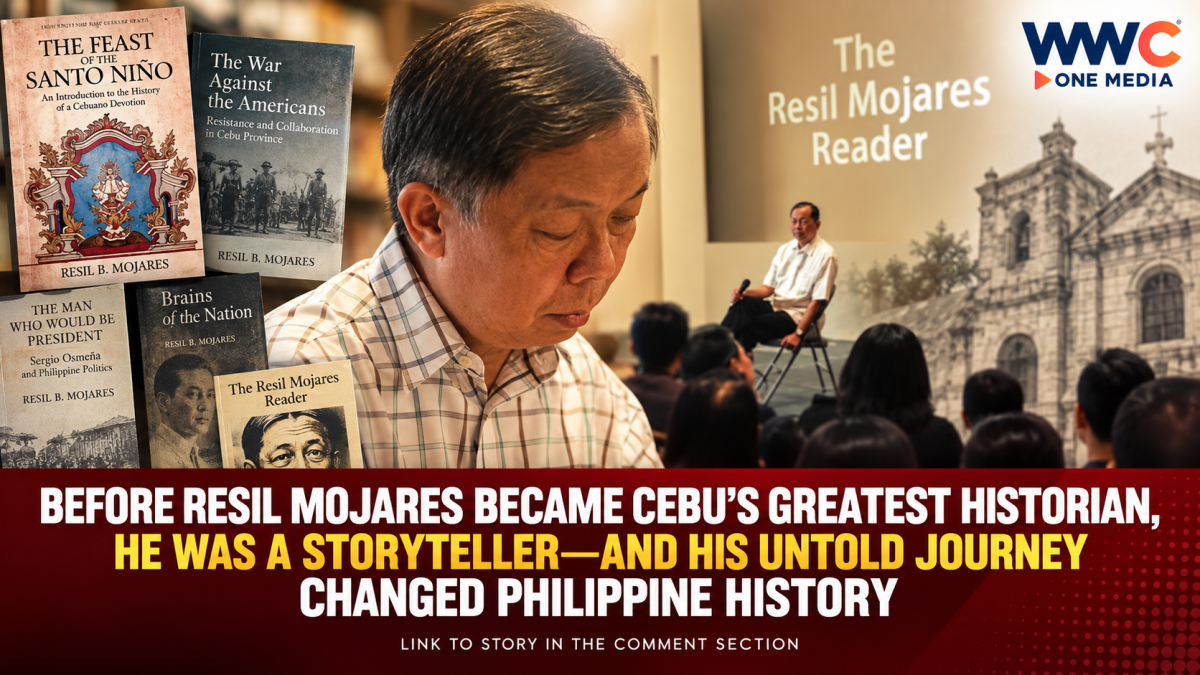
CEBU CITY, Philippines — Before Resil B. Mojares became one of the Philippines’ most respected historians, literary critics and National Artists, he was first a storyteller.
That detail is now taking on even greater meaning as Cebu and the wider Philippine cultural community remember the man widely regarded as the “Visayan Titan of Letters.”
Mojares, who died on September 5, 2026, just a day after celebrating his 83rd birthday, left behind far more than books and academic papers. His life’s work helped transform how Filipinos understand history—particularly the histories of regions that were too often treated as secondary to the Manila-centered national narrative.
Before the Historian Came the Fictionist
The celebrated scholar did not begin his intellectual journey as the historian many Filipinos came to know.
Before becoming a towering figure in Philippine historical and cultural studies, Mojares was a fictionist and journalist. His early interest in storytelling would eventually shape the way he approached history—not simply as a collection of dates and events, but as a complex story about people, communities, memory and identity.
His work as a young journalist during the politically turbulent 1970s also exposed him to the social realities and struggles of Philippine society. According to the University of the Philippines Cebu, his journalism during what he described as the “long seventies” reflected his growing interest in popular struggles, local histories and the wider realities shaping the country. His detention during the early years of Martial Law would become one of the defining experiences of his early intellectual life.
But even as his career evolved, the storyteller never completely disappeared.
Instead, Mojares brought that instinct into his scholarship.
He Made Local History Matter to the Entire Philippines
For decades, Philippine history was often presented through a national lens dominated by Manila and the country’s political center.
Mojares challenged that perspective.
Writing and researching from Cebu, he demonstrated that the Philippines could be understood more deeply by examining the histories, languages and experiences of communities outside the capital.
The University of San Carlos, where Mojares spent much of his academic life, said one of his greatest contributions was teaching Filipinos to look closely at places and stories that the national narrative had too often overlooked.
For Mojares, Cebu was never simply a province on the edge of Philippine history.
It was a window into the nation itself.
That approach would help establish him as one of the country’s most important advocates for local and regional studies.
The Man Behind the Cebuano Studies Center
Mojares was the founding director of the University of San Carlos Cebuano Studies Center, which was established in 1975.
The institution became a major center for the study and preservation of Cebuano history, culture and identity.
His influence extended across literature, history, biography, journalism and cultural studies. He also served as a professor, researcher, editor and mentor to generations of students and scholars.
According to the Cebuano Studies Center, Mojares earned degrees in English and literature from the University of San Carlos and later completed his doctorate in Literature at the University of the Philippines Diliman.
His academic work also took him beyond the Philippines through fellowships, research and teaching engagements connected with institutions in the United States and Asia.
The Books That Built a National Legacy
Mojares produced an extraordinary body of work that crossed traditional academic boundaries.
Among his major works were:
- The War Against the Americans: Resistance and Collaboration in Cebu Province
- House of Memory: Essays
- The Man Who Would Be President: Sergio Osmeña and Philippine Politics
- Brains of the Nation
- Origins and Rise of the Filipino Novel
His work explored Philippine literature, intellectual history, politics, local history and cultural identity.
According to accounts cited by the Philippine Daily Inquirer, Mojares produced 124 titles between 1969 and 2017, including 107 sole-authored and co-authored works. Six of his works received National Book Awards.
His scholarship was widely respected because of both its depth and its range.
He could write about novels and intellectuals, Cebu and nationalism, political figures and forgotten communities—yet his work consistently returned to one major question:
Who gets remembered, and who gets left out of the story?
The Historian Who Helped Settle the First Mass Debate
Mojares’ influence extended beyond books and classrooms.
In 2018, he chaired a panel of scholars convened to review the long-running dispute over the location of the first Easter Sunday Mass in the Philippines in 1521.
The panel examined competing historical claims involving Limasawa and Butuan and reviewed available documentary and historical evidence.
The group eventually recommended that Limasawa remain recognized as the site of the historic Mass, a position later formalized by the National Historical Commission of the Philippines.
The controversy showed another side of Mojares’ approach to history: careful, evidence-based scholarship grounded in credible and verifiable sources.
National Artist, But Still a Teacher at Heart
In 2018, Mojares received the country’s highest recognition for artists when he was named National Artist for Literature.
He became the first Cebuano to receive the prestigious distinction, marking a historic moment not only for Cebu but also for Philippine regional literature and scholarship.
Yet tributes following his death have repeatedly focused on more than his awards.
Colleagues remembered a scholar who combined extraordinary learning with humility.
Historian Ambeth Ocampo described Mojares as someone who showed that it was possible to be deeply learned while remaining warm and approachable.
The University of the Philippines also remembered him as a pioneering scholar whose life was devoted to literature and cultural and historical studies, particularly through his work in advancing Cebuano studies.
Why Resil Mojares Still Matters
The death of Resil Mojares is not simply the loss of a historian.
It is the loss of a thinker who changed the direction of Philippine scholarship.
At a time when history can easily be reduced to viral posts, political arguments and simplified narratives, Mojares represented something increasingly valuable: patience.
He read archives.
He studied forgotten communities.
He examined conflicting evidence.
And perhaps most importantly, he reminded Filipinos that the story of the Philippines cannot be told from only one place.
His legacy lives in the archives he helped preserve, the books he wrote, the scholars he mentored and the institutions he helped build.
But the deepest part of his legacy may come from the storyteller he was before he became a historian.
Because Resil Mojares understood something powerful:
History is not only about what happened. It is also about who tells the story—and whose stories are finally allowed to be remembered.
More than a National Artist, Resil B. Mojares was a keeper of memory.
And for Cebu—and the Philippines—his story is far from over.




Leave a Reply