
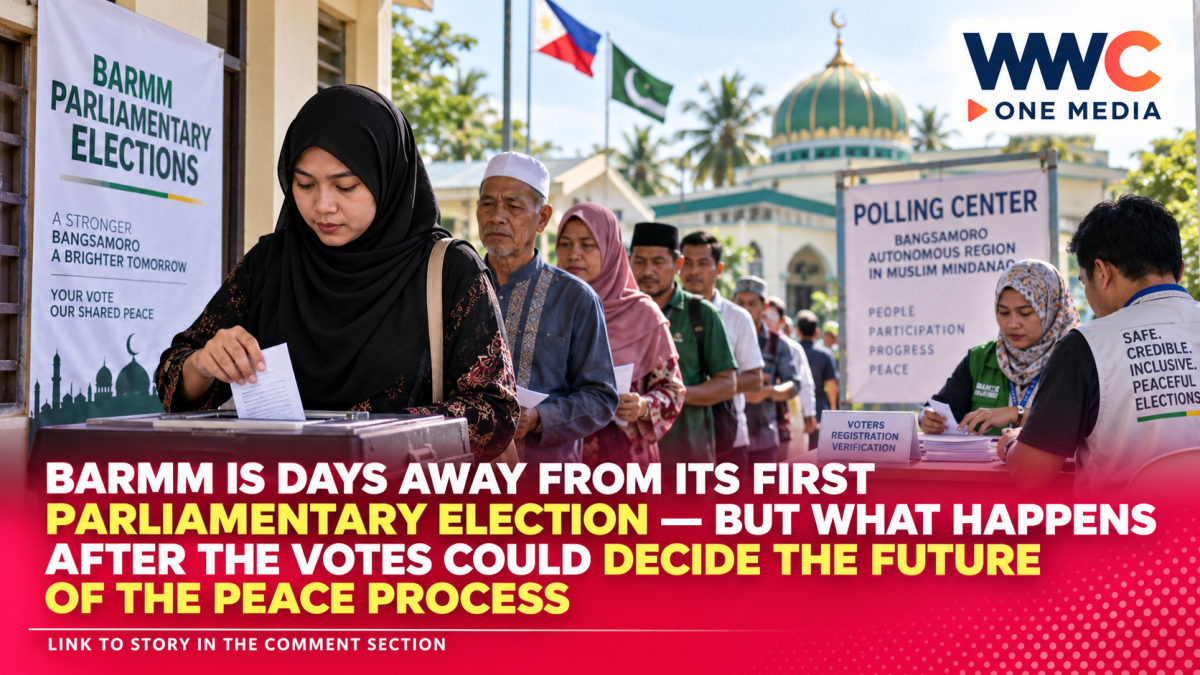
COTABATO CITY, Philippines — After decades of armed conflict, negotiations, ceasefires and political transition, the Bangsamoro is approaching a moment its peace process was ultimately designed to produce:
an elected regional government chosen at the ballot box.
On September 14, 2026, roughly 2.39 million registered voters are expected to participate in the first regular parliamentary elections of the Bangsamoro Autonomous Region in Muslim Mindanao, or BARMM.
But with election day only days away, Presidential Adviser on Peace, Reconciliation and Unity Mel Senen Sarmiento is delivering an increasingly urgent message to candidates and political organizations:
Political competition must not destroy what took decades to build.
Sarmiento has repeatedly called on political parties, candidates, supporters, communities and security forces to protect the gains of the Bangsamoro peace process and ensure voters can choose their leaders without intimidation or violence.
And the warning is not merely ceremonial.
The election comes after complaints of alleged voter intimidation, an armed attack on the convoy of BARMM Interim Chief Minister Abdulraof Macacua and lingering unfinished commitments under the peace agreement between the Philippine government and the Moro Islamic Liberation Front.
That makes September 14 much more than another election.
It is arguably the biggest democratic stress test yet for the Bangsamoro peace process.
From Armed Conflict to an Election Ballot
The road to this election stretches back decades.
The Philippine government and the Moro Islamic Liberation Front (MILF) signed the Comprehensive Agreement on the Bangsamoro in 2014, ending years of negotiations and providing a framework for replacing armed struggle with expanded regional autonomy and democratic governance.
Congress subsequently enacted the Bangsamoro Organic Law, and BARMM was formally established in 2019.
Since then, the region has been governed by the appointed Bangsamoro Transition Authority, which was supposed to prepare institutions, laws and political structures for an eventual elected parliament.
The September election is supposed to complete one of the most important pieces of that transition: replacing the appointed interim authority with officials deriving their mandate directly from Bangsamoro voters.
Sarmiento has therefore described the election not simply as a contest for political office, but as part of the implementation of the peace agreement itself.
“The success of these elections will not only be a milestone for the Bangsamoro peace process,” he said in an August 30 statement reported by GMA News. “It will be a victory for peace, democracy, and the Filipino people.”
2.39 Million Voters Will Choose a New Kind of Government
The electoral system itself is unlike anything previously used on this scale in the Philippines.
The new Bangsamoro Parliament has 80 seats.
Of those:
- 40 seats are allocated to regional political parties based on their share of the party vote.
- 32 seats are elected from parliamentary districts.
- Eight seats are reserved for specified sectors, including women, youth, traditional leaders, ulama, settler communities and Non-Moro Indigenous Peoples.
COMELEC’s certified regional list includes 13 regional parliamentary political parties competing in the election.
Two seats reserved for Non-Moro Indigenous Peoples have already been selected through sectoral assemblies. GMA reported that Teduray representative Jo Genna Jover and Lambangian representative Leticio Datuwata are expected to be proclaimed alongside the other 78 winners.
COMELEC has prepared 2,393,202 official ballots for voters across Basilan, Lanao del Sur, Maguindanao del Norte, Maguindanao del Sur, Tawi-Tawi, Cotabato City and other areas included in BARMM, including its Special Geographic Area in North Cotabato.
The poll body said in August that election preparations were already about 95 percent complete.
COMELEC Chairman George Garcia has said he hopes turnout reaches roughly 65 to 70 percent.
But Security Has Already Become Part of the Story
The election campaign has not been entirely free of warning signs.
In July, OPAPRU disclosed that it had received complaints involving people allegedly wearing uniforms, carrying firearms and displaying campaign material.
Sarmiento said those complaints had been referred to COMELEC.
His warning was straightforward: voters must not be intimidated, and political campaigning cannot be conducted while displaying long firearms.
Then came a far more serious incident.
On August 15, armed men fired on the convoy of Interim Chief Minister Abdulraof Macacua in Datu Odin Sinsuat, Maguindanao del Norte.
Macacua and his delegation escaped without injury, but several vehicles were hit.
Authorities had not publicly established the attackers’ identities or motive when officials issued their initial statements, making it important not to automatically characterize the attack as election-related.
Sarmiento nevertheless warned that violence must not be allowed to disrupt the wider political transition.
“We have come too far in our journey toward peace to allow violence to undermine what has been achieved through decades of dialogue, sacrifice, and peacebuilding,” he said following the attack.
Security forces subsequently strengthened their presence in potentially vulnerable areas.
The Philippine Army deployed hundreds of additional troops to Maguindanao, while broader security deployments were mobilized across BARMM to enforce the election gun ban and protect voters and candidates.
The Government and MILF Are Activating Old Peace Mechanisms for a New Purpose
One of the more significant developments ahead of the election is the use of institutions originally created to prevent renewed fighting between government forces and the MILF.
OPAPRU says the government is tapping mechanisms including the Coordinating Committee on the Cessation of Hostilities and the Ad Hoc Joint Action Group to help prevent election violence and maintain security.
These structures were designed during the peace process to manage ceasefire issues and coordinate against criminal and armed threats.
Now they are being used to help protect an election — a remarkable illustration of how the conflict has changed.
The government and MILF have also resumed substantive engagement on both the political and normalization tracks of the Comprehensive Agreement on the Bangsamoro.
Sarmiento has stressed that while the September 14 election represents a major advancement in the political track, the normalization process will continue after ballots are counted.
That distinction is crucial.
Because the Peace Agreement Is Not Finished Yet
Holding elections does not mean every commitment under the Bangsamoro peace agreement has been completed.
One of the largest unfinished components involves normalization — the long-term process intended to transform former MILF combatants and their communities while reducing the conditions that fueled armed conflict.
Earlier reporting showed that 26,145 of an estimated 40,000 MILF combatants had undergone decommissioning, while roughly 14,000 remained for the final phase.
The MILF had temporarily suspended substantive peace-process engagement earlier in 2026 amid disputes and delays over implementation before negotiations were revived.
That means the incoming parliament will inherit more than budgets, ministries and development projects.
It will inherit a peace process that remains unfinished.
And that may explain why Sarmiento has repeatedly emphasized reconciliation after the election.
Political parties can compete aggressively before September 14.
Afterward, however, whoever wins will still have to govern alongside political rivals, traditional leaders, former combatants, local clans, indigenous communities, settlers and civil society organizations inside one autonomous region.
As Sarmiento put it earlier this year:
“Elections are temporary, but the Bangsamoro identity and our shared future are permanent.”
The Election Has Already Been Delayed Several Times
The significance of September 14 is heightened by how long Bangsamoro voters have waited.
The region’s first regular elections were originally envisioned much earlier, but the transition was repeatedly extended or rescheduled.
The election moved from the original 2022 timetable, eventually to 2025, then October 2025, March 2026 and finally September 14, 2026 amid legislative changes, litigation and the need to redraw parliamentary districts.
A major complication came after the Supreme Court ruled that Sulu is not part of BARMM, because voters in the province had rejected the Bangsamoro Organic Law during the 2019 plebiscite.
That decision required adjustments to representation and contributed to the need for a legally valid new districting framework.
The current 32 parliamentary districts allocate nine seats to Lanao del Sur, five each to Maguindanao del Norte and Maguindanao del Sur, four each to Basilan and Tawi-Tawi, three to Cotabato City and two to the Special Geographic Area.
President Ferdinand Marcos Jr. subsequently signed legislation fixing the election on September 14, 2026.
He has also declared the date a special non-working day in BARMM so voters can participate.
Marcos Says Peace Must Now Survive Politics
President Marcos has linked the election directly to the larger national peace agenda.
Opening National Peace Consciousness Month on September 1, Marcos said peace must continually be “protected and strengthened,” while promising that the government would work to ensure Bangsamoro voters can cast ballots “freely and without fear.”
He called the parliamentary election one way of strengthening the democratic institutions created by the peace process.
That message reveals the real stakes.
Peace negotiations are difficult when opposing sides are armed.
But democratic politics brings a different kind of challenge.
Former allies become electoral competitors.
Local leaders fight for districts.
Political parties compete for power.
Supporters expect rewards.
And once the votes are counted, some groups inevitably lose.
The crucial question is whether those defeats remain political defeats rather than triggers for renewed violence.
September 14 Is Not the Finish Line
If the election proceeds peacefully, it will be tempting to portray September 14 as the culmination of the Bangsamoro peace process.
It isn’t.
It is better understood as the moment when that process changes form.
For years, the central question was whether the Philippine government and the MILF could end a long-running rebellion through negotiation.
Then the challenge became whether agreements could be converted into laws and institutions.
Now comes another test:
Can those institutions survive genuine competition for political power?
COMELEC can print the ballots.
Soldiers and police can guard polling centers.
Peace mechanisms can respond to security threats.
But once an elected parliament takes office, the durability of the peace process will increasingly depend upon political leaders themselves.
That is why Sarmiento’s appeal to BARMM’s candidates matters.
The Bangsamoro has already demonstrated that an armed conflict can be transformed into a political process.
September 14 will begin showing whether that political process is strong enough to survive an election.
WWC ONE MEDIA M.J.E



Leave a Reply