
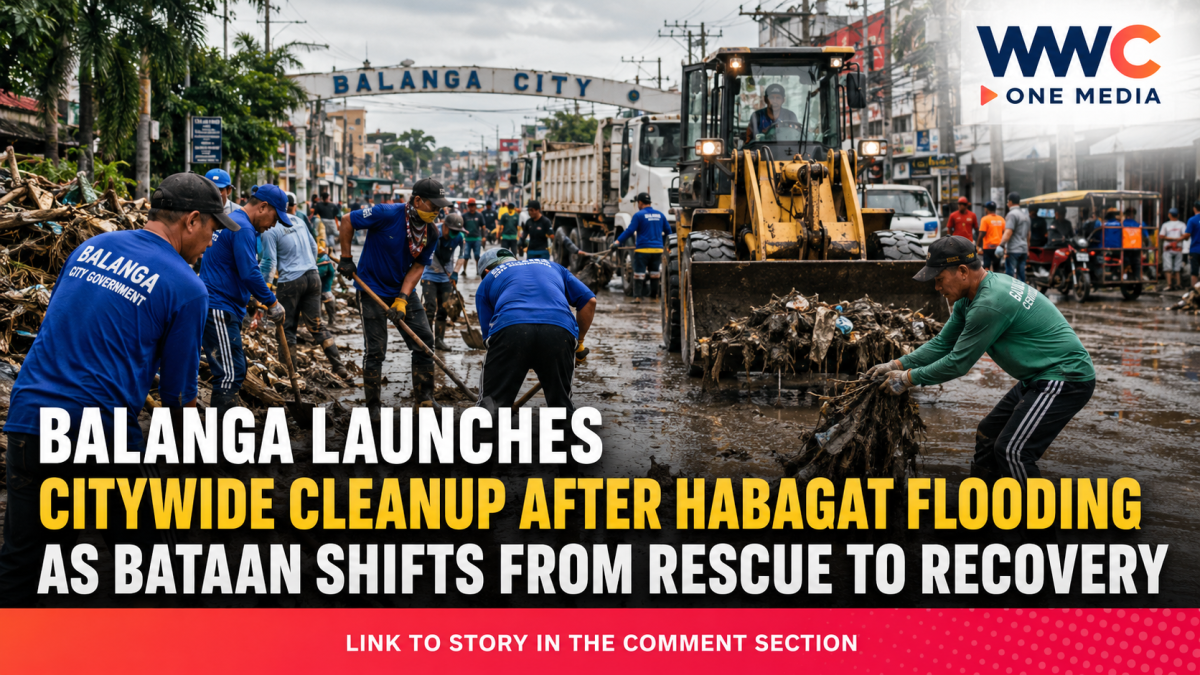
BALANGA CITY, Bataan — Balanga has launched a citywide post-disaster cleanup after another stretch of punishing rains and flooding linked to the southwest monsoon, or Habagat, as authorities race to clear communities and waterways before the next round of heavy weather arrives.
The cleanup operation, reported by the Manila Standard on September 2, comes after days of weather disruptions across Bataan and much of western and Central Luzon.
But for Balanga, the bigger challenge may go beyond cleaning streets after the water recedes.
Recent flooding has again exposed how quickly prolonged monsoon rains can overwhelm communities, turn waterways into hazards and disrupt transportation across the province.
Floodwaters rose sharply in parts of Balanga
GMA News reported on August 29 that continuous Habagat rains caused flooding in several areas of Luzon, including Balanga City.
Some residents encountered ankle-deep flooding, while footage submitted to GMA showed water reaching calf level in parts of the city. In another area, floodwaters reportedly rose to chest level after a river overflowed.
The flooding came as PAGASA warned that Bataan and other western Luzon provinces faced significant rainfall from the southwest monsoon.
The state weather bureau had forecast monsoon rains over Bataan, Zambales, Pangasinan, La Union, Benguet, Tarlac and Pampanga on August 29, warning that heavy to intense rainfall could trigger flash floods and landslides.
An Inquirer report citing PAGASA later said rainfall totals of up to 200 millimeters were possible over Bataan and several other Luzon areas on August 30 as the enhanced Habagat persisted.
The threat remained serious enough that Malacañang ordered national government agencies in Bataan and 14 other Luzon provinces to adopt appropriate alternative work arrangements on September 1 because of expected heavy rainfall and possible urban flooding.
Balanga was already clearing rivers before the latest flooding
The latest cleanup is also part of a longer battle against clogged waterways and recurring floods.
On August 14, the Bataan provincial government reported that Balanga had intensified the regular cleaning of rivers and waterways.
Mayor Raquel Garcia said the City Environment and Natural Resources Office was removing garbage and other obstructions that could restrict the flow of rainwater, particularly during periods of heavy rainfall.
The city also urged residents to dispose of waste properly, stressing that keeping waterways clear is essential to maintaining the capacity of drainage systems.
That means the September cleanup is not simply about restoring appearances after a storm.
For Balanga, clearing garbage, sediment and obstructions from drainage networks and waterways has become part of a broader flood-risk strategy—especially during a monsoon season capable of delivering repeated heavy-rain events.
Bataan remains under pressure from repeated floods
The problem stretches well beyond Balanga.
Bataan’s provincial board declared the province under a state of calamity on August 20 after repeated Habagat-driven rains damaged communities, agriculture and infrastructure.
According to the provincial government, reported damage reached about ₱56.53 million, affecting 2,490 farmers and fisherfolk and approximately 1,752 hectares of agricultural land.
Authorities also recorded 225 damaged houses, including 14 that were totally damaged.
The province has since mounted a large-scale relief effort.
As of September 1, Bataan authorities reported that 157,708 food packs had been distributed to affected communities. Of that number, 156,725 came from the Department of Social Welfare and Development and were distributed through local governments, while another 983 packs were provided by the provincial government to families in evacuation centers.
Nationally, disaster officials have been responding to the combined effects of Tropical Cyclones Luis, Maymay and Neneng, together with the enhanced southwest monsoon, underscoring how repeated weather systems have prolonged the emergency across parts of the country.
Cleanup is only the first stage
For Balanga, the immediate priority is straightforward: restore affected areas, keep drainage channels open and remove materials that could worsen flooding during another heavy downpour.
But the recurring pattern raises a more difficult question.
How much can post-flood cleanup accomplish if intense monsoon rains repeatedly push rivers and drainage systems close to—or beyond—their capacity?
Balanga has taken preventive measures by regularly clearing waterways, while Bataan has invested in disaster preparedness, environmental management and relief operations. The province was also recently recognized by the Department of Environment and Natural Resources for environmental stewardship and ecological solid-waste management programs.
Yet extreme rainfall remains a structural challenge.
A 2026 study published in Frontiers in Water examining riverine flooding in Balanga found that flood hazards are shaped not simply by the total amount of rainfall but also by its duration, timing and the interaction between tropical cyclones and the southwest monsoon.
That makes the current cleanup both a recovery operation and a reminder.
The floodwater may disappear within days. The debris can be removed. But Balanga’s longer-term test is whether its waterways, drainage systems and flood-management measures can withstand the next prolonged Habagat event.
WWC ONE MEDIA MJE




Leave a Reply