
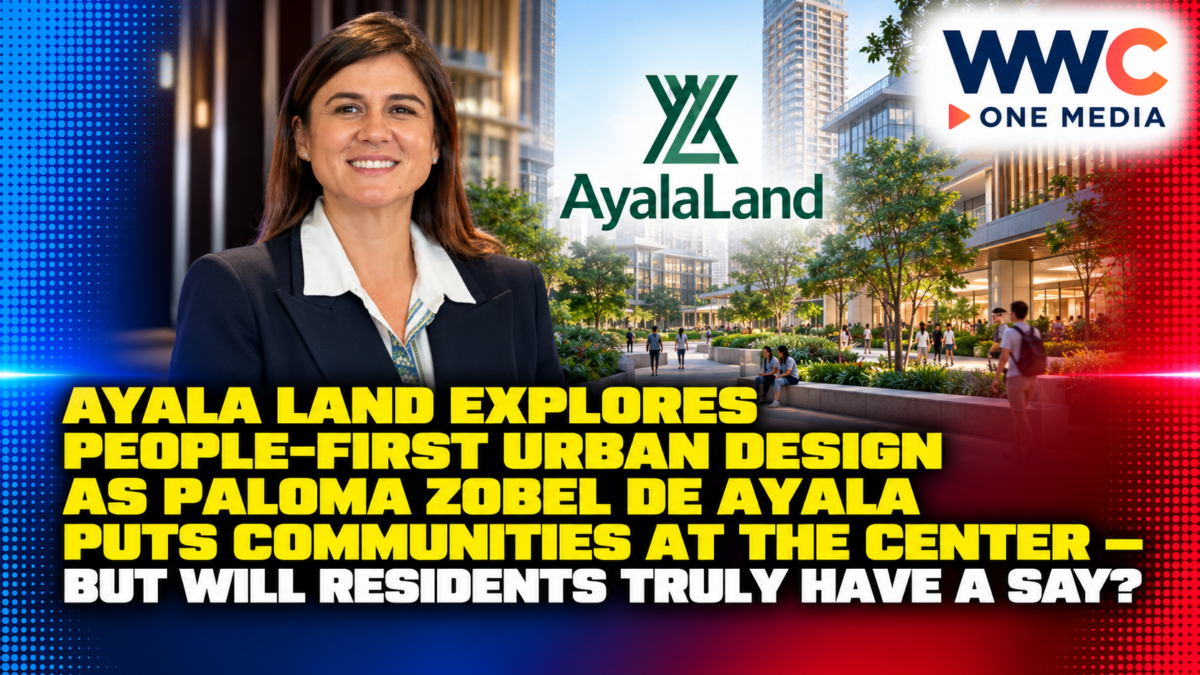
MANILA, PHILIPPINES — What if the future of Philippine cities were shaped not only by architects, corporate executives and property developers, but also by the artists, families, entrepreneurs and residents who actually live and work in them?
That question is gaining attention as Ayala Land Inc., one of the country’s largest property developers, explores a community-led approach to designing and managing urban spaces.
At Design Week Philippines 2026, Ayala Land creative director Paloma Urquijo Zobel de Ayala shared how experiences in El Nido, Palawan, and Circuit Makati are influencing a more collaborative philosophy of development.
The approach challenges a familiar model in which the physical design and intended activities of a commercial community are determined largely before people begin using the space.
Instead, it emphasizes listening to communities, allowing different activities to emerge and adjusting public spaces as residents’ needs evolve.
The idea has already influenced creative spaces such as Kalye Artisano in El Nido and cultural programming at Circuit Makati.
But turning that philosophy into a model for large-scale property developments presents new challenges.
Can Ayala Land give communities a meaningful voice in the design of Philippine cities—or will commercial priorities ultimately determine how public and shared spaces are used?
AYALA LAND EXPLORES COMMUNITY-DRIVEN URBAN DEVELOPMENT
Ayala Land is examining how local participation can become a more important part of its urban development approach.
The concept encourages property developers to consider the needs and experiences of residents, artists, small businesses and cultural organizations.
Rather than treating an estate as a finished product once buildings are completed, the philosophy recognizes that communities change over time.
New businesses emerge.
Families develop different needs.
Artists and cultural groups create activities that were not necessarily anticipated in the original master plan.
The developer’s challenge is to establish flexible spaces where such activity can grow.
However, Ayala Land has not announced that it is transferring formal planning authority over its townships to residents.
The company is exploring ways to incorporate greater community participation, rather than launching a confirmed nationwide community-governance program.
PALOMA URQUIJO ZOBEL DE AYALA SHARES HER DESIGN PHILOSOPHY
Paloma Urquijo Zobel de Ayala, Ayala Land’s creative director, discussed the approach during the “Neighbors by Design” panel at Design Week Philippines.
She emphasized the importance of understanding each community’s unique character.
Her perspective is that developers can establish the initial conditions for a place to thrive but must remain open to the ideas and activities of the people who eventually use it.
A neighborhood’s identity cannot be fully created through architectural drawings alone.
It also develops through everyday interactions, cultural traditions and the relationships people establish.
For Ayala Land, this way of thinking could influence how future urban spaces are planned, activated and improved.
DESIGN WEEK PHILIPPINES BRINGS THE IDEA INTO THE SPOTLIGHT
The discussion took place as part of the 15th edition of Design Week Philippines.
The event was organized around the theme “Sama All,” which encourages collaboration and shared participation in design.
The Design Center of the Philippines confirmed that the festival ran from October 10 to 18, 2026.
The “Neighbors by Design” conversation was scheduled on October 10 at the Likhang Filipino Exhibition Halls in Pasay City.
It explored how shared spaces can become genuine neighborhoods rather than simply locations occupied by tenants or customers.
The panel also considered adaptive reuse, local craftsmanship and the preservation of community character.
These subjects are especially relevant as major Philippine cities continue expanding.
DESIGN LEADERS DISCUSS WHAT MAKES A NEIGHBORHOOD
The panel brought together several creative and urban-development figures.
Participants included Paloma Urquijo Zobel de Ayala, First United Building Corporation managing director Robby Sylianteng, Maya Colayco of Comuna, and Karla Maria Ana Batiquin of the Holistic Coalition of the Willing and Atuá Midtown.
Designer Dan Matutina moderated the conversation.
Their discussion highlighted a common challenge.
A building can be carefully designed without necessarily creating a strong sense of community.
A successful neighborhood requires places where people can interact, participate in shared activities and build relationships.
The question for developers is how to support these experiences while maintaining safety, commercial viability and accessibility.
KALYE ARTISANO PROVIDES THE FIRST MAJOR EXAMPLE
One of the strongest influences on Paloma’s approach is Kalye Artisano, a creative hub she co-founded in El Nido, Palawan, in 2015.
The project originally provided space for Filipino artists, artisans and local businesses to showcase their work.
Its early concept centered on promoting craftsmanship and locally made products.
But the community gradually developed beyond the founders’ initial vision.
New activities and organizations emerged.
The space became more than a commercial destination for art and design.
Its evolution demonstrated how community members could help determine the identity and future uses of a place.
THE EARTH SCHOOL SHOWS HOW COMMUNITIES CAN CREATE SOMETHING UNEXPECTED
During the pandemic, educator David Esteban established The Earth School within Kalye Artisano.
The school focuses on education connected with sustainability and environmental awareness.
According to the project account cited by InsiderPH, its enrollment expanded from approximately 20 students to more than 80, with a waiting list.
This development was not necessarily part of the creative hub’s original purpose.
Instead, it emerged from the needs and initiatives of the community.
For proponents of people-centered design, the example demonstrates the importance of allowing spaces to evolve.
However, the enrollment figure relates to the school.
It should not be represented as the number of residents participating in an Ayala Land township consultation or the number of new schools being constructed.
THE LESSON: A PLACE’S IDENTITY EMERGES THROUGH ITS PEOPLE
The Kalye Artisano experience offers a broader lesson for property developers.
Developers can create roads, buildings, parks and commercial spaces.
But the people who use those facilities help give them meaning.
A location originally intended for retail may become a center for community education.
A public plaza may evolve into an arts venue.
An unused corner may become a gathering place for local entrepreneurs.
The philosophy does not suggest abandoning professional planning.
Instead, it encourages designing environments flexible enough to support changing uses.
The challenge is creating appropriate opportunities for participation without allowing commercial pressures to exclude less affluent members of the community.
CIRCUIT MAKATI IS BECOMING A TESTING GROUND
Ayala Land is applying similar principles through cultural activities at Circuit Makati.
The estate includes the Kontempo Community Studio, a space where residents and creative groups can organize events, exhibitions and collaborative activities.
The concept gives local participants opportunities to shape how cultural space is used.
This differs from a venue whose entire program is determined by the property owner.
Community-led events can reflect the interests and identities of the people involved.
But the available reporting does not establish that the studio’s users control all estate development decisions.
The initiative is better described as a participatory cultural program within a larger developer-managed district.
KONTEMPO CULTURAL INSTITUTION IS STILL UNDER DEVELOPMENT
Another major project is Kontempo, the Center for Contemporary Art Philippines.
The planned institution is being developed by Ayala Foundation within Circuit Makati.
It is envisioned as a contemporary arts center that supports artistic experimentation, public engagement and dialogue.
Robb Report Philippines reported in August that Kontempo was targeting completion in late 2028.
However, the institution is not yet complete.
It should not be described as an already opened museum with permanent exhibitions operating at full capacity.
The existing Kontempo Community Studio and the larger planned arts institution are related initiatives but are not identical facilities.
KONTEMPO AIMS TO CREATE A MORE ACCESSIBLE CULTURAL SPACE
The planned institution is intended to offer a different experience from conventional museums.
Its concept emphasizes openness, community engagement and connections between art, nature and urban life.
Rather than presenting a cultural building as an isolated destination, its organizers want it to interact with the surrounding neighborhood.
Consultation with artists and other stakeholders has been part of the institution’s development approach.
However, accessibility will ultimately need to be assessed through actual operating policies.
These could include admission fees, programming, disability access, transport connections and the availability of activities to different communities.
An open architectural design alone does not guarantee equitable access.
REUBEN KEEHAN NAMED ARTISTIC DIRECTOR
Ayala Foundation announced in February 2026 that veteran curator Reuben Keehan had been selected as Kontempo’s incoming artistic director.
Keehan brings experience in Asia-Pacific contemporary art and cultural programming.
His appointment reflects the institution’s intention to become an important platform for artistic exchange.
But the appointment should not be confused with the opening of the completed arts center.
The institution remains in development.
Its full exhibition schedule, admission policies and final operating arrangements have not been established in the reporting reviewed.
THE MOVEMENT EXTENDS BEYOND ART GALLERIES
Community-centered urban design also raises questions about daily life.
Residents need safe walking routes, accessible public spaces and places where neighbors can gather.
Families may benefit from parks and recreation facilities close to their homes.
Small businesses need commercially viable spaces and opportunities to attract customers.
Cultural organizations require venues where activities can develop over time.
These needs can overlap, but they can also compete.
A property developer must consider how different users share limited space.
A genuinely responsive approach requires more than occasional cultural events.
It involves understanding how communities use places throughout the day and across different stages of development.
AYALA LAND ALREADY PROMOTES THE 15-MINUTE CITY MODEL
The community-led design discussion follows Ayala Land’s broader promotion of walkable, mixed-use estates.
In May, BusinessWorld reported that the developer was expanding its “15-minute city” approach.
The principle is that many everyday needs—such as schools, work, groceries, healthcare and recreation—should ideally be reachable within a short walk or bicycle ride.
Ayala Land has promoted this model as a response to long commutes and inefficient urban development.
However, designing a mixed-use district does not prove that every resident can actually reach all essential services within 15 minutes.
Accessibility depends on individual locations, available services, transport infrastructure and affordability.
The concept represents a planning objective rather than a universal travel-time guarantee.
THE DEVELOPER NOW HAS 54 ESTATES NATIONWIDE
Ayala Land reported in September 2026 that its portfolio included 54 estates across the Philippines.
These include established destinations such as the Makati Central Business District, Bonifacio Global City and Nuvali.
They also include emerging growth centers such as Arca South, Vermosa and Cresendo.
The geographic scale of the portfolio demonstrates why community-led planning could be significant if adopted more broadly.
But each estate has different residents, local economic conditions and development needs.
A cultural initiative that succeeds in El Nido may not work in exactly the same way in a large business district.
Paloma’s approach emphasizes learning from local communities rather than applying a single design formula everywhere.
VERTIS NORTH SHOWS HOW OPEN SPACES CAN SERVE MULTIPLE PURPOSES
Another example of Ayala Land’s approach to urban space is the Vertis North Rain Garden in Quezon City.
The two-hectare landscaped area functions as both a recreational space and a component of the estate’s stormwater-management system.
It is designed to capture and retain rainfall, helping slow runoff during heavy rain.
Context.ph reported that the project received two Gold Awards at the NEXT Awards Philippines 2026.
The example illustrates how urban spaces can combine environmental functions with community use.
However, it is a nature-based infrastructure project rather than proof of formal resident control over planning decisions.
These are related but distinct approaches to improving urban development.
VERMOSA RECEIVES HIGH-LEVEL GREEN DISTRICT CERTIFICATION
Ayala Land’s 752-hectare Vermosa estate in Cavite received BERDE 5-Star Certification under the Philippine Green Building Council’s district assessment framework.
Context.ph confirmed the recognition on October 13.
Vermosa incorporates residential areas, commercial developments, green spaces and active mobility infrastructure.
The certification provides an additional example of the developer’s focus on sustainable urban planning.
But environmental certification and community-led design are not the same concept.
A project may meet sustainability requirements without giving local residents formal authority over development decisions.
Both dimensions require separate evaluation.
WHY COMMUNITY INVOLVEMENT COULD MATTER TO SMALL BUSINESSES
Community-led spaces can create opportunities for local entrepreneurs and artisans.
Markets, workshops and cultural events may allow small businesses to introduce products to nearby customers.
In tourism destinations, locally made goods can also help preserve regional craftsmanship.
Kalye Artisano provides an example of how a creative hub can support a community of artists and local businesses.
However, participation must be commercially sustainable.
Rising rental costs or redevelopment pressures can eventually make creative districts less accessible to the very people who helped establish them.
Developers pursuing community-centered design must consider these potential tensions.
COULD THIS MODEL HELP REDUCE URBAN ALIENATION?
Large urban developments can sometimes feel disconnected from the people who use them.
Commercial spaces may prioritize retail transactions over social interaction.
Community-centered design attempts to address that problem by encouraging local activities and shared experiences.
Public art, cultural events, gardens and gathering spaces can provide opportunities for connection.
But the social benefits are difficult to establish from promotional announcements alone.
Meaningful assessment could consider participation rates, accessibility, user satisfaction and whether different income groups feel welcome.
Ayala Land has not published a nationwide evaluation demonstrating that the new design approach has improved these outcomes across all its estates.
THE BIG QUESTION: WHO GETS TO PARTICIPATE?
One of the most important issues is representation.
A community can include homeowners, renters, workers, students, informal entrepreneurs and visitors.
Their needs may differ significantly.
Consulting only established property owners or business tenants could exclude other people who use the same spaces.
Likewise, occasional public events do not necessarily create a meaningful voice in long-term development decisions.
A community-led approach becomes more credible when participation is accessible and when the developer explains how feedback affects actual decisions.
The October announcement does not identify a formal consultation process or binding community voting system.
Those questions remain open.
WHAT OTHER NEWS OUTLETS AND OFFICIAL SOURCES CONFIRM
InsiderPH reported the community-led design initiative on October 28.
Adobo Magazine independently published a feature focusing on Paloma’s experience at Kalye Artisano and her participation in Design Week Philippines.
The Design Center of the Philippines confirms the festival’s October 10–18 dates, its “Sama All” theme and the October 10 “Neighbors by Design” panel.
Robb Report Philippines separately documented Kontempo’s concept and previously announced late-2028 completion target.
PhilSTAR Property reported on Ayala Land’s 54-estate portfolio and its evolving approach to urban development.
BusinessWorld covered its wider 15-minute city strategy.
Context.ph reported on the sustainability features at Vertis North and Vermosa.
These sources corroborate the event, the people involved and several existing examples.
However, multiple accounts of Paloma’s remarks derive from the same discussion and associated publicity material.
They do not establish that community-led planning has already been adopted as a binding corporate policy across every Ayala Land project.
WHAT THE CHANGE COULD MEAN FOR PROPERTY BUYERS
For residential buyers, a community-led approach may eventually mean greater opportunities to influence shared spaces and activities.
Residents may benefit from developments that respond more closely to changing needs.
Cultural venues, public gardens and pedestrian areas can contribute to the experience of living in a community.
But buyers should distinguish design philosophy from contractual promises.
A property’s amenities, development schedule, maintenance responsibilities and association rules should be evaluated through official documents.
The company’s interest in community participation does not guarantee a specific increase in property value or rental returns.
WHAT THE CHANGE COULD MEAN FOR INVESTORS
For shareholders, people-centered urban design may influence how property developers build long-term destinations.
Attractive public spaces and active community programming can help sustain interest in an estate.
However, these activities involve costs, management responsibilities and ongoing maintenance.
Their commercial benefits depend on the development and the markets it serves.
Ayala Land has not announced a new investment budget or revenue forecast directly attributable to the community-led design initiative.
Investors should therefore avoid treating the concept as a confirmed source of additional earnings.
THE BIGGER QUESTION: CAN AYALA LAND BUILD CITIES WITH COMMUNITIES?
Ayala Land’s exploration of community-led urban design reflects a growing recognition that successful cities are not defined only by buildings, roads and commercial floor space.
They are also shaped by people.
Kalye Artisano in El Nido illustrates how a creative space can evolve through community initiatives.
Circuit Makati’s cultural programs show how urban spaces can support artists and collaborative activities.
The planned Kontempo institution represents a larger ambition to integrate contemporary art with public life.
But translating those ideas into large-scale property development will require careful execution.
Developers must balance financial objectives, public accessibility, safety, long-term maintenance and the needs of different community groups.
The most important question is not whether Ayala Land can create attractive places, but whether the people who use those places will have a meaningful role in shaping their future.
And as Philippine cities continue growing, one question remains:
Will Ayala Land’s people-first design philosophy give residents, artists and local businesses a genuine voice—or will the future of urban communities still be decided mainly inside corporate boardrooms?










