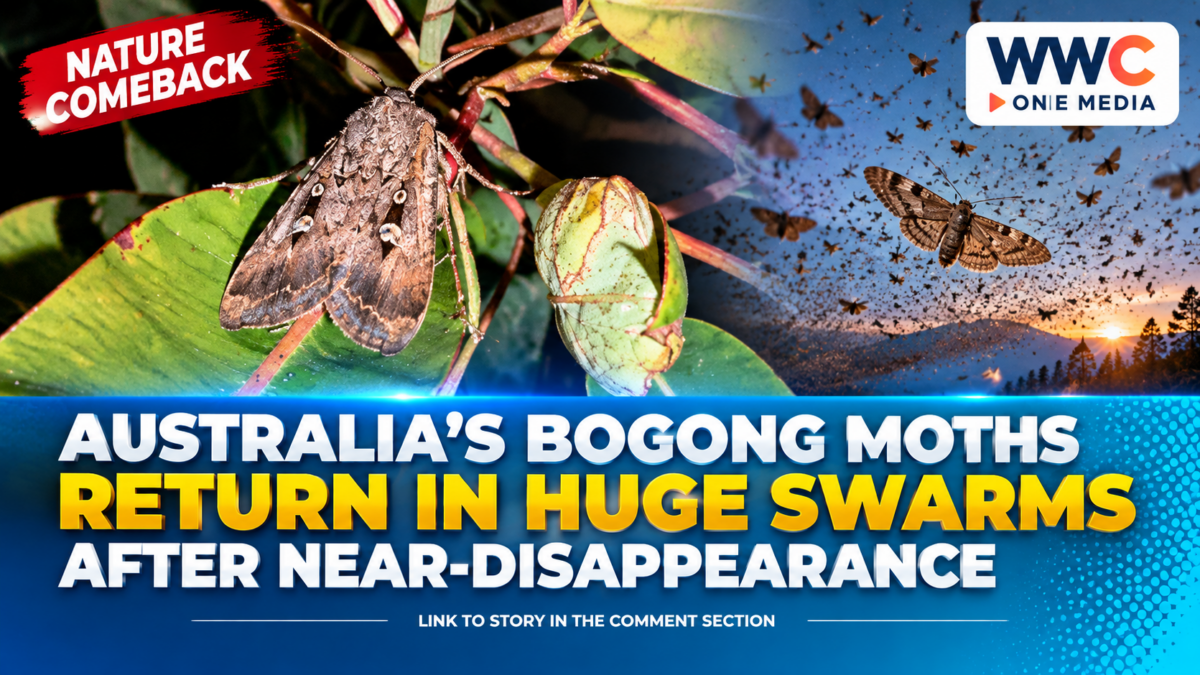
Australia’s skies are filling with Bogong moths again — and what looks like a massive insect invasion may actually be a rare sign of recovery for an endangered species.
Large numbers of Bogong moths have recently been spotted across New South Wales, the Australian Capital Territory and parts of Victoria, as the insects begin their annual migration toward the cooler Australian Alps.
For some residents, the resurgence has been impossible to miss, with moths gathering around homes, windows and outdoor lights. Scientists, however, are watching the phenomenon with very different interest: the numbers are far greater than in recent years.
Bogong moth populations suffered a dramatic collapse, falling by as much as 99.5 percent in 2017 amid drought and climate-related pressures. The species was subsequently listed as endangered in 2021.
Now, researchers say the return of large swarms could indicate that conditions have improved enough to support a stronger population.
One possible factor is increased rainfall, which may have provided better conditions for moth larvae. Warmer weather and favorable winds may also have helped the insects during their migration toward the Alps. Scientists are still studying exactly why this year’s numbers have increased.
The Bogong moth’s journey is remarkable. The insects can travel hundreds — and potentially up to around 1,000 kilometers — toward Australia’s alpine regions, where they shelter from summer heat in cool caves. Researchers have also found that Bogong moths can use celestial cues for long-distance navigation.
Their return matters far beyond the spectacle. Bogong moths are an important source of food for native wildlife, including the critically endangered mountain pygmy-possum, while their migration also transfers nutrients into alpine ecosystems. The species also has cultural significance for First Nations communities.
Researchers are encouraging the public to document sightings through citizen-science projects, helping scientists track where the moths are appearing and better understand their recovery.
The sudden swarms may be surprising to people who have not seen them in years — but for scientists monitoring the species, the return of the Bogong moth could be one of Australia’s most unexpected conservation stories of 2026.
And if the swarms really do signal a population rebound, the skies over Australia’s southeast may only be showing the beginning of the comeback.
WWC ONE MEDIA G,A