NAGOYA, Japan — The Aichi-Nagoya Asian Games are facing growing criticism over accommodation, transportation and logistical problems just as the multi-sport event prepares for its official opening on September 19.
Athletes and team officials from several countries have reported long waits, room-allocation problems, cramped accommodation and transport disruptions, prompting concerns about whether competitors can properly rest and prepare for competition.
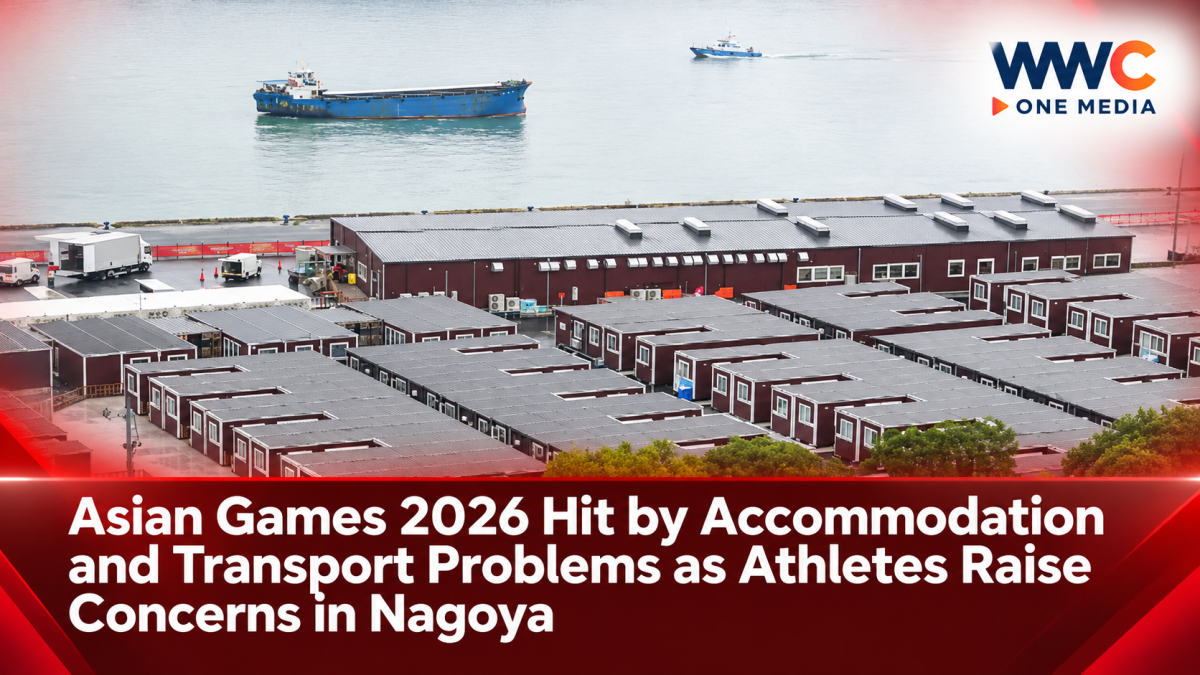
The issues have emerged across several accommodation sites, including hotels, temporary wooden container-style facilities and the Costa Serena cruise ship, which is being used to house thousands of participants.
Athletes Report Long Delays and Accommodation Problems
South Korea’s delegation was among those reporting serious logistical difficulties.
According to Korean broadcaster SBS, members of the South Korean team arriving at Chubu Centrair International Airport on September 17 faced waits of three hours or more because of delayed shuttle-bus arrangements. Some athletes reportedly waited more than five hours before reaching their accommodation.
A table-tennis delegation official said athletes waited several hours at both the airport and welcome center before reaching the cruise ship after 7 p.m.
Some members of South Korea’s rowing team reportedly paid for taxis themselves after becoming exhausted by the delays.
The concern is particularly significant for athletes competing at a high level, because lengthy travel and waiting times can interfere with preparation, recovery and competition schedules.
Short Beds Become an Unexpected Problem
Accommodation conditions have also attracted attention.
Several delegations have raised concerns about bed sizes, particularly for taller athletes.
The Independent reported that Jung Jae-yong, vice-president of the Korea Basketball Association, criticized the accommodation arrangements and said athletes taller than two meters could struggle to fully stretch out on beds.
South Korean media also reported complaints about 195-centimeter bed bases, cramped shower areas and leaking washbasins at some accommodation facilities.
These concerns have added to wider complaints about the temporary accommodation model being used for the Games.
Why Japan Did Not Build a Traditional Athletes’ Village
Unlike several recent major multi-sport events, Aichi-Nagoya does not have a newly constructed central athletes’ village.
Instead, organizers are using a combination of existing hotels, temporary wooden structures and the Costa Serena cruise ship.
The Olympic Council of Asia says the decision was intended to avoid creating expensive infrastructure that could become underused after the Games.
OCA Director General Husain Al-Musallam defended the approach on September 18, saying organizers needed to consider what would happen to a purpose-built village after the event ended.
OCA Coordination Commission chairman Tayyab Ikram similarly said an athletes’ village is not a mandatory component of the Asian Games.
The organizers say all more than 17,000 registered athletes and officials have been provided with Games-appropriate accommodation.
Participant Numbers Added to the Pressure
One explanation offered by organizers is that the number of participants grew beyond the original planning assumptions.
CNA reported that organizers initially expected approximately 15,000 athletes and officials, but the OCA later put the figure at around 17,000, including roughly 11,000 athletes and 6,000 officials.
Additional sports, including teqball and padel, were added to the program after the original planning stage.
That increase put further pressure on accommodation and transportation arrangements.
Organizers had previously warned that late additions would have to make their own arrangements because of limited space and budget constraints.
India Also Reports Logistical Difficulties
The problems have not been limited to South Korea.
Indian athletes and officials have reported difficulties involving room assignments, food options, transportation and accreditation.
The Indian Express reported that some athletes faced lengthy journeys to training and competition venues, with shooting venues located roughly 50 to 60 kilometers from some accommodation sites.
Transportation shortages and delayed buses were also reported.
The Times of India separately reported an accommodation mix-up involving Indian gymnast Pranati Nayak and her coach, who were initially assigned the same cruise-ship room before the issue was resolved with assistance from the Indian Olympic Association.
These individual cases should not be interpreted as evidence that every delegation experienced the same problems, but they add to the wider picture of logistical pressure surrounding the Games.
Heavy Rain Made the Situation More Difficult
The Games have also had to deal with severe weather before the opening ceremony.
Nagoya experienced exceptionally heavy rainfall on September 8, with about 104 millimeters falling in one hour.
The resulting flooding disrupted roads and public transportation, while hundreds of athletes staying in temporary accommodation near Nagoya Port were briefly evacuated.
Rainwater was also reported inside some competition venues.
The evacuation was temporary, and organizers said the weather did not threaten the Games’ opening.
Nevertheless, the episode exposed another vulnerability of the temporary accommodation arrangements.
South Korea Raises a Separate Historical Protocol Complaint
The Games have also encountered a diplomatic issue involving South Korea.
South Korean officials objected to the appearance of a historical figure associated with Japan’s invasions of Korea at a welcome-related ceremony.
SBS reported that the Korean Sport & Olympic Committee expressed regret to the OCA and organizing committee and requested measures to prevent similar incidents. Organizers said there was no intention to convey a historical political message through the appearance.
That dispute is separate from the accommodation and transportation complaints but has added another layer of controversy ahead of the opening ceremony.
Organizers Defend Their Approach
Despite the criticism, the OCA says the accommodation system has fulfilled its basic objective of providing housing for participants.
Al-Musallam argued that building a permanent athletes’ village could leave the host city with an expensive facility that has limited use after the Games.
The OCA said the priority remains providing athletes with comfortable rooms, healthy meals and a safe environment, while maintaining flexibility because of the scale and changing requirements of the event.
Japan’s approach is also being contrasted with future Asian Games.
The next two editions — Doha 2030 and Riyadh 2034 — are expected to have traditional athletes’ villages, according to Reuters’ reporting on the OCA’s position.
The Bigger Test Begins With Competition
The Aichi-Nagoya Asian Games officially open on September 19 and run through October 4, with more than 11,000 athletes expected to compete across 43 sports representing 45 countries and regions.
For organizers, the immediate challenge is now to keep transportation, accommodation, accreditation and competition operations running smoothly once the Games reach full scale.
For athletes, the priority is much simpler: arriving at venues on time, getting adequate rest and being able to focus on competition.
The controversy surrounding Aichi-Nagoya therefore goes beyond uncomfortable beds or delayed buses. It has become a test of whether a major international sporting event can use a more flexible, lower-cost accommodation model without allowing logistical problems to interfere with the athletes themselves.