
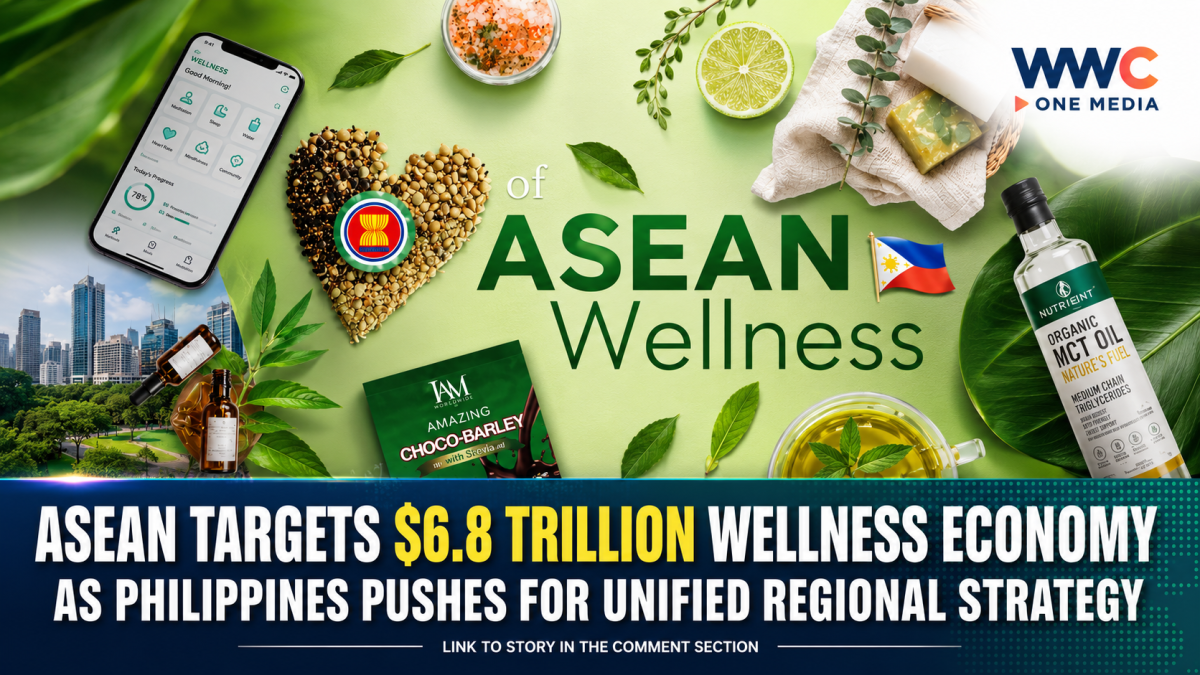
MANILA, Philippines — Southeast Asia is being urged to stop treating wellness and health tourism as separate national industries and instead build a unified regional identity capable of competing for a share of the world’s rapidly expanding $6.8 trillion wellness economy.
The call came Friday as the Philippines hosted the ASEAN Health Tourism & Wellness Economy Summit in Pasay City, where business and government leaders argued that closer regional cooperation could unlock a much larger economic opportunity for Southeast Asia.
Philippine Chamber of Commerce and Industry (PCCI) President Ferdinand “Perry” Ferrer said ASEAN’s 11 countries should work toward creating a recognizable “wellness identity” for the region rather than competing individually for the same tourists and investors.
His argument comes as global spending on wellness reaches unprecedented levels.
From spas to a much bigger economic industry
The wellness economy is no longer limited to spas, supplements or traditional health retreats.
According to the Global Wellness Institute (GWI), the global wellness economy reached $6.8 trillion in 2024, following 7.9% growth from 2023. The organization projects the market could reach approximately $9.8 trillion by 2029 if its current growth trajectory continues.
The industry covers a broad range of activities, including wellness tourism, physical activity, mental wellness, wellness real estate, personal care, healthy eating and nutrition, traditional and complementary medicine, and other related sectors.
That rapid expansion is creating an opportunity for Southeast Asia, a region already known for tourism, hospitality, traditional healing practices and increasingly sophisticated healthcare services.
Ferrer said ASEAN could benefit by making it easier for businesses to operate across borders while sharing standards, data and best practices.
He described the future of wellness as one in which healthcare intersects with hospitality, nutrition intersects with technology, and mental well-being intersects with public policy.
The objective, he said, is to create an ASEAN wellness ecosystem large enough to generate economic opportunities across the region.
Philippines already has a major wellness market
The Philippines is positioning itself as an important player in that regional push.
DSWD Secretary Rex Gatchalian, who also serves as chair of the ASEAN Socio-Cultural Community, said the Philippine health and wellness sector generated $5.5 billion in 2024, with medical tourism contributing about $1.2 billion, according to figures cited at the summit.
However, newer data from the Global Wellness Institute provides an even broader picture.
GWI reported in March 2026 that the Philippine wellness economy reached $47.3 billion in 2024, up 31% from $36 billion in 2019. In local-currency terms, the increase was even larger, at 45%, because of movements in the peso-dollar exchange rate.
GWI estimated that wellness accounted for 10.2% of Philippine GDP in 2024, putting the country among the global leaders in terms of wellness’s contribution to national economic output.
The difference between the $5.5-billion health-and-wellness figure cited at the summit and GWI’s $47.3-billion wellness-economy figure reflects the fact that the two figures cover different definitions and scopes. The broader GWI measurement encompasses the many sectors that make up the wellness economy rather than healthcare and medical tourism alone.
Why ASEAN cooperation could matter
Ferrer argued that ASEAN countries could gain more by complementing each other’s strengths than by competing independently.
The proposed approach could include greater cooperation on:
- Wellness and healthcare standards
- Cross-border investment
- Tourism and medical travel
- Data sharing
- Best-practice exchanges
- Digital health and wellness technology
- Nutrition and preventive health
- Mental wellness
- Training and development
- Regional marketing
Such coordination could make ASEAN easier to recognize internationally as a single wellness destination while allowing individual countries to maintain their own specialties.
For example, Southeast Asia already offers a diverse mix of medical services, resort-based wellness, traditional therapies, fitness, nutrition, preventive health programs and nature-based tourism.
The challenge is turning those separate strengths into a coherent regional value proposition.
A market approaching $10 trillion
The scale of the opportunity is what makes the ASEAN push particularly significant.
GWI’s latest research shows the global wellness economy has more than doubled since 2013 and is growing faster than the overall global economy. It grew an average of 6.5% annually between 2013 and 2024, compared with 3.2% annual global GDP growth over the same period.
GWI expects the wellness economy to expand another 7.6% annually from 2024 through 2029, potentially reaching nearly $9.8 trillion.
Two of the fastest-growing areas are particularly relevant to ASEAN’s future strategy: wellness real estate and mental wellness. GWI said those sectors grew at average annual rates of 19.5% and 12.4%, respectively, from 2019 to 2024.
That suggests the next phase of wellness tourism may involve much more than traditional vacation packages.
Consumers are increasingly spending on environments, services and technologies designed around longer-term health, prevention and quality of life.
Philippines takes ASEAN chairmanship role
The Philippines, which holds the 2026 ASEAN chairmanship, is also presenting health as part of a wider regional development agenda.
Foreign Affairs Undersecretary Leo Herrera-Lim said the Philippines wants to advance a regional health agenda that is resilient, sustainable, equitable and people-centered.
The summit builds on the ASEAN Health & Wellness Tourism Policy Framework and Roadmap established following the Bangkok Conference, giving the latest discussions a policy foundation rather than treating wellness solely as a private-sector opportunity.
The broader question now is whether ASEAN can translate those commitments into practical regional cooperation.
The opportunity — and the test ahead
The numbers make the opportunity difficult to ignore.
A global wellness economy worth $6.8 trillion today and potentially $9.8 trillion by 2029 represents one of the world’s most significant consumer-driven economic sectors.
ASEAN already possesses many of the ingredients needed to compete: major tourism destinations, expanding healthcare industries, diverse cultural traditions, wellness resorts, growing middle-class consumer markets and a large regional population.
But having those assets individually does not automatically create a globally competitive ASEAN wellness industry.
The real test will be whether the region can harmonize standards, improve cross-border cooperation, attract investment and market itself internationally as more than a collection of individual destinations.
For the Philippines, the stakes are particularly high.
With wellness already representing a significant part of its economy, the country’s 2026 ASEAN chairmanship gives Manila an opportunity to push wellness from a tourism niche into a broader regional economic strategy.
The question now is whether Southeast Asia can move from competing for pieces of the global wellness market to building an ASEAN brand powerful enough to capture a much larger share of it.



Leave a Reply